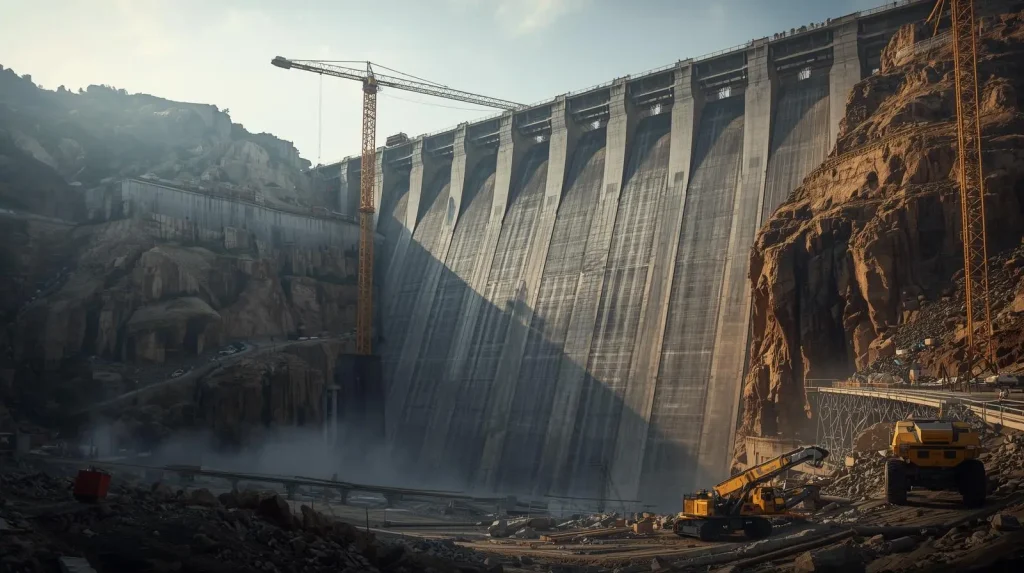
Buttresses are rarely the most visible part of a structure, but they are often the reason it stands at all. From retaining walls and dams to historic masonry buildings, buttresses exist to solve one fundamental problem in civil engineering: resisting lateral (sideways) forces safely.
This guide explains the meaning of buttress in civil engineering, how buttresses work structurally, where they are used in modern Indian construction, and why omitting them is one of the most expensive site mistakes.
What Is a Buttress?
A buttress is a structural support built against or connected to a wall to resist lateral forces such as soil pressure, water pressure, or roof thrust, preventing bending, cracking, or collapse.
In civil engineering, a buttress is a projecting structural member constructed to strengthen a wall by transferring horizontal forces into the ground.
These forces may come from:
- Earth pressure (retaining walls)
- Water pressure (tanks, dams)
- Wind loads (tall walls)
- Roof or vault thrust (arches, domes)
A buttress works by increasing stiffness and providing a direct load path from the wall to the foundation.
How Does a Buttress Work Structurally?
Structurally, a buttress functions as a compression strut tied into the main wall.
Load path in simple terms:
- Lateral force acts on the wall
- Wall transfers force to the buttress
- Buttress carries force vertically downward
- Foundation spreads load safely into soil
By doing this, buttresses:
- Reduce bending moments in the wall
- Limit cracking and deflection
- Allow thinner, more efficient wall sections
- Walls are strong in compression but weak in bending. Buttresses reduce bending demand.
Why Walls Fail Without Buttresses
On Indian sites, failures often follow a familiar pattern. At times, projects where 4–5 metre retaining walls, begIn tilting within two monsoons.
Cause → Effect → Regre shows up ast:
- Buttresses removed to “save concrete”
- Wall thickness increases instead
- Bending stresses remain
- Diagonal cracks form
- Cracks plastered over
- Water enters, steel corrodes
- Wall leans further
- Final outcome: demolition and rebuild
The failure does not happen in year one. It appears when repair requires breaking the finished work.
The Lateral Load Rule™
If a wall resists soil, water, or roof thrust, it must be supported by buttresses, counterforts, or a structural frame.
Thickness alone is not a substitute.
Main Types of Buttresses
- Plain (Pilaster-Type) Buttress
- Vertical projection from wall
- Common in masonry structures
- Works mainly in compression
- Stepped Buttress
- Used for taller walls
- Wider base improves stability
- Counterfort (Related Concept)
- Placed on backfill side of retaining wall
- Acts in tension, tying wall to base slab
- Flying Buttress
- External arched support transferring roof thrust
- Mostly historical but important conceptually
- Architectural Buttress
- Integrated into stair cores or service blocks
- Provides both structure and form
Buttress vs Counterfort
| Aspect | Buttress | Counterfort |
| Location | Outside / exposed face | Backfill side |
| Primary action | Compression | Tension |
| Typical use | Masonry walls, dams | RCC retaining walls |
Verdict: Function is similar; placement depends on space and construction method.
What Is a Buttress Dam?
A buttress dam uses a thin upstream concrete slab supported by a series of triangular or rectangular buttresses on the downstream side.
How It Works
- Water pressure acts on upstream slab
- Load transfers to buttresses
- Buttresses carry load to foundation
Advantages
- Uses less concrete than gravity dams
- Lower foundation loads
Considerations
- Complex formwork and detailing
- High execution precision required
Verdict: Efficient, but sensitive to construction quality.
What Is Buttress Thread? (Construction Hardware)
A buttress thread is a screw thread form where:
- One flank is nearly vertical (load-bearing)
- Other flank is sloped
Used in:
- Heavy-duty jacks
- Formwork props
- Lifting and pressing equipment
The name comes from the same principle: resisting high force efficiently in one direction.
Where Buttresses Are Used in Modern Indian Construction
- Retaining walls along highways and basements
- Water tanks, reservoirs, treatment plants
- Bridge abutments and wing walls
- Industrial silos and bins
- Tall boundary walls on slopes
Even when not visible, the buttress concept is widely used in RCC form.
Practical Design Considerations
Key factors engineers must address:
- Buttress spacing and geometry
- Reinforcement continuity at junctions
- Foundation capacity below buttress
- Crack control at stress concentrations
Things To Keep In Mind
- For retaining walls, lateral support matters more than thickness.
- Walls fail in bending before they fail in compression.
- Missing buttresses cause more failures than poor concrete.
Common Mistakes to Avoid:
- Increasing wall thickness instead of adding lateral support
- Not adding buttress or counterfort even if concrete quantity increases
- Not adding buttress when wall height exceeds safe limits,
Rebuilding costs far more than building once correctly.
Structural Priority Table
| Element | Can Be Fixed Later | Must Be Right First Time |
| Plaster | Yes | No |
| Paint | Yes | No |
| Concrete quality | No | Yes |
| Buttress detailing | No | Yes |
| Foundation below buttress | No | Yes |
Buttresses are not optional accessories. They are structural necessities wherever lateral loads exist.
Frequently Asked Questions (FAQ)
What is a buttress in civil engineering?
A structural support that resists lateral forces acting on walls.
Where are buttresses used?
Retaining walls, dams, bridges, masonry buildings, and tall boundary walls.
What is a flying buttress?
An external arched support transferring roof thrust to ground.
Is buttress required in RCC walls?
Yes, when lateral loads are significant.
Can wall thickness replace buttress?
No. Thickness alone cannot control bending effectively.
What happens if buttress is omitted?
Cracking, tilting, and possible collapse.
Who decides buttress spacing?
The structural engineer.
Are buttresses still used today?
Yes — often in RCC form rather than visible masonry.
Is buttress dam still relevant?
Yes, where foundation or material efficiency matters.
Are buttresses expensive?
Cheaper than repairing or rebuilding failed walls.