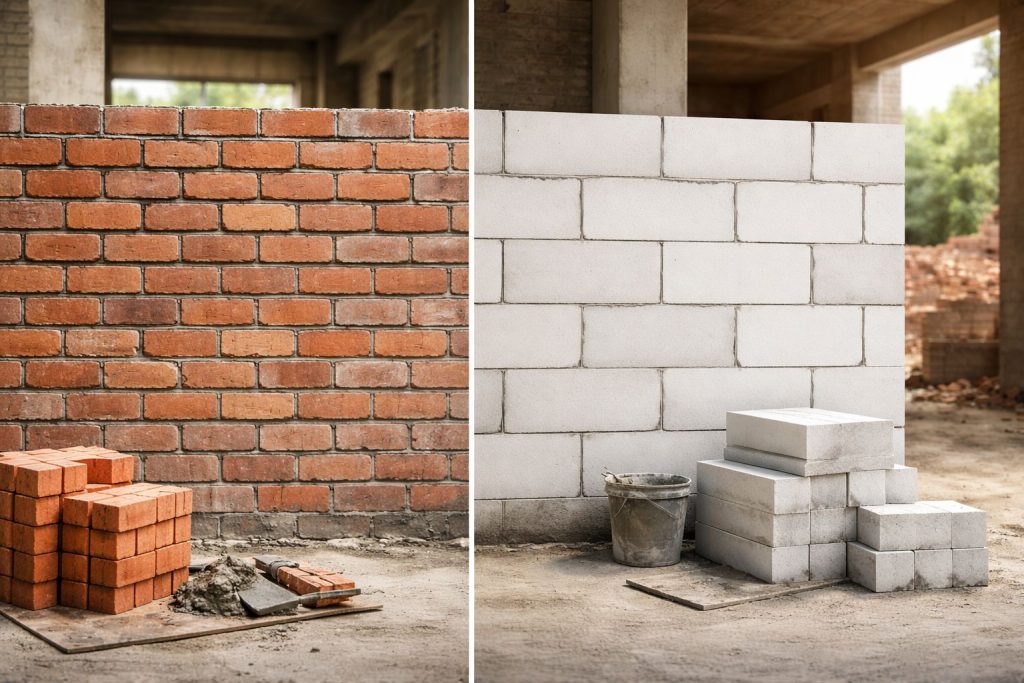
Walk into any site in India, and you’ll hear this debate — “AAC blocks vs bricks, kaunsa better hai?” This choice isn’t small. It affects how much you spend, how fast the project moves, how comfortable your home feels, and how strong your walls stay over time.
I’ve personally seen Delhi contractors swear by red clay bricks — “pakka hai, tested hai.” In contrast, on a Pune high-rise, AAC blocks shaved three weeks off the timeline and reduced AC bills. The truth is: both materials work, but each shines in different contexts. Let’s go deeper.
What Are AAC Blocks?
AAC (Autoclaved Aerated Concrete) blocks are lightweight, precast units made with cement, lime, fly ash, gypsum, and aerating agents. They’re cured in high-pressure autoclaves, which gives them their unique porous structure.
Key points:
- 3–4 times lighter than clay bricks.
- Uniform, larger size — faster wall construction.
- Thermal insulation keeps interiors cooler.
- Made with fly ash = eco-friendlier.
Think of AAC as the “engineered, modern alternative.”
What Are Clay Bricks?
Clay bricks are the tried-and-tested material of Indian construction. Made by molding clay and firing in kilns, they’ve stood strong for centuries.
Key points:
- Compressive strength of 3.5–7.5 N/mm².
- Familiar for masons across India.
- Widely available, especially in small towns.
- Labor doesn’t need special training.
Bricks represent the “trust factor.”
AAC Blocks vs Bricks: Technical Breakdown
Here’s a quick comparison for easier reading:
| Feature | Clay Bricks | AAC Blocks |
| Strength | 3.5–7.5 N/mm² | 2.5–4 N/mm² |
| Weight | Heavy, adds load | 60–70% lighter |
| Thermal Insulation | Poor, heats up | Excellent, 2–3°C cooler |
| Sound Insulation | Moderate | High |
| Construction Speed | Slow | 30–40% faster |
| Cost (per unit) | Cheaper per brick | Higher per block |
| Mortar Usage | High | 60% less |
| Eco Impact | Uses fertile soil | Uses fly ash (waste) |
| Best For | Traditional low-rise | High-rise, urban projects |
Site Reflection
As one Nagpur contractor put it:
“Brick ka kaam mazdoor khud kar leta hai. AAC block ke liye training chahiye. Lekin ek baar aadat pad gayi toh kaam tez hota hai.”
When to Choose Bricks
- For small-town projects with easy brick access.
- When local masons are untrained in AAC work.
- For traditional low-rise houses.
When to Choose AAC Blocks
- For high-rise and commercial projects.
- In metro cities where speed matters.
- For energy-efficient homes.
FAQs on AAC Blocks vs Bricks (Voice Search Friendly)
1. Can I use AAC blocks for building a 2 or 3-storey house in India?
Yes, but usually within an RCC frame. For purely load-bearing walls, bricks are safer.
2. Which is cheaper overall: AAC blocks or bricks?
Bricks cost less upfront, but AAC blocks cut expenses in plaster, mortar, and electricity.
3. Do AAC block houses crack more than brick houses?
Cracks depend on workmanship. AAC needs proper curing and thin joint mortar. Bricks need quality control.
4. What material keeps homes cooler in Indian summers?
AAC blocks, thanks to their insulation, reduce indoor heat and AC bills.
5. Can AAC blocks be used in bathrooms or kitchens?
Yes, but apply waterproof plaster or tiles. Bricks naturally resist water better.
6. How long do AAC blocks last compared to bricks?
Bricks have centuries of proof. AAC blocks are newer but tested to last 50–70 years with proper care.
7. Do AAC blocks need special cement or plaster?
Yes, polymer-based plaster or thin joint mortar is ideal. Bricks can use regular mortar.
8. Are AAC blocks earthquake resistant?
Yes, being lighter, they reduce seismic load, making RCC structures safer.
9. Can I fix shelves and heavy items on AAC block walls?
Yes, but use special fasteners. Bricks are easier for nails and hooks.
10. Which is more common in Indian cities right now?
AAC blocks dominate in metros for apartments and offices. Bricks remain popular in semi-urban and rural areas.