A cement sheet is not a new material. It has been around on Indian construction sites for decades. What has changed is how it’s made, where it’s used, and how reliable it has become.
At its simplest, a cement sheet is a factory-made board created to cover, separate, or protect spaces. You’ll see it on shed roofs, boundary walls, site cabins, staircases, and utility areas. It doesn’t demand attention. It just works. That’s why it’s still widely used, even when newer materials keep entering the market.
Most people first look at cement sheet price. That’s fair. It’s usually chosen when budgets are tight and timelines are tighter. But price alone is not why cement sheets survive year after year. They survive because they don’t fail easily.
When used properly, whether on a roof or as a cement sheet for a wall, they hold up in heat, rain, dust, and daily wear.
What a Cement Sheet Is Actually Made Of
Earlier generations of cement sheets were basic.
Modern ones are better engineered.
Today, most good-quality sheets are fiber cement sheets. Cement is still the main ingredient, but it’s reinforced with fibers—usually cellulose or synthetic materials. These fibers are what stop the sheet from cracking or snapping under stress.
A fiber cement sheet behaves differently from plain cement. It bends slightly before it breaks. It holds screws better. It stays stable when temperatures swing.
This is important in India, where surfaces heat up during the day and cool rapidly at night. That movement is where weaker materials fail. Cement sheets, especially fiber cement ones, handle this movement quietly.
That’s one reason they’re used so often as a cement sheet for walls in semi-open or external areas.
Types of Cement Sheets You’ll Find on Site
There aren’t dozens of types in real use. Just a few, used well.
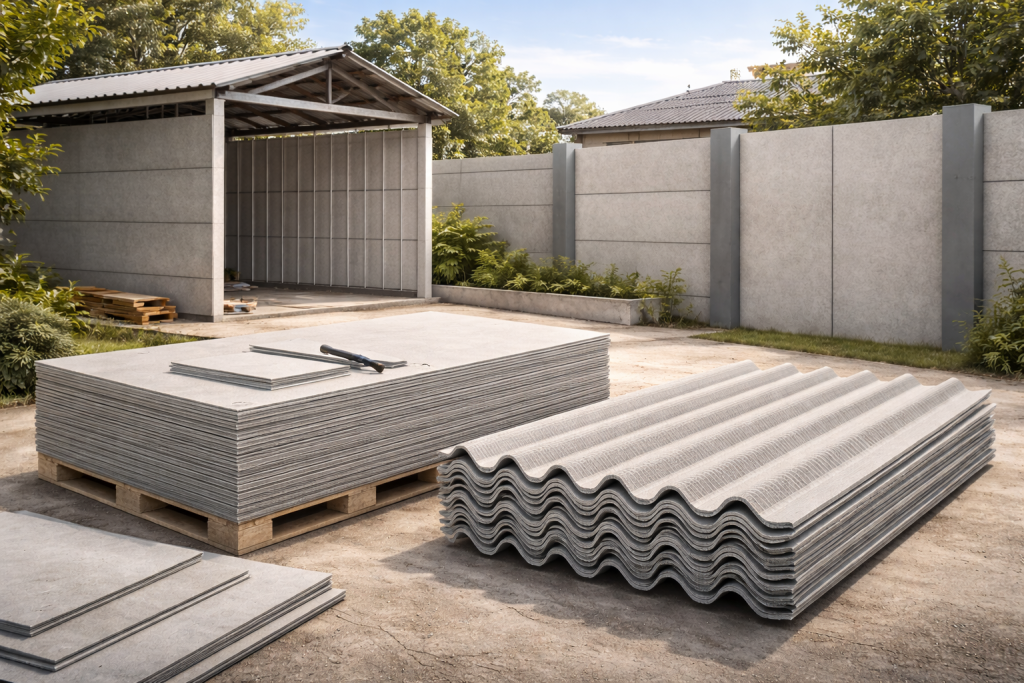
Flat or plain cement sheets are common for walls and partitions. These are the sheets used for site offices, store rooms, staircase sides, and internal dividers. When someone asks for a cement sheet for a wall, this is usually what they mean.
Then there are corrugated sheets. These are the familiar wavy sheets used for roofing. The wave adds strength and helps water drain quickly. Almost all corrugated sheets sold today are fiber cement sheets, because older materials didn’t last as long.
Thickness varies. Thicker sheets cost more, so cement sheet price changes accordingly. Thicker also means heavier, so the support structure matters.
There are also premium fiber cement sheets with smoother finishes or higher load ratings. These are chosen when the structure is permanent and replacement later would be difficult.
Where Cement Sheets Are Actually Used
Cement sheets are chosen for function, not decoration.
For roofing, fiber cement sheets are common on industrial sheds, godowns, parking areas, farm structures, and labour housing. They don’t trap heat like metal. They don’t rust. And they don’t demand frequent replacement.
As walls, cement sheet for wall applications are everywhere. Site cabins, boundary walls with steel frames, utility blocks, stair enclosures, and service areas all rely on them. They’re also used behind wardrobes or in balcony enclosures where moisture is an issue.
In prefabricated construction, cement sheets save time. Fix the frame, bolt the sheet, and the space is usable. That speed is one reason people accept the cement sheet price without much debate.
Understanding Cement Sheet Price Without Guesswork
There is no single cement sheet price.
It changes based on use.
Thickness is the biggest factor. Thicker sheets cost more but last longer. Size matters too. Larger sheets reduce joints but are harder to handle.
Fiber cement sheet pricing is usually higher than older non-reinforced sheets, but the difference shows up later—in fewer cracks, fewer leaks, and fewer complaints.
Another thing people forget is the finishing cost. When a cement sheet for wall is used, plastering can often be avoided. Paint or texture can go directly on the surface. That saves labour and time.
Over the life of the structure, cement sheets usually end up cheaper than they look on day one.
Why Cement Sheets Continue to Be Trusted
Cement sheets don’t rot.
They don’t invite termites.
They don’t soften with moisture.
A fiber cement sheet also resists fire better than many alternatives. That’s why it’s still preferred in factories and storage areas.
Maintenance is minimal. Once installed properly, cement sheets don’t ask for attention. Occasional cleaning is enough.
They also handle rough use. As a cement sheet for wall, they take knocks, scrapes, and daily wear without falling apart.
This reliability is why people stop worrying about cement sheet price once the structure is up and running.
Use in Homes: Practical, Not Decorative
In residential buildings, cement sheets are not used everywhere. They’re used where they make sense.
Utility rooms, terrace enclosures, balconies, store rooms, and external walls are common places. A fiber cement sheet works well here because moisture and heat don’t affect it much.
Boundary walls built using frames and cement sheets go up faster and cost less than brickwork. Again, cement sheet price plays a role, but speed and durability matter just as much.
For main living spaces, people usually choose other finishes. But cement sheets quietly support the rest of the house.
Installation Decides Everything
Even the best cement sheet can fail if installed badly.
Frames must be straight. Fixing points must be correct. Expansion gaps must be allowed. This matters more for roofing but applies equally to cement sheets for wall work.
Water slope on roofs is critical. So is edge sealing. Many failures blamed on material are actually installation errors.
When installed with care, a fiber cement sheet easily lasts decades.
Closing Note
A cement sheet isn’t about fancy design. It’s a choice you make when building something.People go for it when they want stuff that lasts, is easy to figure out, and stays strong for ages where they’re building. Whether it’s for roofs, walls, or dividers, you want it to just work without causing trouble down the road. That’s why it’s important to get it from companies that really know their stuff about Indian construction sites. Companies like JK Cement have spent years working with builders and projects, so they’re all about making sure their stuff is always the same quality, not just trying to trick you with something flashy.
Cement sheets are cheap enough for everyone. They work well, so you can trust them. That mix of not costing much and being really good is why cement sheets, especially from brands you can trust, are still used all over the place in towns, cities, and factories across the country.
FAQs
1. What is a cement sheet mainly used for?
Cement sheets are used for roofing, partitions, boundary walls, and utility structures.
2. What makes a fiber cement sheet different?
A fiber cement sheet contains reinforcing fibers, making it stronger and more crack-resistant.
3. Can cement sheets be used as walls?
Yes. Cement sheet for wall applications are common in partitions, service areas, and external enclosures.
4. Why does cement sheet price vary?
Thickness, size, and whether it is a fiber cement sheet affect pricing.
5. Are cement sheets suitable for Indian weather?
Yes. They handle heat, rain, and humidity well when installed properly.
6. How long does a fiber cement sheet last?
With correct installation, 25–30 years or more.
7. Do cement sheets need regular maintenance?
No. Maintenance is minimal compared to many other materials.