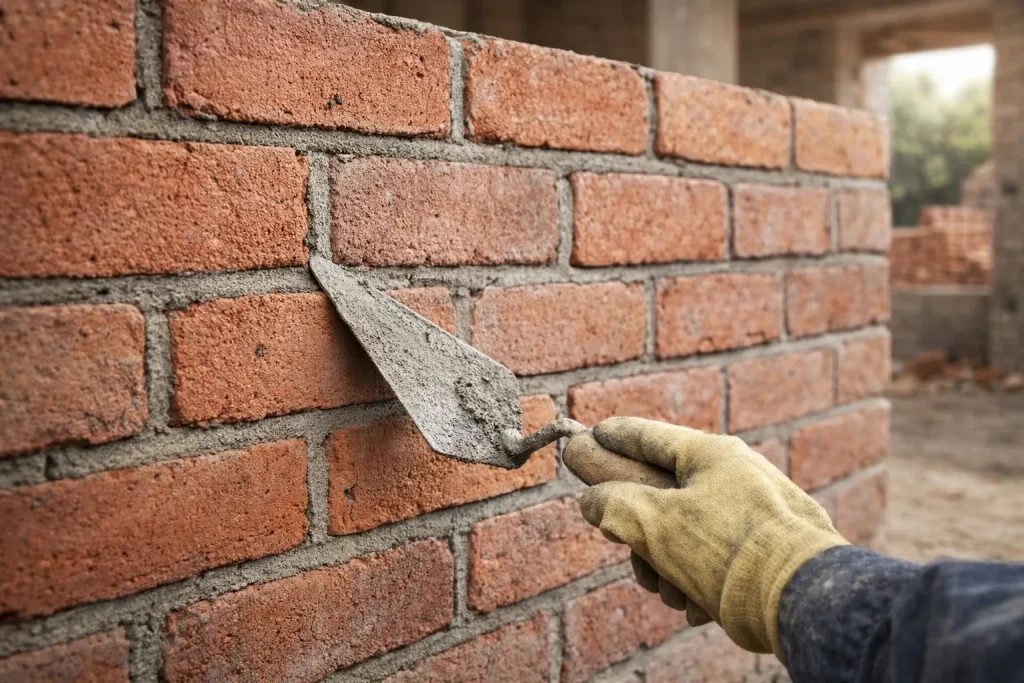
If you’ve ever walked past an under-construction house early in the morning, you’ve seen it.
Stacks of red brick, still rough, edges chipped, dust everywhere.
Before painting. Before plaster. Before dreams get polished.
There’s something honest about a red brick.
No coating. No hiding.
Just clay, fire, and time.
In India, the brick red colour is almost emotional.
It reminds people of school buildings, old railway quarters, village homes, boundary walls, temples.
It’s familiar in a way concrete never is.
And yet, people still ask simple questions on site.
Why this brick?
Is the size standard?
Will a red brick wall last longer?
Why does one batch look darker than the other?
Let’s break it down. Slowly. Clearly. Like we would over cutting chai.
What exactly is a red brick?
A red brick is basically baked clay.
Clay is dug out locally, moulded, dried, then fired in a kiln.
That firing is where the magic happens.
Iron content in the clay reacts with oxygen at high temperatures.
That’s what gives you the classic brick red colour.
If the kiln runs hotter → darker, almost brownish brick red.
If it runs cooler → lighter, more orange-toned brick red.
That’s why on one truckload, you’ll see slight shade variations.
That’s normal.
And honestly, that’s what gives a raw red brick wall its character.
Perfectly uniform bricks usually mean heavy processing—or worse, weak firing.
Red brick size – what’s standard and what’s not
On paper, the standard red brick size in India is:
190 mm × 90 mm × 90 mm (L × W × H)
Add mortar joints (around 10 mm), and it becomes 200 × 100 × 100 mm in masonry calculations.
But here’s the reality.
Not every brick kiln is a textbook.
You’ll often find small variations in red brick size depending on:
- Region
- Type of clay
- Kiln quality
- Whether bricks are hand-moulded or machine-made
That’s why experienced masons always “dry stack” a few bricks before starting a red brick wall.
It helps adjust mortar thickness and alignment early.
Ignoring this is how walls go out of plumb by the third course.
Why the brick red colour still works today
Some people think brick red is old-fashioned.
That it belongs only to exposed village houses or industrial-style cafés.
That’s not true.
Brick red works because it’s neutral in a very Indian way.
It handles dust well.
It ages gracefully.
It doesn’t scream for attention.
In homes, brick red colour pairs beautifully with:
- White or off-white plaster
- Grey cement finishes
- Wooden doors
- Black metal railings
That’s why architects still keep one exposed red brick wall in modern houses.
Not for cost savings.
For warmth.
Paint can peel.
Tiles can crack.
A good brick red surface just… settles in.
Structural strength of a red brick wall
Let’s clear up a big myth.
A red brick wall is not weak by default.
Its strength depends on:
- Brick quality
- Proper curing
- Correct mortar mix
A well-fired red brick with good compressive strength, combined with the right cement-sand ratio, can easily last decades.
That’s why load-bearing structures in older towns still stand strong today.
No RCC frames.
Just brick red masonry done right.
Of course, modern multi-storey buildings rely on RCC.
But for partition walls, boundary walls, single-storey homes—red brick walls are still reliable.
Especially when paired with good-quality cement and curing discipline.
Where red brick is commonly used today
You’ll still see red brick everywhere, just used smarter.
Common applications include:
- External walls (plastered or exposed)
- Internal partition walls
- Boundary and compound walls
- Staircase enclosures
- Parapet walls
- Landscaping elements
Exposed red brick walls are also popular in:
- Farmhouses
- Cafés
- Schools
- Resorts
- Studio apartments
They reduce plaster cost and add a natural finish.
But remember—exposed brick needs proper weather protection.
Otherwise, the monsoon will slowly eat into that beautiful brick red colour.
Brick red vs other masonry options
People often ask whether brick red is outdated compared to blocks.
Here’s a simple comparison from site experience:
Red brick:
- Better thermal comfort
- Easier local availability
- Familiar workmanship
- More forgiving during execution
Concrete blocks:
- Faster construction
- More uniform size
- Better for high-rise infill
For individual houses, a red brick wall still feels more “alive”.
Blocks feel efficient.
Bricks feel human.
That’s why even today, homeowners specifically ask for brick red instead of grey blocks.
Things contractors quietly check before buying red bricks
Good contractors don’t just look at price.
They check:
- Uniformity of red brick size
- Sharp edges (not crumbly)
- Sound test (two bricks struck together should ring, not thud)
- Water absorption (shouldn’t soak like a sponge) max 20 % by wt
- Colour consistency within reason
Over-burnt bricks look too dark, almost blackish brick red.
Under-burnt ones are pale and weak.
The sweet spot is a solid, earthy brick red colour—not flashy, not dull.
A small site truth about red brick walls
Here’s something no brochure tells you. A red brick wall teaches patience.
You can’t rush brickwork.
If you do, alignment suffers.
Curing gets skipped.
Cracks show up later.
That’s why seasoned masons respect brickwork more than plaster or paint. Brick remembers mistakes. But when done right, it also forgives time.
Basically, a red brick wall’s quality comes down to the materials and how well it’s built. The right brick size, good mortar, and correct curing keep that classic red color strong over time. On construction jobs, good cement really matters. Even great bricks need strong cement to stay together. That’s why many engineers and builders trust choices like JK Cement – not because of the name, but because they’re sure the wall will last, handle the weather, and keep its red brick look for years.
FAQs
1. What is the standard red brick size in India?
The commonly accepted red brick size is 190 × 90 × 90 mm. With mortar, it’s taken as 200 × 100 × 100 mm for calculations.
2. Why does brick red colour vary from batch to batch?
Variation in clay composition and kiln temperature affects the brick red colour. Slight differences are normal and acceptable.
3. Is a red brick wall strong enough for houses?
Yes. A properly built red brick wall with good-quality mortar and curing can last for decades.
4. Can red brick be left exposed without plaster?
Yes, but exposed red brick walls need protective coatings to handle rain, dust, and moisture.
5. Which is better: brick red bricks or concrete blocks?
For individual homes, brick red offers better thermal comfort and traditional workmanship. Blocks are faster for large projects.
6. Does red brick absorb too much water?
Good-quality red brick should have controlled water absorption. Extremely porous bricks indicate poor firing.
7. Can brick red colour be painted later?
Yes. A red brick wall can always be plastered or painted later if design preferences change.
To determine if a brick is of “First Class” quality suitable for construction, you should evaluate it based on Field Tests (visual/physical checks you can do on-site) and Technical Standards (Lab criteria).
The standard Indian Code for burnt clay bricks is IS 1077.
1. Quick Field Tests (On-Site Checks)
These are simple checks you can perform instantly to judge quality.
Color & Finish:
Color: It should be a uniform, deep copper, cherry, or red color.
Uniformity: Avoid bricks that are patchy (yellow spots indicate under-burning; dark black/blue spots indicate over-burning).
Edges: Edges should be sharp, straight, and right-angled. They should not be chipped.
The Ringing Test (Soundness):Strike two bricks against each other lightly.
Good Quality: Produces a clear, metallic “clinking” sound.
Poor Quality: Produces a dull “thud” (indicates the brick is cracked or not baked enough).
The Scratch Test (Hardness):Try to scratch the surface of the brick with your fingernail.
Good Quality: No impression or mark is left.
Poor Quality: You can easily scratch the surface (indicates the clay is soft/under-burnt).
The Drop Test (Toughness):Drop a brick flat on the ground from a height of about 1 meter (approx. 3-4 feet).
Good Quality: It should not break.
Structure:Break a brick in half and look at the cross-section. It should be compact, uniform, and free from lumps of lime, pebbles, or air holes.