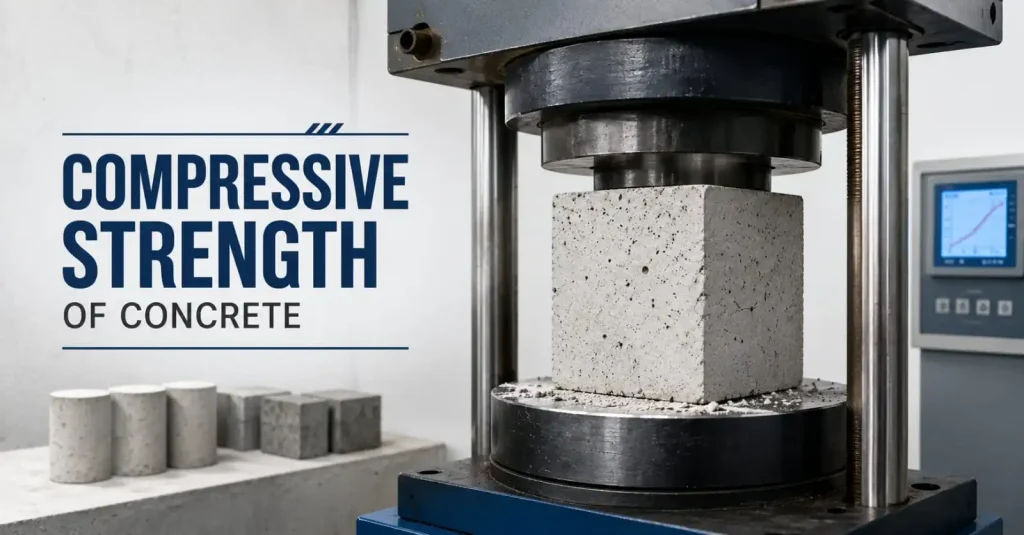
Planning. Quality materials. Skilled workmanship. These are the three factors that make every building stand strong. When it comes to materials, it is important to consider the compressive strength of concrete. It determines the strength of your structure. Higher compressive strength means structures can carry the loads efficiently. This is why engineers test and verify the strength of concrete before using it to create structures.
Read on this blog post to know what the compressive strength of concrete means and how to test it.
What Is Compressive Strength?

Compressive strength refers to the maximum load concrete can hold before it fails under compression. Let’s understand it this way: You squeeze a brick between two heavy machines. Hence, the amount of force it survives before breaking is its compressive strength.
The measuring unit for compressive strength is megapascals (MPa) or N/mm². What is important to note is that both units are numerically equal. For example, M20 concrete has a characteristic compressive strength of 20 MPa. Concrete gains strength over time. This is why these values are determined after 28 days of curing. What’s more? The compressive strength of concrete directly influences the following factors:
- Structural safety
- Load-bearing capacity
- Durability
- Service Life
- Resist cracks
This is why contractors prefer concrete cube testing for a standard quality check on a construction site.
Why Is Compressive Strength of Concrete Important?
A building carries everyday loads. Every floor transfers weight to beams. Thereafter, beams transfer it to columns. What’s next? Columns pass loads to the foundation. Concrete resists enormous compression at every stage. The lower compressive strength of concrete may result in the following problems:
- Structural cracks
- Excessive deflection
- Low durability
- Water seepage
- High maintenance costs
- Structural failure
Indian Standard IS 456:2000 specifies minimum concrete grades that workers use for various purposes. To illustrate, M20 concrete is the minimum grade popular for reinforced concrete construction. The engineers use higher-grade concrete for heavy loads and harsh environmental conditions.
What Is the Formula for Compressive Strength in Concrete?
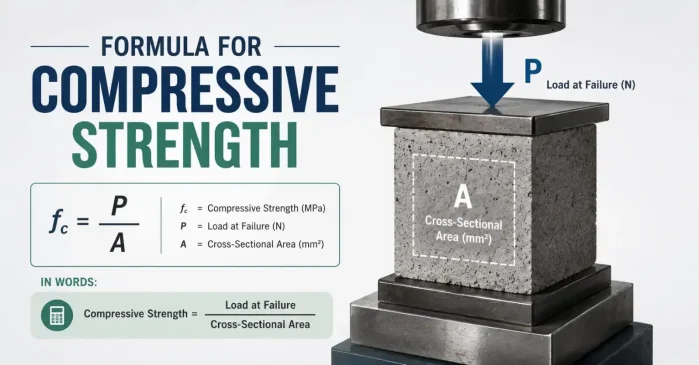
The compressive strength of concrete formula is given below:
Compressive Strength = Maximum Load Applied / Cross-Sectional Area
Let’s understand this with an example:
A concrete tube of 150 mm x 150 mm x 150 mm fails under a load of 675,000 N. So, the calculation will be as follows:
Area = 150 x 150 = 22500 mm²
Compressive strength = 675,000 / 22,500 = 30 N/mm² (30 MPa)
Hence, the concrete meets the needs of M30 grade concrete.
How to Test the Compressive Strength of the Concrete?
The engineer follows a standard process to test the compressive strength of concrete. Given below is the process:
- Prepare Concrete Cubes
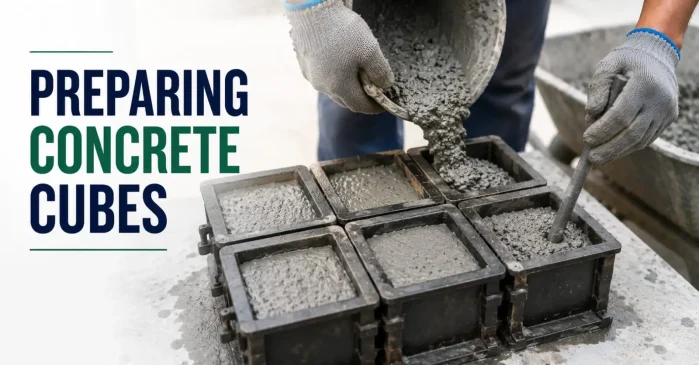
The workers pour fresh concrete into standard cube molds of 150 mm x 150 mm x 150 mm. What’s next? They compact the concrete properly to remove trapped air.
- Cure the Specimens

The cubes removed from the molds are soaked in clean water after 24 hours. The experts usually advise curing the concrete for 28 days for the best results. If not possible, you can also cure it for 7 days or 14 days as per your preference.
- Test Using a Compression Testing Machine
The next stage is to place a cured cube inside a compression testing machine. The load increases until the cube fails. The maximum load is used in the compressive strength of concrete formula to calculate the final strength.
Most construction projects perform routine cube tests, as it helps them identify quality issues at an early stage.
What Are the Tips to Improve Compressive Strength of Concrete?
Given below are the tips to improve the compressive strength of concrete:
- It is advisable to use good-quality materials to create a stronger concrete mix.
- Too much water reduces the compressive strength of concrete. Thus, it is necessary to maintain the correct water-cement ratio.
- Poor mixing of concrete creates weak zones that reduce overall strength. So, keep the concrete consistent.
- Air pockets reduce density and make concrete weak. This is why proper vibration must be done. It not only eliminates voids but also improves strength.
- Cure the concrete for at least 7-14 days for compressive strength.
The Final Words
The true performance of concrete lies in numbers that engineers measure carefully. It has a lot of properties. However, compressive strength is the most important indicator of structural quality. Make sure you hire an expert who knows the compressive strength of the concrete formula. Because proper workmanship is equally important.
FAQs
1. What is the difference between compressive strength and tensile strength of concrete?
Compressive strength is concrete’s ability to withstand crushing loads, while tensile strength measures resistance to pulling forces. Concrete is naturally strong in compression but weak in tension, which is why reinforced concrete uses steel bars to handle tensile stresses.
2. What factors affect the compressive strength of concrete?
The compressive strength of concrete depends on the water-cement ratio, cement quality, aggregate properties, mixing, compaction, curing, and concrete age. Proper construction practices ensure the concrete achieves its intended strength and long-term durability.
3. Which concrete grade is commonly used for residential construction?
M20 and M25 are the most commonly used concrete grades for residential construction in India. M20 is suitable for general reinforced concrete work, while M25 is preferred for structures requiring greater strength, durability, and improved load-bearing capacity.
4. Can concrete continue gaining strength after 28 days?
Yes. Concrete continues gaining strength beyond 28 days if it is properly cured. Although 28-day compressive strength is the standard for quality assessment, hydration continues, allowing concrete to become stronger over time.
5. Why is maintaining the correct water-cement ratio important?
The water-cement ratio directly affects concrete strength and durability. Too much water increases porosity, reducing compressive strength and making concrete more vulnerable to cracks, shrinkage, and moisture penetration.
6. Is higher compressive strength always better?
The higher compressive strength is not always good. The required compressive strength depends on the structure’s design and application. Using higher-strength concrete than necessary can increase construction costs without delivering meaningful structural or economic benefits.