Let’s be honest: The first thing that comes to mind is cement and red bricks when we hear construction. Isn’t it? But do you know that modern construction no longer prefers traditional red brick? This is because hollow blocks are becoming more popular nowadays. These blocks are larger than ordinary bricks. Moreover, some cavities run through these blocks. Read on this blog post to understand hollow blocks in detail.
Quick Answer
Hollow blocks are the best alternative to solid bricks in the following scenarios:
- The wall height is lower.
- If you want to complete masonry work quickly.
- In case you want to follow uniform construction practices.
The engineers often recommend using a hollow block of 400 x 200 x 100 mm. However, the right size depends on wall thickness and design. The best part? Hollow blocks cover more wall area per unit. The builders can save more on mortar and labor costs.
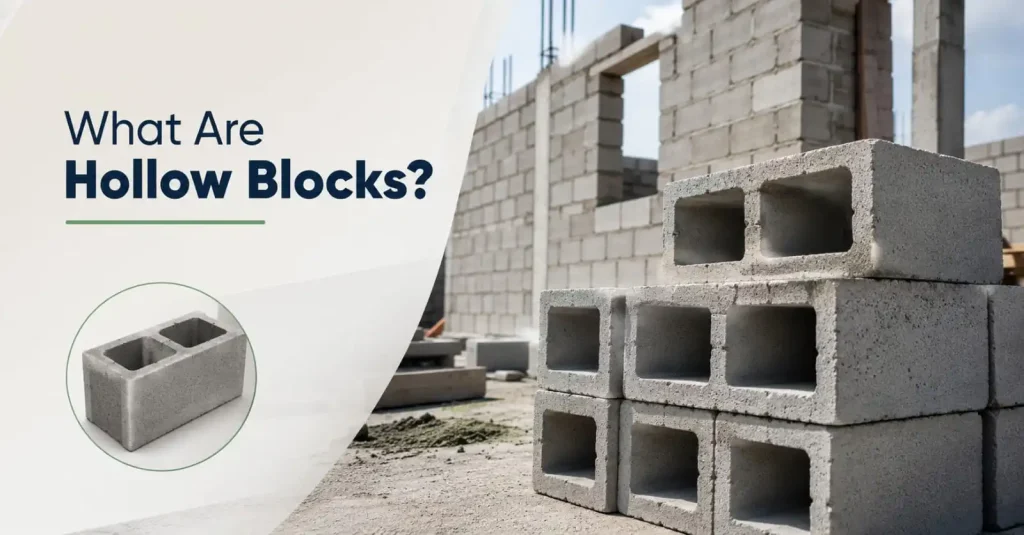
What Are Hollow Blocks?
Hollow blocks are concrete masonry units that are manufactured with one or more cavities. These cavities run through the blocks. The BIS states that solid material in hollow concrete blocks occupies 50% to 75% of the total volume. The various building materials are used to manufacture hollow blocks. Some of these materials are as follows:
- Cement
- Aggregates
- Sand
- Water
It is necessary to mix these materials in the right proportion and control the molding process. This will help you produce more consistent dimensions in all the hollow blocks.
What Are the Common Sizes Available in Hollow Blocks?
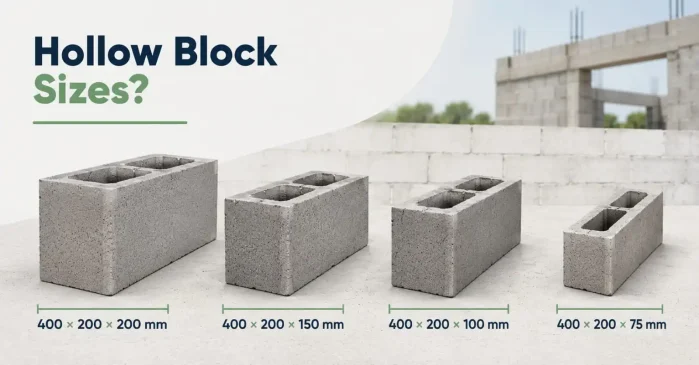
As per IS 2185, the common nominal dimensions for hollow blocks are:
| Dimension | Area |
| Length | 400, 500, and 600 mm |
| Height | 200 and 100 mm |
| Width | 50 to 300 mm |
Structural engineers often advise a 400 x 200 x 100 mm size for residential construction. However, the size may vary depending on the project and construction needs. Some of the common factors to consider before buying hollow blocks are as follows:
- Required wall thickness
- Whether the wall is load-bearing or non-load-bearing
- Necessary strength grade
- Local building requirements
- Availability of the chosen size
Expert Tip: It is advisable to choose the larger hollow blocks because one block helps you cover more wall area.
What Are the Factors that Influence the Price of Hollow Blocks in India?
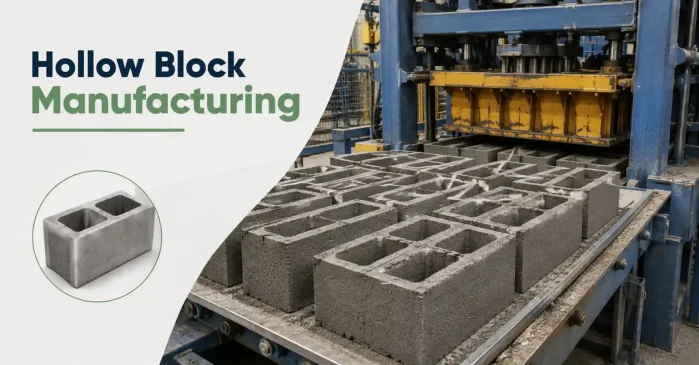
Given below are the factors that affect the hollow block prices in India:
- Size and Thickness of the Block
The price of hollow blocks varies as per the dimensions of the hollow block. Wider blocks require more concrete material than thinner partition blocks. This means a 100 mm block will cost less than a 200 mm block.
- Quality and Compressive Strength
Stronger blocks are expensive because they are manufactured from good-quality raw materials. Moreover, load-bearing and non-load-bearing blocks perform differently. Thus, a block that carries a heavy load may cost more than a simple partition wall.
- Transportation and Delivery Distance
Hollow blocks are heavy. Thus, transportation costs significantly increase the delivered price. A supplier near a construction site may have a lower delivered price. However, a manufacturer located several kilometers away charges a higher transportation cost.
- Order Quantity
The number of hollow blocks you purchase also influences the price. The manufacturer usually charges better rates if a builder orders in large quantities. This is because they produce and transport a large quantity of hollow blocks in one batch.
- Location and Local Market Demand
Hollow blocks vary from one city to another. Other factors that influence the hollow block rate are as follows:
- Local demand
- Availability of manufacturers
- Labor costs
- Raw materials supply
- Competition among suppliers
What Are the Advantages of Hollow Blocks in Construction?
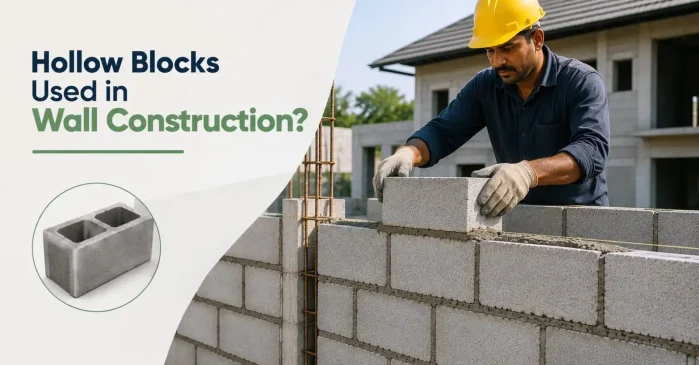
Given below are the advantages of hollow blocks in construction:
- Faster Construction
A hollow block is larger than a traditional brick. Thus, one unit covers more wall area and masons place fewer units to build the same wall. This is highly useful on large residential and commercial projects.
- Lower Mortar Consumption
Hollow blocks have larger dimensions. They require fewer masonry joints. The result? It reduces the amount of mortar that is needed to lay the wall.
- Better Material Efficiency
The hollow sections mean that the block does not need to be solid for masonry work. This property of hollow blocks allows manufacturers to produce larger units with less solid material.
- Consistent Dimensions
The manufacturers use molds to produce hollow blocks. Hence, it provides more uniform dimensions to each block. This allows masons to maintain uniformity and more consistent joints.
- Suitable For Different Wall Applications
Hollow blocks are available in different sizes and strength grades. This is why they are suitable for various masonry applications. The structural engineer uses them for both load-bearing and non-load-bearing walls.
The Final Words
Hollow blocks are popular in modern construction because of their unique properties. The builder prefers them to reduce material and labor costs. Moreover, hollow blocks also help you speed up the masonry work. The hollow block prices may vary depending on the above-mentioned factors. Hence, it is advisable to compare price quotes from different manufacturers.
FAQs
1. What are hollow blocks used for?
Hollow blocks are used to build concrete masonry walls in residential, commercial, and other construction projects. Depending on their strength grade and design, they can be suitable for load-bearing and non-load-bearing walls. The correct block should always be selected according to the project requirements.
2. What is the standard size of a hollow block?
There is no single standard hollow block size. Under IS 2185, nominal dimensions include lengths of 400, 500, and 600 mm; heights of 100 and 200 mm; and widths ranging from 50 to 300 mm. The appropriate size depends on wall thickness and application.
3. Are hollow blocks cheaper than bricks?
Hollow blocks can be cost-effective compared with bricks, but the per-piece price does not tell the whole story. Compare the total cost of the completed wall, including blocks, mortar, labor, transportation, and finishing, to understand which option offers better value.
4. Are hollow blocks stronger than solid bricks?
There is no universal answer to whether hollow blocks are stronger than solid bricks. Strength depends on the block’s grade, brick quality, wall design, and intended application. Always select a masonry unit that meets the required structural strength for the project.
5. Do hollow blocks reduce mortar consumption?
Yes, hollow blocks can reduce mortar consumption because their larger size means fewer units and masonry joints are needed compared with conventional bricks. However, actual mortar usage depends on the block dimensions, joint thickness, workmanship, and construction method used on the site.
6. Are hollow blocks good for house construction?
Yes, hollow blocks can be a practical choice for house construction when the right size, strength grade, and installation method are used. They can help with faster masonry, consistent wall dimensions, and potentially lower wall weight, depending on the building design and application.
7. How do I choose the right hollow blocks?
Choose hollow blocks based on the wall specification, not just price. Check the required size, wall thickness, strength grade, application, and exposure conditions. Then compare suppliers based on material quality, consistency, transportation, and total installed cost rather than the lowest quotation alone.