Lightweight Concrete: Types, Density, Properties and Applications

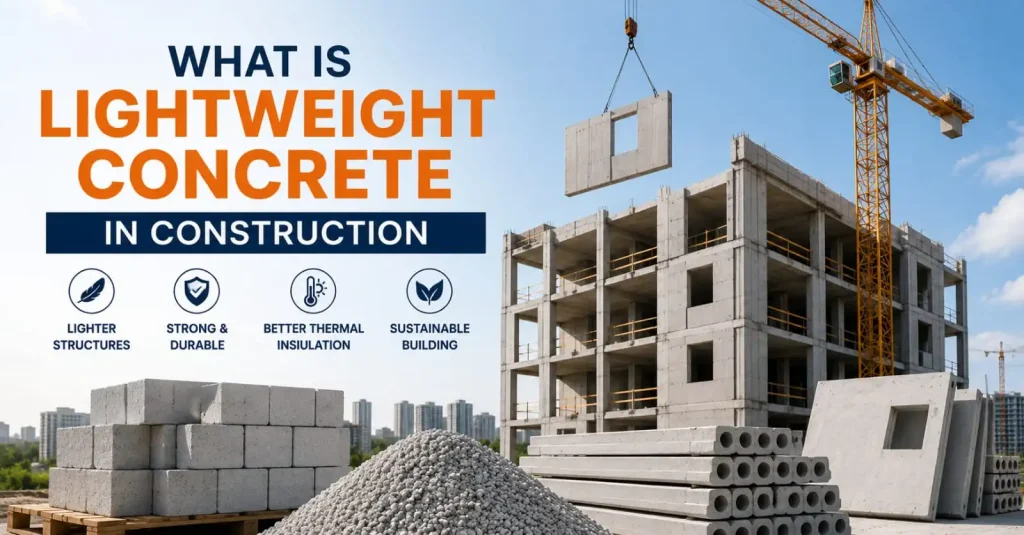
Modern construction not only relies on strength and durability. But sustainability has also become one of the most important factors in the construction of modern buildings. This is why lightweight concrete is popular among modern homeowners. But what exactly is lightweight concrete? It is a building material that delivers structural performance and reduces the overall weight of the building. Engineers have been using it for decades in the construction of bridges and high-rise buildings. Want to know what lightweight concrete is in detail? Read on this blog post to find out!
What Is Lightweight Concrete in Construction?
It is a type of concrete that weighs less than conventional concrete. The engineers achieve this low weight when they replace normal stone aggregates with the following materials:
- Expanded clay
- Expanded shale
- Pumice
- Perlite
- Vermiculite
- Fly ash aggregates
- Aerated concrete mixtures
The primary goal is to reduce structural weight and maintain sufficient strength. The reports highlight that lightweight concrete reduces the dead load of a structure by 20% to 35%.
What Is the Density of Lightweight Concrete?
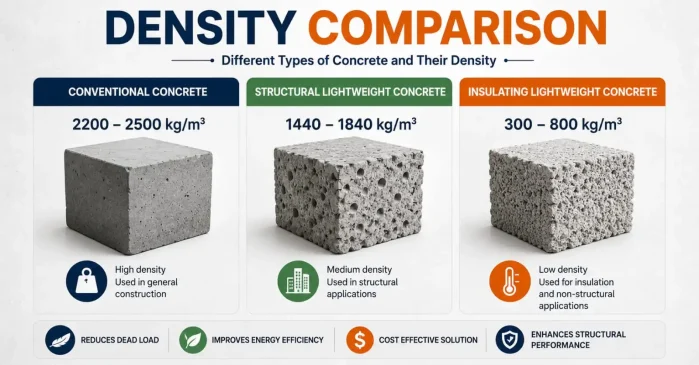

Lightweight concrete density features a lower unit weight. The table below highlights the comparison between different types of concrete.
| Type of Concrete | Density |
| Conventional Concrete | 2200-2500 kg/m³ |
| Structural Lightweight Concrete | 1440-1840 kg/m³ |
| Insulating Lightweight Concrete | 300-800 kg/m³ |
The exact lightweight concrete density depends on various factors like aggregates, water-cement ratio, and application. But how is this lower density beneficial? Given below are some advantages of lower-density concrete:
- Reduce dead load on beams and columns
- Easy to handle during construction
- Reduces transportation costs
- Better thermal insulation
- Improve seismic performance due to lower building mass
This is why modern high-rise buildings use lightweight concrete
What Are the Different Types of Lightweight Concrete in Construction?
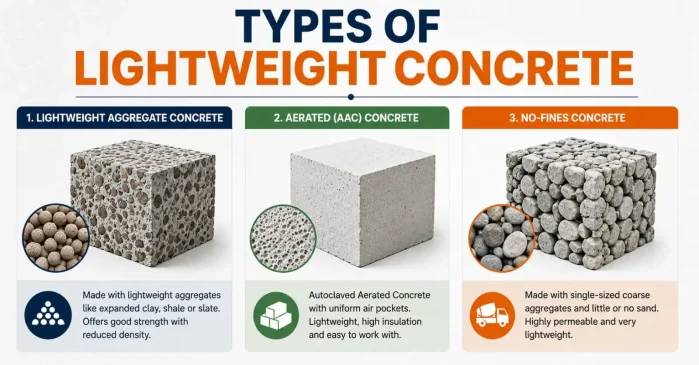
Given below are different types of lightweight concrete in construction:
- Lightweight Aggregate Concrete
Engineers mostly prefer lightweight aggregate concrete because it offers a good balance between strength and low weight. Thus, it is ideal for structural applications.
- Aerated Concrete
It is also known as cellular concrete or AAC (Autoclaved Aerated Concrete). The workers introduce tiny air bubbles into the concrete mix using aluminum powder or foaming agents. Hence, it forms a light material that is excellent for thermal insulation.
- No-Fines Concrete
This concrete contains cement, water, and coarse aggregates. However, the workers do not add fine aggregates like sand. The air voids not only reduce density but also improve drainage. Engineers mostly prefer no-fines lightweight concrete for the construction of pavements and non-load-bearing walls.
What Are the Properties of Lightweight Concrete?
Lightweight concrete is popular due to many reasons. Given below are some advantages of lightweight concrete in construction:
- Lower Dead Load
The entire structure carries less permanent load because the concrete weighs less. Hence, it leads to more economical foundation and structural designs.
- Better Thermal Insulation
The transfer of heat reduces due to air pockets in lightweight concrete. This keeps the building cool in summers and warm in winters.
- Good Fire Resistance
Many lightweight aggregates resist high temperatures naturally. This is why it is suitable for fire walls and structural components.
- Sound Insulation
The porous structure absorbs sound more effectively than conventional concrete. This property of lightweight concrete makes it suitable for apartments and schools.
- Adequate Strength
Lightweight concrete achieves strengths exceeding 17 MPa. Moreover, some special mixes may reach 40 MPa or higher. This makes it ideal for many structural applications.
The Final Words
Modern construction is all about smart and sustainable buildings. Lightweight concrete is a building material that plays a large role in modern buildings. As the name suggests, it is lightweight and offers many other advantages to homeowners. What’s important is that you must hire an expert who knows what is lightweight concrete and its density properly.
FAQs
1. What is lightweight concrete?
Lightweight concrete is a type of concrete with a lower density than conventional concrete. It is made using lightweight aggregates, air-entraining agents, or cellular materials that reduce its weight without compromising essential performance. Lightweight concrete is widely used in construction to reduce structural loads, improve thermal insulation, and simplify handling and installation.
2. What is the density of lightweight concrete?
The density of lightweight concrete typically ranges from 300 kg/m³ to 1,840 kg/m³, depending on the materials and manufacturing method. Structural lightweight concrete generally falls between 1,440 and 1,840 kg/m³, while non-structural and insulating variants have much lower densities, making them suitable for lightweight construction and energy-efficient buildings.
3. What are the different types of lightweight concrete?
The three main types of lightweight concrete are lightweight aggregate concrete, aerated (cellular) concrete, and no-fines concrete. Lightweight aggregate concrete uses porous aggregates, aerated concrete contains air bubbles created during production, and no-fines concrete omits fine aggregates, producing a highly permeable and lightweight material for specific construction applications.
4. Is lightweight concrete as strong as normal concrete?
Structural lightweight concrete can achieve compressive strengths suitable for many residential, commercial, and infrastructure projects. While it generally has lower stiffness than conventional concrete, it provides sufficient strength for load-bearing applications when properly designed. Engineers select lightweight concrete based on structural requirements, durability, and overall project performance.
5. Where is lightweight concrete commonly used?
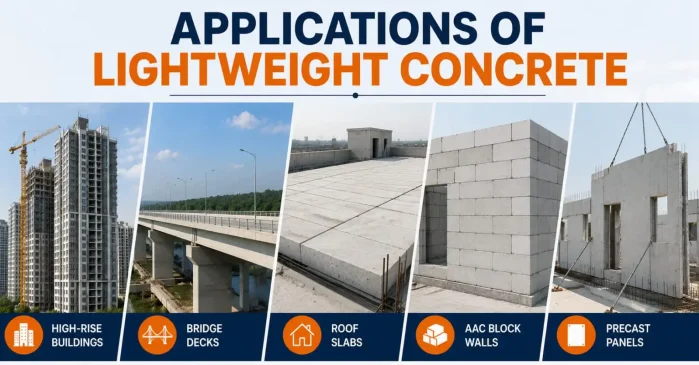
Lightweight concrete is commonly used in high-rise buildings, bridge decks, roof slabs, precast panels, partition walls, floor screeds, and insulation layers. Its reduced weight lowers the dead load on structures, making it ideal for projects requiring faster construction, improved energy efficiency, and better seismic performance.
6. What are the advantages of lightweight concrete?
Lightweight concrete offers several benefits, including reduced dead load, improved thermal insulation, enhanced sound insulation, and excellent fire resistance. It also simplifies transportation, handling, and installation, helping speed up construction. These advantages can reduce overall structural costs while improving building performance, comfort, and long-term energy efficiency.
7. Is lightweight concrete more expensive?
Lightweight concrete may have a slightly higher material cost than conventional concrete because of specialized aggregates or manufacturing methods. However, the overall project cost is often lower due to reduced structural loads, smaller foundation requirements, easier transportation, faster installation, and lower labor and construction expenses.