Crank Bar in Slab: Meaning, Purpose, Placement and Formula

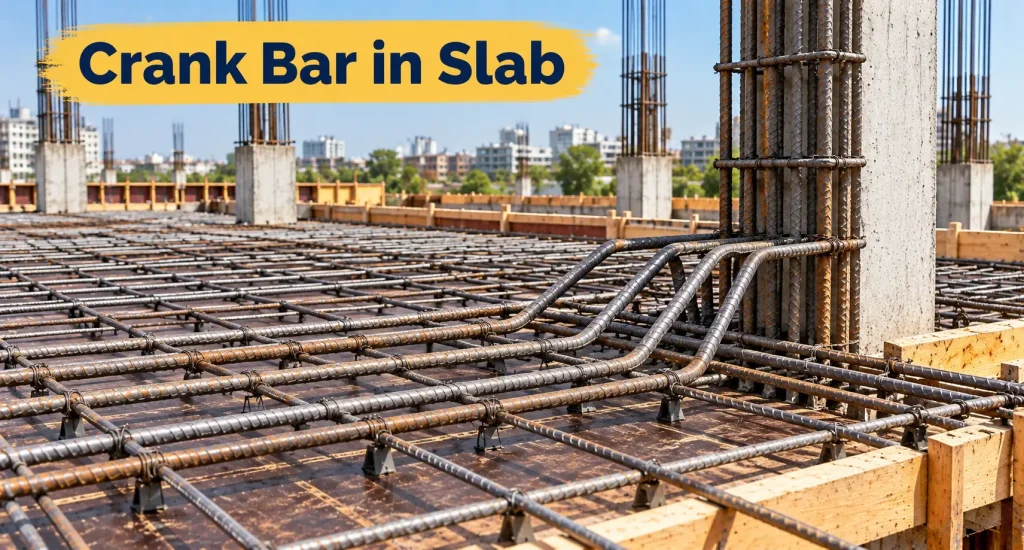
You will notice something interesting when you walk onto a construction site during slab reinforcement work. Not every steel bar lies straight from one end to the other. Some bars bend upwards near the supports before continuing into the slab. These are commonly called crank bars or bent-up bars. They may look like ordinary reinforcement with a slight bend. But that bend serves a structural purpose. Read on to find out about the meaning and purpose of a crank bar in a slab.
Quick Answer
A crank bar in a slab refers to a reinforcement steel bar. It either bends upwards or at a specific location. The exact bending depends on a structural design. The common use of crank bars is reinforced concrete slabs. This is because it helps provide reinforcement where negative bending moments occur near supports.
In traditional reinforcement detailing, the bar may start in the bottom zone of the slab and rise towards the top zone near a support. The exact shape and location depend on the design. Given below are some common points to consider for crank bars:
- Crank bars are bent reinforcement bars.
- They must provide near supports to top reinforcement bars.
- The placement of crank bars must follow structural drawings.
- The cutting length depends on the slab dimensions and bend geometry.
- Not every slab requires crank bars.
What Is the Purpose of a Crank Bar in a Slab?
The main purpose of a crank bar is to position reinforcement in the required structural zone. In a continuous slab the bending behavior changes near supports. The slab may develop negative bending moments over the supports.
This can require reinforcement near the top face of the slab. A crank bar can connect the bottom reinforcement region with the top reinforcement region through a bent shape. The bar therefore supports the reinforcement arrangement specified by the structural engineer.
Given below are the main functions of crank bars:
- Providing reinforcement near supports
Crank bars can help place steel in the top zone where the design requires it.
- Supporting structural detailing
The bent shape allows one bar to change its position within the slab depth.
- Maintaining reinforcement continuity
Depending on the design, the bar may extend through different regions of the slab.
- Supporting construction requirements
Correctly detailed reinforcement helps the team maintain the intended steel arrangement before concrete placement.
It is important to understand one point. Crank bars do not automatically replace all top reinforcement. The engineer must determine the reinforcement required for the slab.
Where Is the Crank Bar Placed in the Slab?
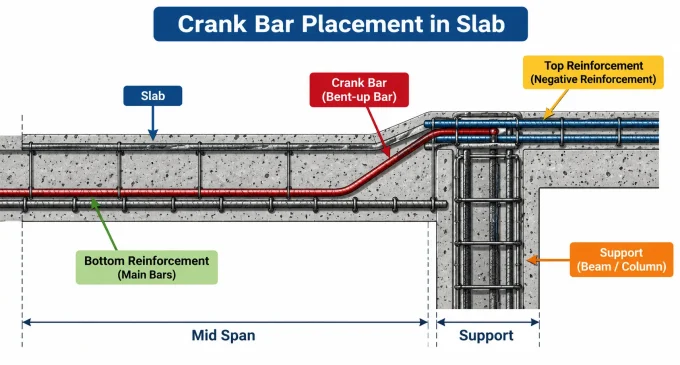

Placement is one of the most important aspects of crank bar reinforcement. A bar may have the correct diameter and length. But if workers place it in the wrong location, then the reinforcement arrangement may not match the design.
In conventional slab detailing, crank bars are often associated with support regions. They rise from the bottom reinforcement zone towards the top zone. The exact position depends on the slab type and structural drawings.
The following is the placement of the crank bar in the continuous slab arrangement:
- Bottom reinforcement extends through the span.
- The crank portion rises near the support.
- The top portion provides reinforcement in the required support region.
- The bar continues according to the specified detailing.
For a simply supported slab the reinforcement arrangement may differ. The engineer may use straight bars or other detailing methods instead of crank bars. Never assume that every slab needs a crank bar at the same distance from the support.
What Is the Formula of the Crank Bar in a Slab?

A crank bar generally contains a sloping section between two horizontal portions. The bar changes its elevation through the bent section. The actual angle and dimensions depend on the detailing requirements. A common traditional detailing approach uses a 45-degree crank. However, the site team should not assume 45 degrees unless the drawing specifies it.
Basic geometry of the crank bar in the slab
For a 45-degree bend:
Horizontal projection = vertical rise.
Sloping length = vertical rise × √2.
For example: If the bar rises through a vertical distance of 100 mm then the sloping length is:
100 × √2 =141.4 mm
This is a geometric calculation. It does not by itself establish the full cutting length of the bar. The bar bender must account for all straight portions and the bend detailing.
Crank Bar Formula for Cutting Length
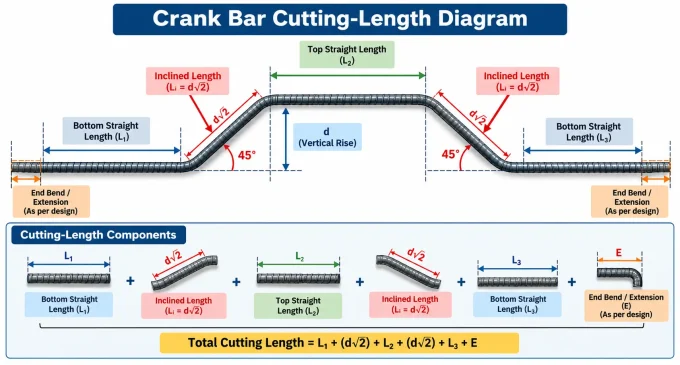
The cutting length of a crank bar depends on its overall shape. There is no single formula that applies to every crank bar arrangement. The straight length and the inclined portions must be included in the calculation. The following are the factors to consider to calculate the cutting length of 45-degree crack arrangement:
- Straight horizontal length.
- Inclined length on the first side.
- Inclined length on the second side.
- Other specified extensions.
Final Thoughts
Crank bars may look like a small detail during slab reinforcement work. But small details deserve attention when they form part of a structural system. A correct bend shape does not matter much if the bar sits in the wrong position. Likewise, a carefully calculated cutting length cannot compensate for reinforcement that does not follow the design.
FAQs
1. What is a crank bar in a slab?
A crank bar is a bent reinforcement bar used in slab construction. It changes level along its length to suit the reinforcement arrangement. Crank bars are generally provided where structural detailing requires a change in reinforcement position.
2. Why are crank bars used in slabs?
Crank bars are used to change the position or level of reinforcement within a slab. They can help provide reinforcement near supports and accommodate traditional reinforcement detailing. Their use depends on the structural design and reinforcement arrangement.
3. What is the angle of a crank bar?
A 45-degree angle is commonly used for crank bars in traditional slab reinforcement detailing. However, the required angle can vary based on structural requirements. Always follow the structural drawing and engineer’s specifications for accurate placement.
4. How is crank bar length calculated?
Crank bar length is calculated by adding the straight portions and inclined sections of the bar. For a 45-degree crank, the inclined length can be calculated using L = d√2. The final cutting length also includes bends and hooks.
5. Are crank bars required in every slab?
No, crank bars are not required in every slab. Their use depends on the structural design, slab type and reinforcement detailing. The structural engineer determines whether crank bars are necessary for a particular slab construction.
6. Can crank bars replace top reinforcement?
Crank bars should not automatically replace top reinforcement in a slab. They serve a specific reinforcement purpose based on structural detailing. The required top reinforcement must follow the structural drawings and engineer’s design specifications.