Self-Compacting Concrete: Meaning, Mix Design & Applications

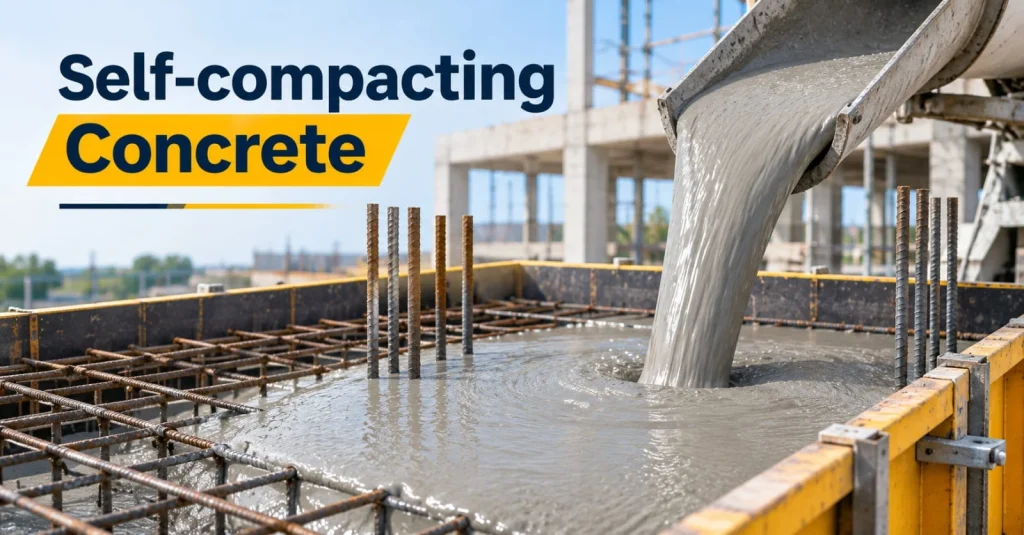
Have you ever seen workers remove trapped air during concrete work? They do it because air traps inside the space between steel bars. However, this process is time-consuming. Self-compacting concrete offers a better solution. It flows under its own weight. It fills the formwork without mechanical vibration. Engineers use this type of concrete for different structures. Read on this blog post to find out the meaning and applications of self-compacting concrete.
Quick Answer
Self-compacting concrete flows to fill the formwork under its own weight. It does not require mechanical vibration to fill the narrow spaces. The best part is that it reduces air gaps in the final structure. The common ingredients in self-compacting concrete are as follows:
- Cement
- Sand
- Coarse aggregates
- Water
- Chemical admixtures
It is advisable to carefully select the quantity of these materials. This will ensure that concrete flows easily without separating.
What Is Self-Compacting Concrete?

Self-compacting concrete is a type of concrete that fills the gaps between formwork. It is also known as self-consolidating concrete. Why? This is because it fills the gap without the help of a vibrator. It naturally flows into the corners to reduce the risk of air gaps. However, it works properly only if the mix has the right properties. Engineers also recommend that workers handle and place this concrete carefully. The mix may result in leak or defects if it is not designed properly.
What Are the Main Properties of Self-Compacting Concrete?
Given below are the main properties of self-compacting concrete:
- Filling Ability
This property helps self-compacting concrete reach corners. This is because it spreads and fills the entire formwork under its own weight.
- Passing Ability
The concrete easily moves between close steel bars. This is an essential property of self-compacting concrete for heavy structural members.
- Resist Segregation
Segregation happens if the materials in concrete separate from one another. For example, coarse aggregates settle, but the cement paste moves away.
What Is Self-Compacting Concrete Mix Design?
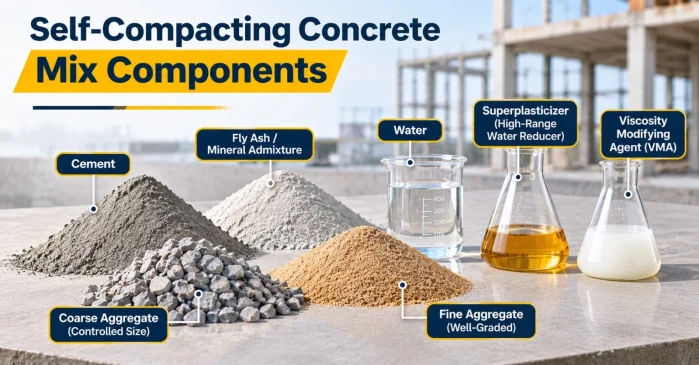
A self-compacting concrete mix design varies from one project to another. Engineers must understand the project requirements to mix the necessary building materials. What exactly are these building materials? These materials include:
- Cement
- Sand
- Coarse aggregate
- Water
- Admixture
Tip: It is advisable to add each ingredient in the right proportions. This will ensure that concrete flows easily without losing its strength.
What Are the Uses of Self-Compacting Concrete?
Given below are the common applications of self-compacting concrete:
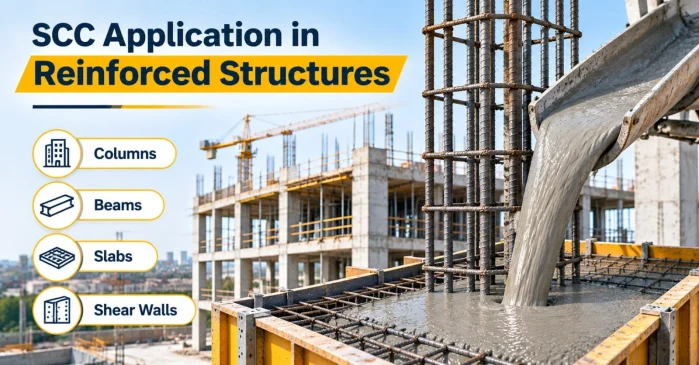
- High-Rise Buildings
Structural members in tall buildings often contain closer steel bars. Self-compacting concrete fills these sections without the need to insert vibrators in tight spaces.
- Bridges and Flyovers
Bridges and complex structural parts also use self-compacting concrete. Why? This is because it flows easily and reaches difficult areas.
- Precast Concrete Products
Self-compacting concrete is also used in factories to precast structural members and decorative products. It not only helps them simplify some production steps but also achieve a more consistent surface finish.
- Decorative Concrete Structures
The structures in curve shape and with detailed designs are also made up of self-compacting concrete. This is because it fills small spaces that reproduce the shape of the mold.
- Repair Work
Contractors also use self-compacting concrete to repair complicated areas. However, engineers must first check that the material suits the repair method.
What Is the Difference Between Self-Compacting Concrete and Conventional Concrete?
The table below highlights the difference between self-compacting concrete and conventional concrete.
| Parameter | Self-Compacting Concrete | Conventional Concrete |
| Compaction | Self-compacting concrete flows without mechanical vibration. Hence, it is not necessary to compact it. | The concrete must be compacted properly in this type of concrete. |
| Workability | It spreads easily in compact areas. | The workability of traditional concrete depends on its design mix. |
| Reinforcement | It is useful if the workers design the mix properly. | Traditional concrete is difficult to compact in tight spaces. |
| Surface Finish | Self-compacting concrete provides a smooth finish to the surface. | This type of concrete performs well if it is compacted and cured properly. |
| Initial Cost | The initial cost of self-compacting concrete is usually higher. | The cost for conventional concrete is lower than self-compacting concrete. |
The Final Words
Self-compacting concrete is useful for different applications. Engineers use it for the narrow spaces and congested steel bars. The most intriguing part is that it removes the need for mechanical vibration. However, it is necessary to be careful with mix design and building materials. The initial cost of self-compacting concrete may be higher. But it helps you save time and labour in the right applications.
FAQs
1. What is the full form of SCC?
SCC stands for Self-Compacting Concrete. It is a special type of concrete that flows, spreads and fills formwork under its own weight without mechanical vibration. SCC passes through closely spaced steel reinforcement and fills narrow spaces, making it useful for complex structures, columns, beams and precast concrete elements.
2. What is the typical slump flow of SCC?
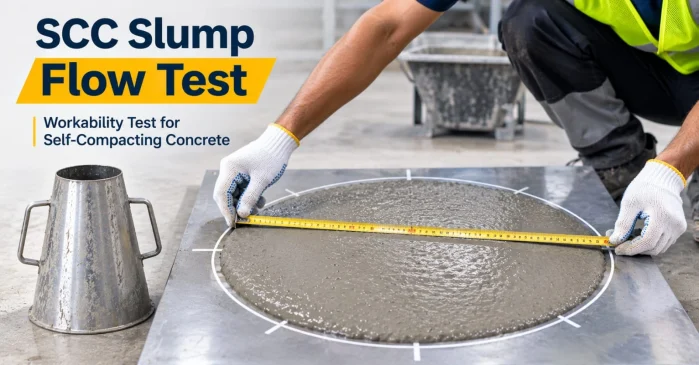
The typical slump-flow range of self-compacting concrete (SCC) is 650–800 mm, depending on the required performance class and project specifications. The slump-flow test measures how far fresh concrete spreads after lifting the slump cone. Engineers use this test to check whether the concrete has sufficient flowability for placement.
3. Does self-compacting concrete require vibration?
No, self-compacting concrete does not require mechanical vibration when the mix has the correct properties. It flows under its own weight and fills the formwork around steel reinforcement. However, workers must place it carefully, use suitable formwork and maintain proper quality control to prevent segregation, leakage and other concrete defects.
4. Is self-compacting concrete stronger than normal concrete?
Self-compacting concrete is not always stronger than conventional concrete. Both types can achieve the same compressive strength when engineers design and prepare the mixes correctly. The main advantage of SCC is its ability to flow easily without vibration. Its final strength depends on the mix design, materials, curing and construction practices.
5. Is SCC more expensive than conventional concrete?
Yes, self-compacting concrete often has a higher initial material cost than conventional concrete because it requires special chemical admixtures and careful mix design. However, SCC can reduce labour costs, vibration equipment requirements and placement time. These savings may offset some of the additional cost, depending on the project size and complexity.
6. Which tests are used for self-compacting concrete?
The main tests for self-compacting concrete include the slump-flow test, J-ring test, V-funnel test and L-box test. The slump-flow test checks filling ability, while the J-ring and L-box tests assess passing ability. The V-funnel test measures flow time. Together, these tests help engineers evaluate the fresh concrete’s performance.