Fly Ash Bricks: Meaning, Advantages, Price, Size & GST Rate (Complete Guide)

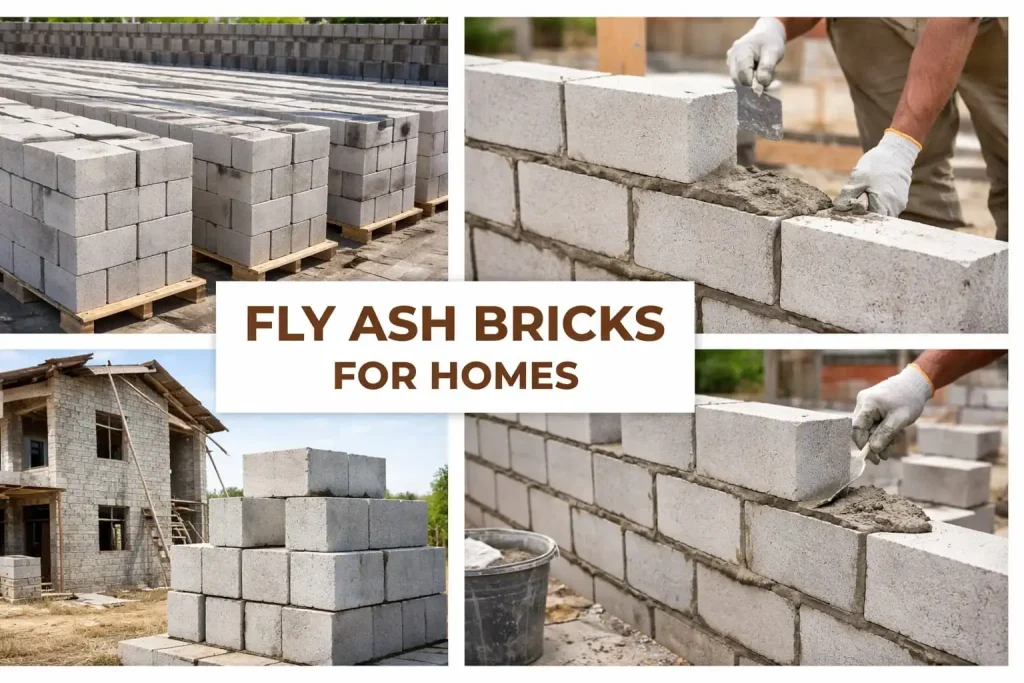
Traditional clay bricks built India’s cities, but fly ash bricks are shaping its sustainable future. Made from thermal power plant waste, these machine-pressed blocks offer uniform size, higher strength, and eco-credentials that align with modern green building norms.
If you’re planning walls for a new home, boundary, or commercial structure, understanding fly ash bricks meaning, standard sizes, real-world advantages, current pricing, and GST rules gives you clear decision-making power.
Fly ash bricks don’t just replace clay bricks. They work better with slump-controlled concrete, precise concealed wiring chases, and even retaining walls with proper weep holes. This cluster shows how they fit the complete construction system.
What Are Fly Ash Bricks?
Fly ash bricks are factory-made masonry units using fly ash (coal combustion byproduct), cement/lime, gypsum, and sand/stone dust. Unlike clay bricks that require soil excavation and wood-fired kilns, fly ash bricks are hydraulically pressed and water-cured.
The fly ash (60-80%) reacts with lime/cement during curing to form strong calcium silicate hydrate bonds. No firing means lower emissions and no topsoil consumption.
IS 12894:2002 governs their manufacture, testing compressive strength (3.5-20 N/mm² classes), water absorption (≤20%), and dimensions. Quality bricks carry BIS certification.
Fly Ash Bricks Size & Specifications
Standard sizes match traditional bricks for easy adoption:
Non-modular (most common): 230 × 110 × 70-75 mm
Modular: 190 × 90 × 90 mm
Hollow blocks: 400 × 200 × 200 mm or larger
Key properties:
- Weight: 2.8-3.2 kg (25-30% lighter than clay bricks)
- Compressive strength: 7.5-10 N/mm² (Class 7.5/10), up to 20 N/mm² premium
- Water absorption: 12-18% (vs 20-25% clay bricks)
- Efflorescence: Slight to nil in quality products
Uniform dimensions (±2mm tolerance) reduce mortar joints and plaster thickness by 30-50%.
Manufacturing Process
- Raw materials mixed: Fly ash (65-80%), lime/cement (8-12%), gypsum (5%), sand (20-30%)
- Hydration in pan mixer with water (8-12% moisture)
- High-pressure moulding (100-150 kg/cm²) in automatic machines
- Steam/water curing 7-14 days for pozzolanic reaction
- Quality testing & stacking
No kiln firing saves 80% energy vs clay bricks. Curing develops strength gradually.
Advantages of Fly Ash Bricks
Environmental benefits:
- Uses 1 million tons fly ash annually per large plant
- Saves 500,000 tons topsoil yearly
- Reduces CO₂ by 80% (no kiln firing)
Construction advantages:
- Uniform size = thinner joints (8-10mm vs 12-15mm)
- Higher strength = load-bearing walls possible
- Lower water absorption = less dampness/efflorescence
- Lighter weight = 20% less dead load on structure
- Smooth finish = 30-50% less plaster needed
Economic advantages:
- Lower mortar use (20-25% savings)
- Faster construction (uniformity speeds masonry)
- Transport savings (lighter per truckload)
Perfect for GRIHA/IGBC-rated projects and government mandates near thermal plants.
Limitations
Quality variation: Poorly cured bricks crumble or absorb excess water. Always demand BIS test certificates.
Initial cost: 10-20% higher than local clay bricks, though total wall cost is often lower.
Thermal conductivity: Moderate insulation (better than clay, worse than AAC blocks).
Bond strength: Smooth faces need cement mortar (not just lime). Wet bricks lightly before laying.
Availability: Best near thermal plants (within 100km). Logistics add cost in remote areas.
Fly Ash Bricks Price in India (2026)
Current market rates (per piece, ex-factory):
text
Delhi/NCR: ₹6.50-8.50
Mumbai/Pune: ₹7.00-9.00
Bengaluru/Chennai: ₹6.00-8.00
Tier 2 cities: ₹5.50-7.50
Bulk (10,000+): 10-15% discount
Per 1000 bricks: ₹5500-8500
Per sqm 9″ wall: ₹110-160 (incl. mortar)
Prices are stable despite cement fluctuations due to fly ash being free byproduct. Branded (JK, UltraTech) cost 15-20% more but guarantee consistency.
Fly Ash Bricks GST Rate & HSN
HSN Code: 68101990 (other bricks/blocks)
GST Rate: 12% standard (5% for ≥90% fly ash content per court rulings)
Input tax credit available for registered businesses. Check supplier invoice for applicable rate.
The government mandates 100% fly ash brick use within 300km of thermal plants (MoEFCC notification).
Applications & Structural Use
Load-bearing walls: Up to G+2/G+3 (Class 10+ bricks)
Partition/infill walls: All building heights
Boundary/compound walls: Excellent (weather-resistant)
Paving: Non-traffic areas only
Wall thickness:
External walls: 9″ (230mm)
Internal: 4.5″ (115mm)
Partitions: 4″ blocks
Engineers design per NBC 2016 & IS 1905 masonry code.
Comparison: Fly Ash vs Clay vs AAC
| Property | Fly Ash Bricks | Clay Bricks | AAC Blocks |
| Strength | 7-20 N/mm² | 3.5-7 N/mm² | 3-5 N/mm² |
| Size tolerance | ±2mm | ±5mm | ±3mm |
| Water absorption | 12-18% | 20-25% | 8-12% |
| Weight (230mm) | 3kg | 3.5kg | 12kg/block |
| Cost/sqm wall | ₹120-160 | ₹100-140 | ₹180-250 |
| Speed | Fast | Medium | Fastest |
Fly ash wins for strength + economy + eco-credentials.
Quality Checks Before Buying
- Visual: Uniform color, no cracks, sharp edges
- Drop test: Drop from 1m height – shouldn’t break
- Water absorption: Immerse 24hrs, weigh wet/dry (<18%)
- Compressive test: Lab certificate for Class 7.5/10
- BIS mark on packing/pallet
- Reject pale, brittle, or oversized bricks.
Integration With Construction Cluster
With slump-tested concrete: Lighter walls reduce foundation loads. Precise workability ensures strong DPC/plinth connections.
With weep holes: Low-absorption bricks + drainage = dry basement walls perfect for concealed wiring.
With concealed wiring: Smooth uniform faces = straight clean chases, minimal plaster cracking.
Fly ash bricks elevate the entire construction quality when paired with these proven practices.
Why Fly Ash Bricks Matter Here
This cluster shows modern construction synergy:
- Green materials (fly ash bricks)
- Quality concrete (slump test)
- Smart drainage (weep holes)
- Clean services (concealed wiring)
Each supports the others for durable, efficient buildings.
FAQs
1. What are fly ash bricks?
Fly ash bricks use thermal plant waste mixed with cement/lime and sand.
Pressed and cured (no firing), they save soil and emissions.
Machine-made for uniform size and strength.
2. Standard fly ash bricks size?
Most common: 230×110×75mm (matches clay bricks).
Modular: 190×90×90mm. Blocks up to 400×200×200mm.
±2mm tolerance standard.
3. Fly ash bricks vs clay bricks?
Stronger (7-10 N/mm² vs 3-5), lighter (3kg vs 3.5kg), smoother.
Less mortar/plaster (20-30% savings), lower absorption.
Eco-friendly (no topsoil, no kiln emissions).
4. Current fly ash bricks price?
₹6-9/brick (₹6000-9000/1000) depending on city/quality.
Delhi ₹7-8.5, Tier-2 ₹5.5-7. Bulk discounts 10-15%.
Total wall cost often lower than clay.
5. Fly ash bricks GST rate?
12% standard HSN 68101990. 5% for ≥90% fly ash content.
ITC available for businesses. Confirm supplier invoice.
Mandatory within 300km of thermal plants.
6. Are fly ash bricks load-bearing?
Yes up to G+3 (Class 10 bricks). Check engineer approval.
IS 12894 certified for structural use.
Lighter = smaller foundations possible.
7. Do fly ash bricks absorb water?
12-18% (better than clay’s 20-25%). Less dampness.
Quality bricks show “slight” efflorescence only.
Perfect for external/basement walls.
8. How to check fly ash brick quality?
Drop test: Survives 1m drop. Wet test: <18% absorption.
Uniform color/size, BIS mark, lab compressive certificate.
Reject pale/brittle/oversized bricks.
9. Need soaking before laying?
No – sprinkle water only. Already moisture-balanced.
Use cement mortar (1:6). 10mm joints max.
Cure walls 7 days minimum.
10. Fly ash bricks thermal insulation?
Moderate – better than clay, less than AAC.
0.8-1.2 W/mK conductivity. Good for the Indian climate.
Add cavity/insulation for extreme hot/cold.