POP Ceiling vs Gypsum Ceiling: Difference, Advantages, and Cost Comparison

POP ceilings are the most important elements of modern interiors. Why so? They not only hide wiring and improve lighting but also add character to your room. They change the overall look and feel of the room.
But the debate that arises when you choose false ceiling options is the POP ceiling vs. the gypsum ceiling. Both are popular. Both look elegant. Both help create stunning ceiling designs. So, how do you choose between them?
Read this blog post to find out the differences between POP ceilings and gypsum ceilings.
What Is a POP Ceiling?


The plaster of Paris helps with the design of the POP ceilings. But how exactly is this material made? It is produced when gypsum heats to a specific temperature and grinds into a fine powder. What’s more? It forms a paste when mixed with water. It is easy to mold this paste into different shapes and designs. The flexibility is the reason behind the popularity of POP ceilings among homeowners.
Given below are some common areas where you can use POP ceilings:
- Living rooms
- Dining areas
- Bedrooms
- Decorative ceiling borders
- Ornamental ceiling designs
- Luxury residential interiors
What is a Gypsum Ceiling?
A gypsum ceiling uses prefabricated gypsum boards and metal framework to form a shape. Factories manufacture these gypsum boards and send them to the market ready for installation. Gypsum ceilings rely on panels instead of wet plaster. The result? The process of installing the gypsum becomes quick and clean.
Given below are some common applications of gypsum ceiling in buildings:
- Apartments
- Modern homes
- Corporate offices
- Hotels
- Retail stores
- Commercial buildings
POP Ceiling vs. Gypsum Ceilings: What Are the Key Differences?
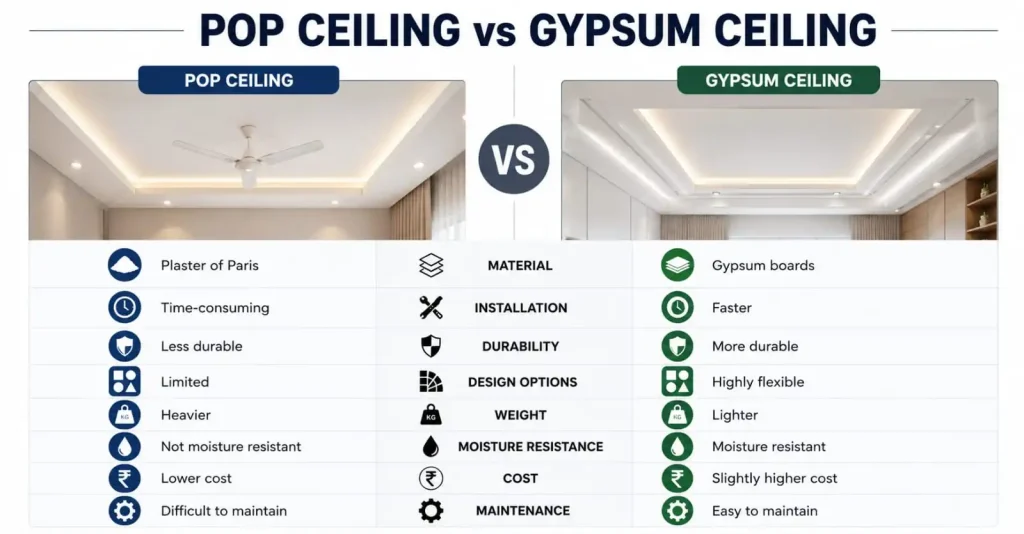
The table below highlights the key differences between POP ceilings and gypsum ceilings:
| Parameter | POP Ceilings | Gypsum Ceilings |
| Material | Plaster of Paris | Gypsum boards that are manufactured in the factory |
| Installation | Applies on-site by a professional plasterer | Easy to install pre-manufactured panels |
| Cost | It is 25% to 40% less expensive than gypsum | It is expensive |
| Durability | Low durability, as they highly depend on the skill of a worker | High durability and lower chances of cracks |
| Repair | It is messy to repair and hard to match the existing detail | Easy to replace the whole section |
| Weight | It is heavy | They are light-weight |
Note: Before choosing between a POP ceiling and a gypsum ceiling, carefully consider your budget.
What Are the Advantages and Disadvantages of POP Ceilings?
Given below are the advantages and disadvantages of POP ceilings:
Advantages of POP Ceiling
- They provide flexibility to mold into any shape or design.
- The material directly applies on-site. The result? It creates a smooth and seamless appearance.
- It is highly durable and lasts for many years without losing its appearance.
- Complex patterns. Floral motifs. Artistic designs. They are easy to create with POP.
Disadvantages of POP Ceiling
- The plasterer prepares and applies the POP manually on-site. Hence, it takes time to install POP.
- It produces more dust and waste materials as work happens at the site.
- The cracks may appear over time if you don’t mix and cure it properly.
- The final finish depends on the skill of the contractor and workers.
What Are the Advantages and Disadvantages of Gypsum Ceilings?
Given below are the advantages and disadvantages of gypsum ceilings:
Advantages of Gypsum Ceiling
- It is clean and easy to use. It generates a little dust or debris during installation.
- The gypsum boards provide a uniform appearance as they are produced in a factory.
- The best part? Gypsum boards offer good fire-resistant properties.
- It is lightweight in comparison to other traditional ceiling solutions.
Disadvantages of Gypsum Ceiling
- Modern gypsum limits the customization. It makes the intricate decorative work challenging.
- Board joints are visible over time if you don’t install them properly.
- Standard gypsum boards are moisture-sensitive. So, you have to choose the moisture-resistant variants.
- You may need to replace the entire board if one section is damaged.
POP Ceiling vs. Gypsum Ceiling: Which Is Better?
The pros and cons of gypsum ceilings and POP ceilings vary. So, which is better? Well, the answer depends on what matters most to you.
Given below are the things to keep in mind when choosing between a POP ceiling and a gypsum ceiling:
| POP Ceiling | Gypsum Ceiling |
| Intricate ceiling patternsDecorative moldingCurves and artistic detailingLuxury look with customization | Complete the project quicklyInstall the ceiling with a minimal messModern and clean aestheticsBetter consistency |
Note: There is no universal winner between gypsum and POP.
Modern apartments and urban homes choose gypsum ceilings because they offer the right balance of cost and speed. They maintain aesthetic appeal.
POP ceiling still wins a heart for villas and luxury residences, as designs are primarily focused there. What’s trending nowadays? Designers combine both materials to create the ceilings. They use gypsum as a primary structure and use POP for decorative detailing.
The Final Words
The debate around POP ceilings vs. gypsum ceilings is about your space and design goals. POP provides artistic freedom and elegance in designs. Gypsum ensures speed and a clean, modern finish. It is advisable to think beyond the cost when you compare the POP ceiling and the gypsum ceiling.
Planning to build your home? Use a house construction cost calculator to determine construction costs effortlessly.
FAQs
1. Which is cheaper, a POP ceiling or a gypsum ceiling?
Generally, a basic gypsum ceiling is slightly more economical because installation is faster and labor costs are lower. However, costs vary depending on design complexity.
2. Which ceiling lasts longer: POP ceiling or gypsum ceiling?
Both can last for many years when installed properly. The lifespan depends largely on workmanship, maintenance, and environmental conditions.
3. Is a gypsum ceiling waterproof?
Standard gypsum boards are not waterproof. For bathrooms and moisture-prone areas, moisture-resistant gypsum boards should be used.
4. Can a POP ceiling develop cracks?
Yes. A POP ceiling may develop cracks if the mixing, curing, or installation process is not done correctly.
5. Which ceiling is better for modern homes?
Many homeowners prefer a gypsum ceiling for modern homes because it offers a sleek finish and faster installation.
6. Can POP and gypsum be used together?
Yes. Many designers combine a gypsum ceiling framework with POP decorative elements to achieve both efficiency and customization.
7. Which ceiling is better for large commercial spaces?
A gypsum ceiling is generally preferred for offices, malls, hotels, and commercial buildings because of its quick installation and consistent finish.