What Is a Portico? Meaning, Design & Uses

Most people don’t wake up thinking about architecture terms.
But stand outside any Indian home during a sudden monsoon shower, and you’ll immediately understand what is portico —even if you’ve never used the word.
That small covered space before the main door.
Where you shake off the rain.
Where guests wait for someone to open the door.
Where deliveries are handed over without soaking the living room.
That’s a portico.
We’ve built them for decades, sometimes consciously, sometimes just because “aise hi bana dete hain.” But there’s solid thinking behind it, both structurally and practically.
Let’s break down the portico meaning, how portico design has changed, and why it still matters today.
Meaning of Portico
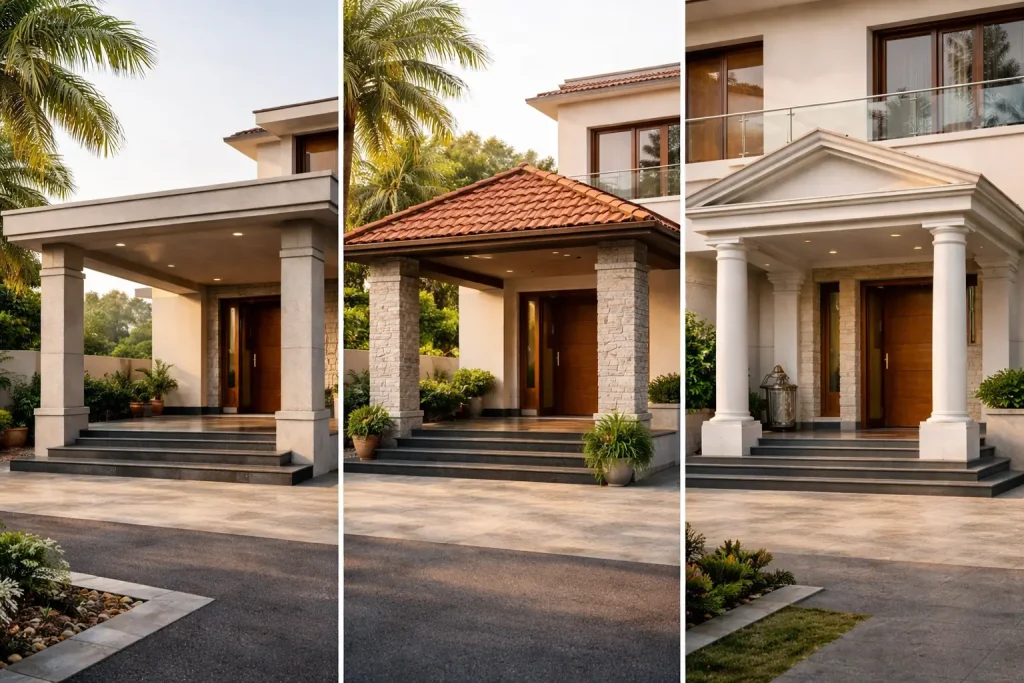
Basically, it’s just a covered entryway stuck onto a building. It usually has columns holding up the roof, or sometimes walls on the sides.
It’s not a room.
It’s not just a slab.
It’s a transition space.
Architecturally speaking, it acts like a buffer between the outdoors and indoors. Practically speaking, it saves your door, flooring, and sometimes even your mood—especially during Indian summers and monsoons.
That’s the real answer to what is portico, beyond dictionary definitions.
Why porticos never went out of relevance
Design trends come and go.
But on-ground needs don’t change.
A portico still solves problems that glass doors and fancy façades can’t:
• Shields the main door from direct rain
• Reduces harsh sunlight entering the house
• Creates a pause space for visitors
• Protects flooring near the entrance
On many sites, we’ve seen homes without porticos face faster wear around the entrance—peeling paint, damp patches, door swelling. The fix often comes later, but it’s avoidable.
That’s where thoughtful portico design paired with good construction materials makes all the difference.
Portico design has changed with time
Earlier portico design meant heavy columns, arches, and decorative plasterwork.
Today, it’s leaner.
Modern portico design often looks like:
• Clean RCC slabs
• Minimal columns or cantilevered projections
• Neutral finishes with subtle lighting
• Integrated rainwater slope planning
The idea hasn’t changed. Only the styling has.
Whether it’s a traditional bungalow or a modern duplex, understanding what is portico helps architects and homeowners design smarter entrances—not just prettier ones.
The material side nobody talks about
Here’s a truth from site work.
Most portico issues don’t come from design—they come from poor execution.
Cracks near the slab edge.
Water dripping close to the door.
Paint peeling within two seasons.
Why?
Porticos get hit by the sun, rain, and all sorts of weather. So, it’s super important to use good cement and cure it right – even more important than when you’re working inside.
Many contractors prefer using consistent-quality cement for portico slabs and columns because fluctuations show up faster in exposed elements. Brands like **JK Cement**, known on site for dependable strength and weather performance, are often chosen for such critical structural zones—not because of marketing, but because repairs cost more later.
That’s the unspoken site logic.
How a portico affects the “feel” of a home
This part is less technical, more human.
Homes without porticos feel abrupt. You step straight from noise into silence.
Homes with a portico feel calmer.
There’s a moment to pause.
To take off footwear.
To greet someone properly.
Architects call it spatial transition. Homeowners just say, “Entrance acha lagta hai.”
That emotional comfort is a big part of what is portico really about.
Different types of portico you’ll commonly see
Across Indian homes and buildings, portico styles usually fall into a few practical categories:
Entrance portico
Covers only the main door area.
Car portico
Extended slab allowing car parking under shade.
Column-supported portico
Classic and structurally straightforward.
Cantilevered portico
Modern look, no front columns, requires strong RCC planning.
Each type of portico design has its own structural needs. Cutting corners here often leads to long-term issues.
Porticos aren’t just for homes
If you look around, you’ll see portico spaces everywhere:
• Hospitals (drop-off zones)
• Hotels (main entrances)
• Schools and colleges
• Apartments (common entry)
Anywhere people arrive, wait, or transition, a portico quietly does its job.
In commercial buildings, portico design often becomes more dramatic—but the function stays the same.
Common mistakes with Porticos
Even today, these errors repeat:
• Slab slope not planned—water flows inward
• Height too low—space feels cramped
• Poor waterproofing—leakage after one monsoon
• Weak concrete mix—early surface cracks
Understanding what is portico means respecting that it’s not just an extension slab. It’s a working architectural element.
Good detailing, proper curing, and dependable cement quality go a long way in making it last.
A portico in construction: understated but vital.
It’s not showy.
It doesn’t show off like a façade or interiors.
But when built right—with sensible portico design and solid materials—it protects, welcomes, and lasts.
That’s why many experienced engineers still insist on getting the basics right here. Strong foundations, well-proportioned columns, and cement that performs consistently across weather conditions—something brands like JK Cement have built trust around over decades of Indian construction.
No drama. Just reliability.
FAQs
1. What is a portico?
Think of it as a covered porch at a building’s entrance – keeps you dry and out of the sun!
2. What does portico mean when talking about buildings?
It’s just a roofed entrance, usually with columns holding it up.
3. Do Indian homes need porticos?
They’re not required, but they’re super useful for dealing with heat, rain, and dust.
4. What’s best to build a portico from?
Reinforced concrete with good cement, strong support, and waterproofing is the way to go.
5. Can you build a portico without columns?
Yep, a cantilevered design is common now, but it needs to be planned well structurally.
6. Does a portico make buildings more expensive?
A bit, but it cuts down on upkeep and keeps the entrance in good shape down the road.
7. How long will a good portico last?
If it’s designed well and made with good stuff, it can last as long as the building itself.