Ceiling Lights: Types, Designs & Best Ceiling Light Ideas for Homes

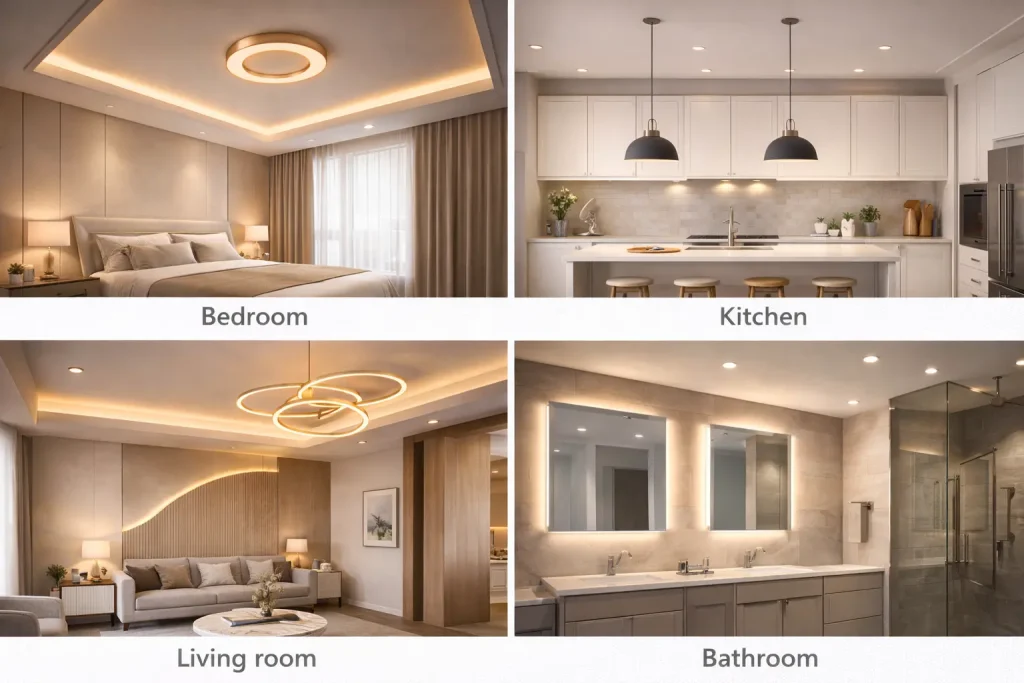
Ceiling lights in 2026 are not about “putting enough lights.”
They’re about how the room feels at 8 AM.
And how it feels at 10 PM.
Because here’s the truth — lighting is the one thing that can make a ₹40 lakh interior look premium… or make a ₹1 crore interior feel flat.
In Indian apartments between 900–1,800 sq ft, ceiling lighting now does five jobs at once:
- Sets mood
• Defines zones
• Expands space visually
• Controls glare
• Manages electricity usage
And most homes still get it wrong.
Let’s break it down properly — design logic, spacing, wattage, colour temperature, mistakes, and what actually works on Indian sites.
Quick Answer
Ceiling lights are fixed overhead lighting systems that deliver ambient, task, and accent illumination through recessed, surface, panel, pendant, track, or indirect formats.
When planned properly, ceiling lighting:
- Reduces harsh shadows
• Makes rooms look larger
• Cuts electricity bills through LED efficiency
• Improves comfort
• Enhances resale value
When planned casually, it:
- Creates glare
• Leaves dark corners
• Causes flickering
• Overheats false ceilings
• Looks uneven at night
The difference isn’t budget.
It’s layout.
Why Ceiling Lighting Matters More in 2026 Homes
Modern Indian homes are:
- False-ceiling heavy
• Open-plan
• Glass-integrated
• Smart-device enabled
• Design-conscious
One central tube light in the middle of the room doesn’t work anymore.
Layered lighting creates:
- Depth
• Warmth
• Architectural lines
• Controlled brightness
Good lighting is invisible when done right.
Bad lighting is obvious instantly.
The 3-Layer Lighting Rule (Used by Professionals)
Every well-designed room has three light layers.
Not one. Not two. Three.
| Layer | Purpose | Ceiling Light Type |
| Ambient | Overall brightness | LED panels, recessed downlights |
| Task | Focused function | COB spotlights, track lights |
| Accent | Mood & drama | Cove lights, wall washers |
Remove any one layer and the room feels incomplete.
For example:
- Only ambient → flat and boring
• Only cove → too dim
• Only spotlights → patchy and harsh
Lighting is composition.
Types of Ceiling Lights Used in 2026 Homes
1. Recessed Downlights (COB / Spot)
Installed flush inside false ceilings.
Why they work:
- Clean finish
• No visual bulk
• Directional beam
• Modern look
COB (Chip-On-Board) lights produce smooth beams without dotted LED appearance.
Ideal for:
- Living rooms
• Bedrooms
• Hallways
• Kitchen counters
Spacing rule:
Keep 2–3 feet from walls and 3–4 feet between lights for balanced coverage.
2. LED Panel Lights
Flat, uniform light distribution.
Best for:
- Bedrooms
• Kitchens
• Studies
• Rental homes
Advantages:
- Low glare
• Even spread
• Budget-friendly
• Easy replacement
If you want safe and practical — panels work.
3. Surface-Mounted Ceiling Lights
Mounted directly on slab ceilings (no false ceiling required).
Perfect for:
- Low-height homes
• Budget interiors
• Older constructions
Modern ultra-slim versions look almost recessed.
4. Cove Lighting (Indirect Light)
LED strips hidden in false ceiling grooves.
Creates:
- Floating ceiling effect
• Soft evening ambience
• Shadow-free glow
Important truth:
Cove lighting is not primary lighting.
It supports ambient layers — it doesn’t replace them.
5. Pendant Lights & Chandeliers
Statement pieces.
Used in:
- Dining tables
• Double-height living rooms
• Entry foyers
They are decorative anchors, not main brightness providers.
6. Magnetic Track Lighting (2026 Trend Leader)
Slim recessed tracks with magnetic fixtures.
Why architects love it:
- Adjustable
• Movable
• Flexible layouts
• Future-proof
You can reposition lights without rewiring.
Ideal for:
- Art walls
• Studio apartments
• Modern living rooms
This is becoming standard in high-end homes.
False Ceiling Lighting: Integration Logic
False ceilings are not decoration.
They are lighting infrastructure.
Before closing gypsum boards, plan:
- Driver placement
• Heat ventilation
• Surge protection
• Wiring access
• Maintenance access panels
Common mistake:
High-watt LEDs installed without airflow → gypsum ceiling yellows within 18 months.
Heat kills ceilings.
Colour Temperature (This Decision Changes Everything)
Lighting colour affects mood, sleep, and comfort.
| Colour | Kelvin | Best For |
| Warm White | 2700K–3000K | Bedrooms, living rooms |
| Neutral White | 3500K–4000K | Dining, study |
| Cool White | 4000K–6500K | Kitchens, bathrooms |
Golden rule:
Never mix warm and cool lighting randomly in the same room.
It creates visual discomfort.
Smart CCT-adjustable LEDs (tunable colour) are dominating 2026 installs.
Room-by-Room Ceiling Lighting Plan
Living Room
- Recessed ambient lights
• Cove lighting
• One feature pendant
Target: 3000K–3500K
Bedroom
- Soft cove lighting
• 3–4 recessed lights
• Avoid lights directly above bed
Target: 2700K
Bedrooms should feel calm, not clinical.
Kitchen
- High-lumen panel lights
• Task lights above counters
Target: 4000K
Cooking requires clarity.
Bathroom
- IP65-rated recessed lights
• Proper moisture sealing
Never install regular indoor lights in wet areas.
Study / Home Office
- Neutral white lighting
• Focused task beam
Target: 3500K–4000K
Improves alertness.
Real Site Mistakes (And Why They Hurt Later)
Common failures:
- Cheap LED drivers → flicker
• No surge protection → voltage damage
• Incorrect spacing → dark patches
• No dimmers → harsh evenings
• Overloading one circuit → breaker trips
These don’t fail on day one.
They fail after 6–12 months.
Hardware quality matters more than brand name.
Ceiling Lights Cost Guide (India 2026)
| Type | Price Range |
| Basic LED Panel | ₹150 – ₹450 |
| Premium Panel | ₹800 – ₹3,000 |
| COB Spotlight | ₹400 – ₹1,200 |
| Magnetic Track (per meter) | ₹1,500 – ₹3,500 |
| LED Strip (5m) | ₹800 – ₹2,500 |
| Designer Pendant | ₹2,000 – ₹20,000 |
| Chandelier | ₹5,000 – ₹1,00,000+ |
Installation:
₹100 – ₹250 per point
False ceiling gypsum work: ₹110 – ₹150 per sq ft
LED systems reduce electricity consumption up to 70% compared to halogen.
Smart Lighting (2026 Standard)
Now common in metro cities:
- App-controlled dimmers
• Motion sensors
• Zigbee hubs
• Alexa / Google integration
• Circadian lighting
Planning rule:
Install conduits before ceiling closure.
Retrofitting later damages finish and increases cost.
If This Were My Own Home
I would choose:
- Recessed COB for ambient
• Cove LED strips for warmth
• Magnetic track for flexibility
• Smart dimmers
• 3000K default tone
And I would never compromise on LED drivers.
Because driver failure = light failure.
FAQs
How many ceiling lights do I need for a 10×12 room?
Typically 4–6 recessed lights plus cove support. A safe guideline is 10–12 watts per square metre for comfortable brightness.
Which ceiling lights are best for low-height rooms?
Slim recessed lights or ultra-thin surface panels. Avoid bulky chandeliers.
Why do LED ceiling lights flicker?
Usually due to poor-quality drivers or voltage fluctuations. Choose surge-protected fixtures.
What is better — panel light or COB light?
Panel lights give uniform ambient lighting. COB lights provide focused directional beams. Most modern homes use both together.
Are false ceiling lights necessary?
Not mandatory, but highly recommended for clean aesthetics, concealed wiring, and layered lighting options.
Which colour light is best for bedrooms?
Warm white (2700K–3000K). It supports relaxation and better sleep cycles.
Do ceiling lights increase electricity bills?
With LED systems, lighting contributes less than 10% of total home electricity consumption.
How long do LED ceiling lights last?
Quality LEDs last 25,000–50,000 hours — typically 10–15 years under normal use.
Final Thought
Ceiling lights are not decorative fittings.
They are architectural tools.
When layered properly, temperature-balanced correctly, and installed with quality drivers and protection — ceiling lighting becomes a comfort asset for the next decade.
Choose with logic.
Design in layers.
Install with discipline.
That’s the difference between “bright” and “beautiful.