What Are Banisters? Meaning, Standard Height, Design & Safety Guide (2026 Guide)


Quick Answer
A banister is the handrail along a staircase—supported by balusters or posts—that provides grip, balance, and safety while moving up or down stairs.
In practical construction:
- It ensures safe movement on stairs
- It provides continuous physical support
- It acts as part of the overall fall-protection system
What “Banister” Really Means (Site vs Technical)
On drawings, the term used is usually handrail.
On site, people commonly say banister.
In real usage, it typically includes:
- The rail you hold
- Vertical supports (balusters or posts)
- End/turn posts (newel posts)
Simple Clarity
- Banister / Handrail → grip and support
- Balustrade → full barrier system
- Guardrail → fall protection at edges
Most staircases combine all three into one system—but their functions differ.
Why Banisters Matter More Than They Look
A banister is not just a finishing detail.
It directly affects:
1. Safety While Moving
Stairs are dynamic movement zones.
A properly placed banister:
- Reduces fall risk
- Provides balance during ascent/descent
2. Ergonomic Comfort
Human grip range defines banister usability.
If height or thickness is wrong:
- Grip becomes unstable
- Movement feels awkward
3. Daily Interaction
Unlike most building elements, this is used multiple times every day.
If it’s wrong—you feel it instantly.
Standard Banister Height (What Actually Works)
Across most codes and global practices:
- 865 mm to 965 mm (34–38 inches) from stair nosing
- Can extend up to 1000 mm depending on regulations
Why This Range Exists
- Too low → unsafe (loss of support)
- Too high → uncomfortable grip angle
This range aligns with average human elbow height and natural arm movement.
How to Measure Banister Height Correctly
Measurement is critical.
✔ Always measure:
- From the front edge of step (nosing)
- Vertically up to the top of handrail
✔ Maintain:
- Consistent height across all steps
Even small variations create discomfort while walking.
Design Principles (What Actually Makes It Work)
1. Grip Size (Critical Ergonomics)
Comfortable grip diameter:
- 32 mm to 50 mm
Too thick:
- Cannot grip properly
Too flat:
- Hand slides instead of holding
2. Continuity (Non-Negotiable)
The handrail must:
- Run continuously from start to end
- Avoid breaks at landings
Rule: You should never lose contact while walking.
3. Wall Clearance
For wall-mounted rails:
- Maintain 35–40 mm gap from wall
Without this:
- Fingers hit wall
- Grip becomes ineffective
4. Alignment with Stair Slope
Banister must follow:
- A smooth, continuous slope
Avoid:
- Step-like alignment
- Uneven transitions
5. Structural Fixing Strength
This is the most overlooked factor.
Banisters must be:
- Firmly anchored into concrete or structural members
- Designed to resist lateral load from leaning
Loose fixing = safety failure.
Materials (What Works Where)
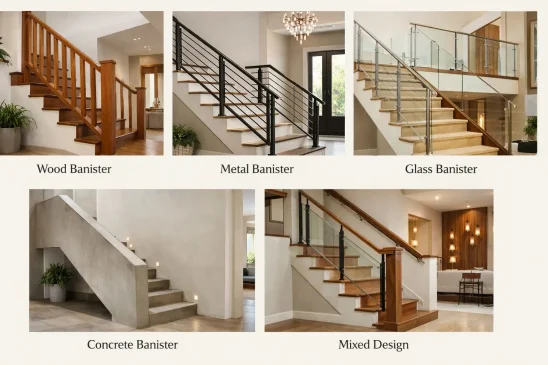

Wood
- Warm and comfortable grip
- Best for interiors
- Requires maintenance
Metal (Steel / Aluminium)
- Strong and durable
- Suitable indoor + outdoor
- Requires anti-corrosion coating
Glass + Rail Systems
- Glass acts as barrier
- Rail provides grip
Best for:
- Modern homes
- Open visual spaces
Concrete / Cement-Based Systems
- Solid and long-lasting
- Suitable for terraces and external stairs
Using high-quality cement like JK Super Cement ensures:
- Better durability
- Resistance to moisture and cracking
Where Banisters Are Critical
- Staircases (primary use)
- Split-level homes
- Duplex internal stairs
- External access stairs
What Actually Goes Wrong on Site
Most issues are execution failures—not design problems.
Common mistakes:
- Incorrect height during installation
- Weak anchoring into slab
- Misalignment across steps
- Over-designed shapes (poor grip)
- Inconsistent levels
Real Site Failure Pattern
- Rail feels slightly loose initially
- Over time → movement increases
- Eventually → unsafe to use
Root cause:
Improper fixing and anchoring—not material failure
Construction Checklist (Practical Use)
Before finalizing:
- Verify height (865–965 mm)
- Check grip size (32–50 mm)
- Ensure continuous run
- Confirm wall clearance
- Test fixing strength manually
Clear Decision Framework
If this was my own house:
- Prioritize comfort over design complexity
- Ensure strong fixing into structure
- Maintain consistent height and slope
- Choose material based on usage (not just look)
Because this is used every day—not just seen.
FAQs
What is a banister in simple terms?
A banister is the handrail along a staircase that provides support and safety while moving up or down.
Is banister the same as railing?
In common usage yes, but technically banister refers to the handrail system, while railing can refer to the entire barrier.
What is standard banister height?
Typically between 865 mm and 965 mm from the stair nosing.
How do you measure banister height?
Measure vertically from the edge of the step (nosing) to the top of the rail.
What size should a banister be for grip?
A diameter of 32–50 mm is comfortable for most users.
Can banister height be different on each step?
No. It must remain consistent throughout the staircase.
Which material is best for banisters?
Wood for comfort, metal for durability, and glass systems for modern design.
What causes banister failure?
Loose fixing and poor installation are the most common causes.
Can I install a wall-mounted banister?
Yes, especially for narrow staircases where space is limited.
Why is continuity important in a banister?
Continuous support ensures safety and stability during movement on stairs.