TMT Bars: Meaning, Properties, and Testing in Construction

If you’ve ever stood at a construction site and watched steel bars being unloaded, you’ve already met TMT bars, even if no one formally introduced you.
They’re the quiet backbone of almost every RCC structure we build today.
Homes.
Apartments.
Bridges.
Flyovers.
And yet, most homeowners only hear the term in passing — usually when a contractor says, “Sir, TMT bars lagane padenge.”
So let’s slow down and really understand it.
What is TMT, in easy words?
TMT full form is Thermo-Mechanically Treated.
In simple words, TMT bars are steel bars that are strengthened using heat and controlled cooling. Consider it akin to tempering glass or hardening a knife blade, where the exterior gains strength while the interior maintains its pliability.
This equilibrium constitutes the core objective.
Because buildings don’t just need strength.
They need to give:
They need to bend slightly during load, wind, or even earthquakes — without snapping.
That’s where TMT changed the game.
Earlier, we used plain mild steel or TOR steel. They worked, but they had limits. Corrosion issues. Less ductility. Inconsistent quality. Once TMT bars entered the picture, construction standards moved up a notch.
How TMT bars are made (without factory jargon)
Here’s the easiest way to explain it on site.
Imagine a hot steel bar coming out of a rolling mill — red hot.
Immediately, it’s blasted with water.
This sudden cooling hardens the outer layer.
The core remains hot and softer.
Then comes controlled cooling, where the inner heat tempers the outer shell.
End result?
• Hard exterior for strength
• Soft, ductile core for flexibility
• Strong bonding with concrete
That’s TMT in action.
And yes, this process directly impacts how the bar performs in a TMT test later.
Why TMT bars matter so much in real buildings
On paper, steel strength is measured in numbers.
On site, it’s measured in trust.
Good TMT bars mean:
• Columns that don’t crack under load
• Beams that can take stress without sudden failure
• Better performance during earthquakes
• Longer life in coastal or humid areas
Structures near the coast rust badly within years — not because cement was poor, but because the steel quality was compromised.
A proper TMT bar, with low carbon content and good manufacturing control, resists corrosion much better.
That’s why engineers insist on branded, tested bars — not local, unverified steel.
Grades of TMT bars you hear about
You’ll often hear terms like Fe 415, Fe 500, Fe 550, or even Fe 500D.
This “Fe” refers to yield strength.
In simple language:
• Fe 415 – more ductile, bends easily
• Fe 500 – higher strength, commonly used today
• Fe 500D – same strength, better ductility
Most residential construction today prefers Fe 500 or Fe 500D TMT bars, balancing strength and safety.
Again, these properties are confirmed through a TMT test.
So what is a TMT test, really?
People often ask — what is the TMT test, and why does it matter?
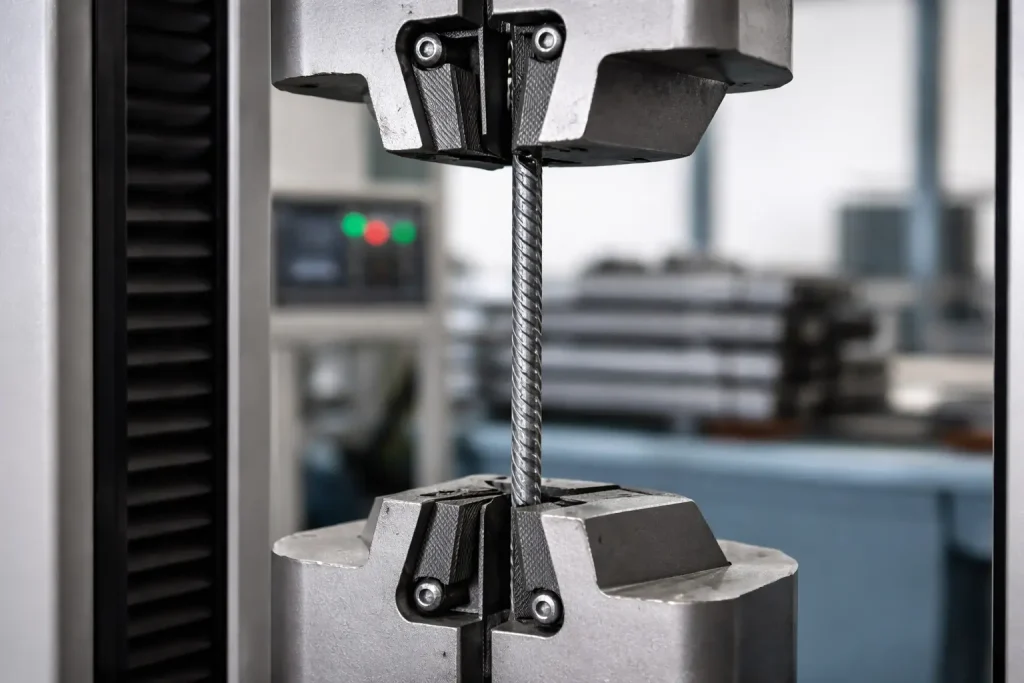
A TMT test is not just one test. It’s a set of checks done to ensure the steel behaves exactly as promised.
Some common TMT tests include:
• Tensile test – checks how much load the bar can take before breaking
• Bend test – bar is bent to see if cracks appear
• Re-bend test – bent, heated, cooled, and bent again
• Elongation test – checks ductility
• Chemical composition test – ensures low carbon content
On site, you may not see all these tests. But at the factory and lab level, every batch of TMT bars goes through them.
If a bar fails a TMT test, it simply shouldn’t be used.
A small site story (this happens more than you think)
A few years ago, a contractor saved a few rupees per kg by buying unbranded steel. It looked fine. Same diameter. Same weight.
During slab casting, bars snapped during bending.
Not dramatic — but enough to delay work and shake confidence.
Later, lab results showed poor elongation and failed TMT test values.
That one decision cost more in rework than what he “saved”.
This is why seasoned engineers obsess over TMT quality. Steel mistakes are permanent. Concrete hides them — but only for a while.
How TMT bars work with concrete
Concrete is strong in compression.
Steel is strong in tension.
Together, they form RCC — reinforced cement concrete.
But here’s the catch.
If steel doesn’t bond properly with concrete, cracks develop. That’s why TMT bars have ribs on the surface.
Those ribs:
• Improve grip
• Reduce slippage
• Distribute stress evenly
During a TMT test, bond strength and deformation patterns are closely observed.
Good steel doesn’t fight concrete.
It works with it.
Corrosion resistance: an underrated benefit of TMT
India’s climate is tough.
Monsoons.
Humidity.
Coastal air.
Pollution.
Low-quality steel corrodes fast, expands, and cracks concrete from inside.
Modern TMT bars, especially those with controlled carbon and sulfur content, resist this much better.
That’s one reason why long-lasting structures today depend heavily on proper TMT selection — not just cement quality.
Things homeowners should always ask
If you’re building a house, don’t hesitate to ask:
• Which grade of TMT bars are we using?
• Are they tested as per IS standards?
• Can I see the test certificate?
A genuine supplier will never hesitate.
Because behind every strong structure is steel that has passed every TMT test quietly, without drama.
Final Notes
At the end of the day, TMT is not just a material choice.
It’s a safety decision.
One that stays hidden inside concrete — quietly holding everything together for decades.
That’s also why responsible builders look at construction as a system, not isolated materials. Good steel needs good concrete to perform as intended. Brands like JK Cement, with their long-standing focus on consistency and on-site performance, fit into that thinking naturally — not as a label, but as part of a build that’s meant to last. And that, honestly, is how good construction should be.
FAQs – People often ask these
1. What does TMT stand for?
TMT stands for Thermo-Mechanically Treated. This treatment makes steel bars stronger and easier to bend, which is helpful in building projects.
2. Why are TMT bars better than regular steel bars?
TMT bars are stronger, more bendable, resist rust better, and perform safer during earthquakes.
3. What’s a TMT test, and who does it?
A TMT test includes tensile, bend, re-bend, and chemical tests. These are conducted at manufacturing units and certified labs.
4. Which grade of TMT bars is best for house construction?
Fe 500 or Fe 500D TMT bars are commonly used for residential buildings due to their balance of strength and flexibility.
5. Can I identify good TMT bars visually?
Not completely. Ribs and finish help, but only a proper TMT test report confirms quality.
6. Are TMT bars rust-proof?
No steel is completely rust-proof. That said, good TMT bars don’t corrode as easily as older kinds of steel.
7. Is TMT testing required in India?
Yes. Indian Standards say TMT bars need to be tested and approved before they can be used for building.