PUF Panel: Meaning, Types, Price & Roofing Applications Explained

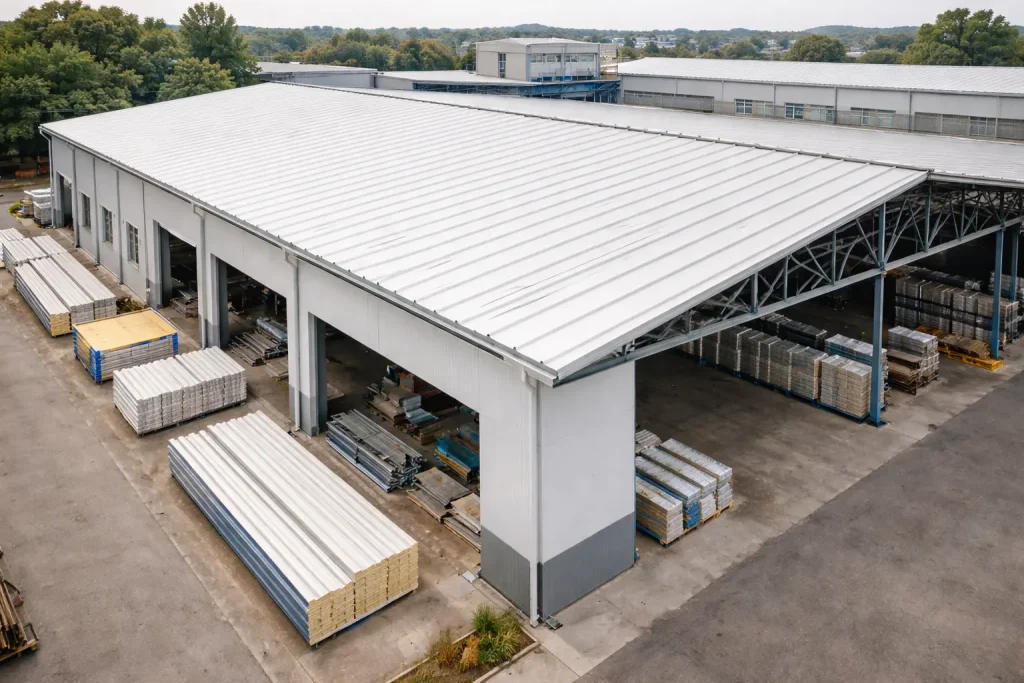
If you’ve ever stepped into a site office at noon in May and felt immediate relief from the heat, chances are you were standing under a PUF panel roof.
No fan blasting.
No hot air trapped inside.
Just a space that feels… normal.
That’s usually the first real introduction people have to PUF. Not through a brochure, but through comfort.
Over the last few years, PUF panel systems have quietly moved from factories and cold storages into warehouses, farmhouses, site offices, showrooms, and even modern homes. And once you understand what a PUF sheet actually does, the popularity makes sense.
Let’s break it down simply—what a PUF panel means, the different types, realistic PUF panel price ranges, and where a PUF panel roof genuinely works well.
What does a PUF panel actually mean?
PUF stands for Polyurethane Foam.
In simple words, a PUF panel is like a sandwich.
Two metal sheets on the outside.
A thick layer of polyurethane foam locked in between.
This foam is the real hero.
It blocks heat.
Cuts down noise.
And keeps indoor temperatures stable.
That’s why when you touch a PUF sheet from outside in the sun, it may feel hot—but inside, the space stays noticeably cooler.
Think of it like a good thermos flask.
Heat struggles to get in.
And whatever temperature you want inside stays there longer.
That’s the basic magic of PUF.
Why PUF panels are getting popular on sites
Earlier, PUF panel roof systems were mostly limited to cold storages and food factories.
Today, contractors use them for all kinds of buildings.
The reason is simple.
A PUF panel solves three everyday site problems at once.
Heat control
Noise reduction
Fast construction
Unlike a regular metal roofing sheet, a PUF sheet doesn’t turn the room into an oven by afternoon. And unlike RCC slabs, it doesn’t take weeks of curing, shuttering, and heavy labour.
For temporary and semi-permanent structures, PUF has become a very practical middle ground.
Types of PUF panels you’ll see commonly
Not all PUF panel systems are the same. On site, you’ll usually come across three main types.
PUF roofing panels
These are made specifically for roofs. They usually have a ribbed or corrugated outer sheet and are designed to handle sun, rain, and wind.
PUF wall panels
Used for side cladding and partitions. These PUF sheets are flatter and focus more on insulation than load-bearing.
Cam-lock PUF panels
Mostly used in cold storage buildings. They lock tightly together to avoid air leakage and temperature loss.
For most buildings, especially sheds or site offices, a PUF panel roof combined with PUF wall panels works well.
How a PUF panel roof performs in real life
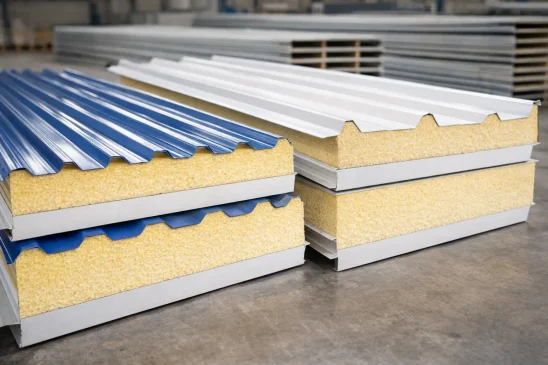

On paper, insulation numbers always look impressive.
On site, what really matters is how it feels.
A properly installed PUF panel roof can reduce indoor temperatures by around 8 to 12 degrees compared to a normal metal roof. In peak summer, that difference is huge.
Noise is another benefit people don’t talk about enough.
Rain on a normal metal sheet can be painfully loud.
Rain on a PUF sheet feels much softer.
For people working long hours inside—security guards, engineers, shop staff—that comfort adds up every day.
PUF panel price: what should you realistically expect?
Let’s talk about money without confusion.
PUF panel price mainly depends on thickness and the quality of the outer metal sheets.
Common thickness options are 30 mm, 40 mm, 50 mm, and 60 mm.
Rough PUF panel price ranges look like this:
30 mm PUF panel: ₹1,200 to ₹1,400 per sq m
50 mm PUF panel: ₹1,500 to ₹1,800 per sq m
60 mm and above: ₹1,800 to ₹2,200 per sq m
Prices change with steel rates, colour coating, and project size. Installation and structural work are usually extra.
Yes, a PUF panel roof costs more upfront than a basic metal sheet. But when you factor in better comfort and lower cooling costs, many owners feel it balances out over time.
Where PUF panels make the most sense
A PUF panel isn’t meant for every type of building. But where it fits, it works extremely well.
PUF panel roof is commonly used for warehouses, factories, cold storages, site offices, portable cabins, farmhouses, and commercial sheds.
In homes, PUF works best for terrace rooms, home offices, studios, or spaces that face direct sunlight all day.
It’s still less common for full RCC houses, though prefab homes are changing that slowly.
Installation matters more than the panel itself
Here’s a simple site truth.
Even the best PUF sheet won’t perform well if the installation is poor.
Most problems happen because joints aren’t sealed properly, the roof slope isn’t right, panels are cut roughly, or flashing and edge protection are ignored.
A PUF panel roof needs proper planning, clean joint work, and experienced installers. When this is done right, leaks and heat issues are rare.
One thing people often overlook
A PUF panel performs best when the structure below it is strong and properly aligned. Whether it’s a steel frame or RCC support, the base matters.
On many sites, good concrete work and dependable cement quietly make a big difference. When the foundation and supports are done properly using reliable materials like JK Cement, PUF panel roofs sit straighter, seal better, and last longer without recurring issues.
The panel gets the attention.
The foundation does the heavy lifting.
Final thoughts
If you’ve dealt with hot sheds, noisy roofs, or high cooling bills, a PUF panel roof is genuinely worth looking at. Just remember to choose the right thickness, understand the real PUF panel price, and work with installers who know their job. Site experience shows again and again that even the best PUF sheet performs only as well as the structure beneath it. When RCC supports and concrete work are done right using dependable materials like JK Cement, PUF panels age better and cause fewer problems over the years. Get the basics right, and the roof takes care of the rest.
FAQs
What are PUF panels used for?
PUF panels are mainly used for roofs and walls where insulation and temperature control are important.
Do PUF panels work well in hot climates?
Yes, they perform very well in hot regions by reducing heat transfer.
How durable are PUF panels?
With proper installation, PUF panels can last 20 to 30 years.
Are PUF panels waterproof?
The panels resist water, but joints must be sealed properly to prevent leaks.
Can PUF panels be used for houses?
They are usually used for terrace rooms, studios, prefab homes, and site offices rather than full RCC houses.
Why do PUF panels cost more than metal sheets?
Because of insulation performance, material quality, and long-term energy savings.
What thickness PUF panel is best for roofing?
For most roofing applications, 40 to 50 mm thickness works well.