Stiffness in Construction: Meaning, Formula & Role in Structural Design

At any building under construction, you will hear people asking the following questions:
“How much load can this beam take?”
“Is this column strong enough?”
But they often forget to talk about how a structure behaves every day. They miss talking about a stiffness property. The meaning of stiffness in construction explains why some buildings feel solid.
The others experience excessive movement and vibration. Engineers focus on stiffness because modern structures require extra comfort. Read on to find out what stiffness is and why it has become a key design parameter.
What Is Stiffness in Construction?
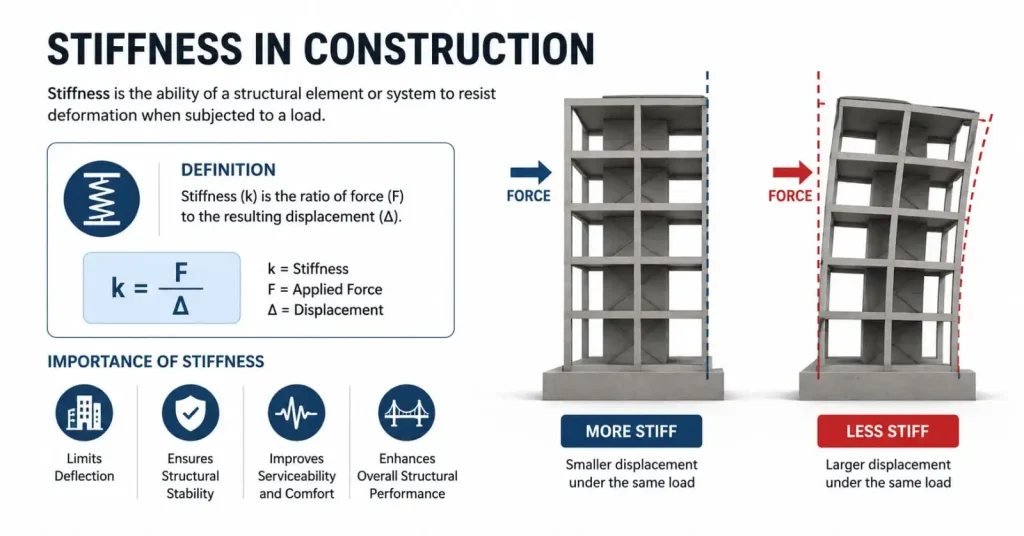
Stiffness is the ability of a structure to resist deformation when an external force or load acts on it. What exactly does it do? It measures the difficulty level of a structural element to
- Bend
- Stretch
- Twist
- Deflect
Let’s understand it this way: Press a steel ruler and a rubber strip with the same force. What will happen? The rubber is easy to bend. But steel? It hardly moves. Thus, the steel ruler has greater stiffness than the rubber. The principle is the same in construction.
There is some amount of deformation in every member when loads from different directions act on a structure. This is where the high-stiffness structures feel less movement under the same load. The twist? It doesn’t mean that the structure is strong. But it means that it resists displacement more effectively.
What Do You Mean by Stiffness in Structural Engineering?
Stiffness in structural engineering highlights the relationship between the force applied and the resulting displacement. Engineers use stiffness to predict the movement of the following under loading:
- Beam
- Column
- Slab
- Frame
Note: The beam has higher stiffness if two beams carry the same load, but one deflects less.
But why do structural engineers evaluate stiffness? They do so because excessive movement can result in:
- Wall cracks
- Uneven floors
- Excessive vibrations
- Discomfort of the occupant
- Reduced service life
A building does not collapse due to failure. But sometimes a structure becomes unusable because it deflects too much. This is why it is important to understand what is stiffness in structural design.
How Do You Calculate Structural Stiffness in Construction?
The engineer calculates the structural stiffness by dividing the applied force by the displacement produced by that force.
Given below is the formula for stiffness:
k = F / δ
Where:
- k = stiffness
- F = applied force
- δ = displacement of deflection
The formula highlights a simple relationship. The structure with high stiffness will cause a small displacement under a large force. Whereas the low stiffness is there if a small force moves the structure significantly.
What Are the Different Types of Stiffness in Construction?
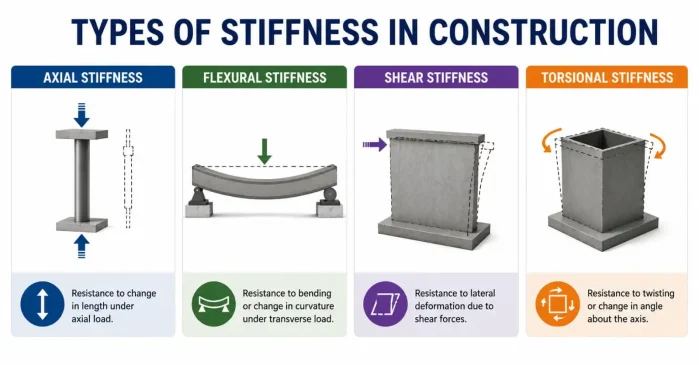

The structural elements resist different forms of movement. This is why there are various types of stiffness in engineering design. Given below are some of them:
- Axial Stiffness
This type of stiffness resists stretching or compression along the length of a member. Columns under compression and tension members in trusses rely heavily on axial stiffness.
- Flexural Stiffness
Flexural stiffness measures resistance to bending. Beams and slabs are primarily designed based on flexural behavior because they constantly face bending loads.
- Shear Stiffness
Shear stiffness helps resist sliding forces acting parallel to a section. It is very important in earthquake-resistant structures.
- Torsional Stiffness
Torsional stiffness refers to resistance against twisting. Irregular building shapes often require careful consideration of torsional effects. Each type contributes to the overall stiffness of a structure.
What Are the Factors that Affect the Stiffness of Structures?
Given below are some factors that influence how much a structure deforms under load:
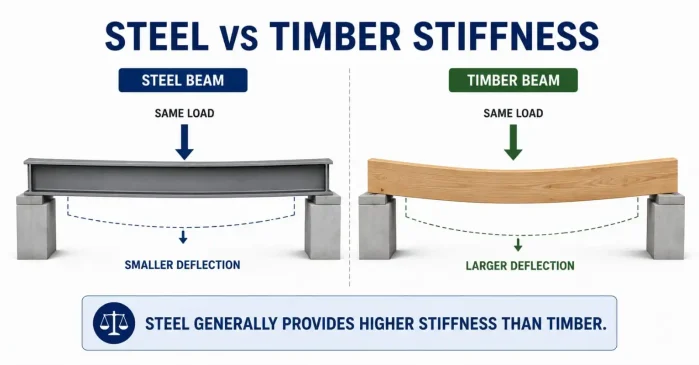
- Material Type
Different materials possess different levels of stiffness. Steel generally has higher stiffness than timber because of its greater modulus of elasticity.
- Cross-Section Size
Larger beams and columns typically provide greater stiffness. A deeper beam resists bending much more effectively than a shallow one.
- Length of Member
Longer members tend to deflect more. This is why long-span beams often require special design considerations.
- Structural Shape
The geometry of a structure influences how loads travel through it. Well-proportioned structural systems usually exhibit better stiffness performance.
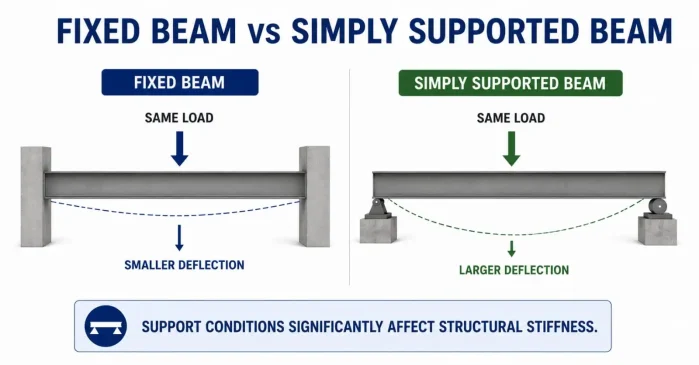
- Support Conditions
A fixed beam generally has greater stiffness than a simply supported beam because its ends resist rotation. All these factors work together to determine how stiff a building ultimately becomes.
What is the Difference Between Stiffness and Strength in Construction?
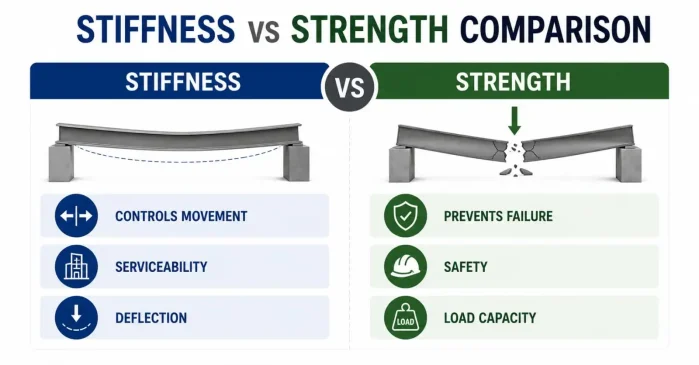
Stiffness measures resistance to deformation, while strength measures resistance to failure. This is one of the most commonly misunderstood concepts in construction. The table below highlights the difference between stiffness and strength:
| Property | Stiffness | Strength |
| Measures | Resistance to deformation | Resistance to failure |
| Focus | Movement and deflection | Load-carrying capacity |
| Concern | Serviceability | Safety |
| Unit | Force per displacement | Stress or load capacity |
A successful structural design requires both strength and stiffness. One cannot replace the other.
How Do Engineers Increase Stiffness in Construction?
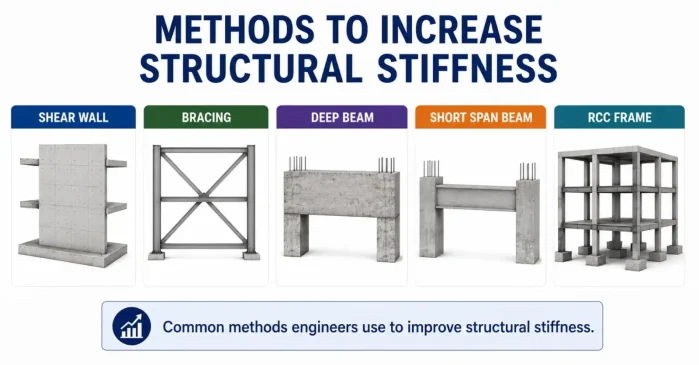
Engineers improve stiffness when they choose appropriate materials and increase member dimensions. They optimize the structural systems. Given below are some ways to increase structural stiffness in construction:
- Increase Member Depth
A deep beam can reduce deflection. Even a modest increase in depth often produces substantial gains in stiffness.
- Use Stiffer Materials
Steel and reinforced concrete generally provide greater stiffness than lighter alternatives.
- Add Bracing
Bracing systems help reduce lateral movement caused by wind and seismic forces.
- Improve Structural Layout
Well-distributed columns and shear walls increase overall building stiffness.
- Reduce Span Length
Shorter spans experience less deflection under similar loading conditions. These strategies help engineers maintain the desired level of structural performance.
What Are the Common Problems that Happen Due to Insufficient Stiffness?
Low stiffness can result in excessive movement, cracking, vibrations, and long-term durability issues. A structure may stand, but still experience serious problems if its stiffness is inadequate.
Common issues include:
- Excessive floor deflection
- Cracks in plaster and finishes
- Window and door misalignment
- Noticeable vibrations
- Water ponding on roofs
- Increased maintenance costs
- Reduced occupant comfort
Insufficient stiffness can also result in excessive sway during strong winds in high-rise buildings. This makes occupants uncomfortable even when the structure remains safe.
What Are the Advantages of Maintaining Adequate Structural Stiffness?
The adequate stiffness not only improves comfort but also durability and performance of structural reliability. A structure with proper design balances both strength and stiffness. Some of the benefits include:
- Less deflection
- Better crack control
- Better occupant comfort
- Greater structural stability
- Longer service life
- Lower maintenance expenses
- Boost earthquake and wind performance
Adequate stiffness also protects non-structural components such as partitions, cladding, ceilings, and finishes from unnecessary damage. For owners, this often translates into fewer repairs and lower lifecycle costs.
The Final Words
The next time you enter a building, notice how solid and stable it feels. That’s the effect of good stiffness design. The stiffness meaning goes beyond engineering textbooks. It explains why buildings resist movement. Also, the reason behind the same level of the floors. What’s more? It clearly explains why structures continue performing for decades.
In simple terms, strength prevents collapse and stiffness controls movement. Stiffness separates a structure that merely stands from one that overperforms throughout its life.
FAQs
1. What is stiffness in simple words?
Stiffness is the ability of a material or structure to resist bending, stretching, twisting, or any other form of deformation when a force acts on it.
2. What is the basic stiffness formula?
The basic formula is stiffness equals force divided by displacement. It shows how much force is needed to produce a certain amount of movement.
3. Why is stiffness important in construction?
Stiffness helps control deflection, vibration, cracking, and structural movement. It improves comfort, durability, and overall building performance.
4. Is stiffness the same as strength?
No. Strength refers to a structure’s ability to resist failure, while stiffness refers to its ability to resist deformation under load.
5. Which material has higher stiffness, steel or timber?
Steel generally has much higher stiffness than timber because it possesses a significantly greater modulus of elasticity.
6. Can a structure be strong but not stiff?
Yes. A structure may safely carry loads without failing, yet still experience excessive deflection because of low stiffness.
7. How do engineers improve structural stiffness?
Engineers increase stiffness by using larger sections, stiffer materials, additional bracing, shear walls, and optimized structural layouts.