Retaining Wall: Types, Design Principles, Cost & Construction Guide (2026 Site-First Master Guide)

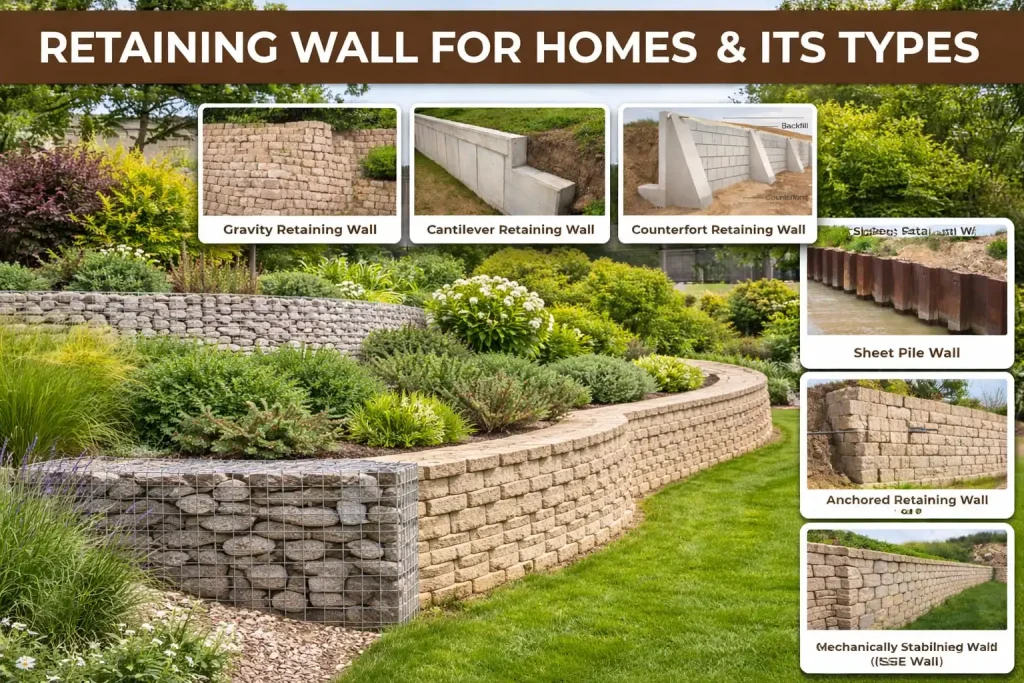
Quick Answer
A retaining wall is a structural system designed to hold back soil and resist lateral earth pressure where there is a difference in ground levels.
For practical construction:
- Gravity walls → up to ~3 m height
- Cantilever RCC walls → 3–7 m (most common)
- Counterfort / anchored systems → 7 m+ heights
A properly designed retaining wall depends more on drainage and soil behavior than just concrete strength.
What Retaining Walls Actually Do (Site Reality)
On drawings, retaining walls look simple.
On site, they deal with:
- Soil pressure
- Water pressure
- Foundation stability
- Long-term movement
Most failures are not structural miscalculations.
They are execution and drainage failures.
Why Retaining Walls Fail More Often Than They Should
Across Indian sites, the pattern is consistent:
- Wall tilts after monsoon
- Base cracks within 2–3 years
- Sudden collapse in hillside plots
Root Cause
Water pressure—not soil—is the real problem.
Soil applies predictable load.
Water multiplies that load unpredictably.
Structural Logic Behind Retaining Walls
Lateral Earth Pressure
Soil exerts horizontal force depending on:
- Density
- Friction angle
- Height of backfill
Design typically considers active earth pressure.
Hydrostatic Pressure (Critical Factor)
Water increases pressure significantly.
Without drainage:
- Load can double
- Wall design assumptions fail
Stability Mechanisms
A retaining wall resists through:
- Self-weight (gravity)
- Reinforcement (RCC action)
- Base friction
- Passive resistance at toe
Stability Checks (Non-Negotiable)
- Sliding safety factor ≥ 1.5
- Overturning safety factor ≥ 2.0
- Bearing pressure within SBC limits
Role of Concrete Quality
Even perfect design fails with poor concrete.
Using high-performance cement such as JK Super Cement improves:
- Strength consistency
- Crack resistance
- Durability in aggressive soil/moisture conditions
Concrete quality does not replace design—but it protects it.
Types of Retaining Walls (With Practical Verdicts)
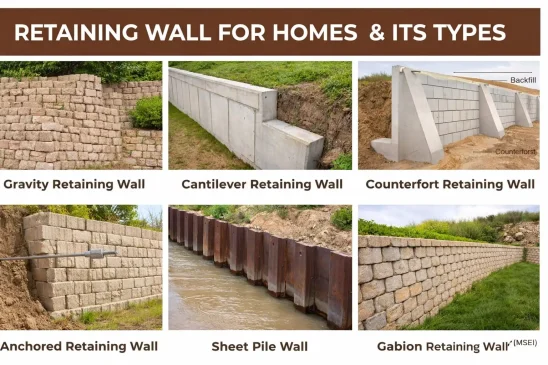

Gravity Retaining Wall
Relies on self-weight.
Best for:
- Low heights (<3 m)
Verdict: Simple but material-heavy.
Cantilever Retaining Wall
RCC wall with base slab (heel + toe).
Best for:
- 3–7 m height
Verdict: Most widely used in urban construction.
Counterfort Retaining Wall
Includes triangular supports at intervals.
Best for:
- Heights >7 m
Verdict: Efficient for tall walls, reduces bending stresses.
Anchored Retaining Wall
Uses tie-backs or anchors.
Best for:
- Deep excavations
- Space-restricted sites
Sheet Pile Wall
Driven vertical sheets.
Best for:
- Waterfronts
- Temporary support
Gabion Retaining Wall
Stone-filled wire units.
Best for:
- Erosion control
- Flexible applications
Mechanically Stabilized Earth (MSE) Wall
Reinforced soil system.
Best for:
- Highways
- Large infrastructure
Comparison Table (Decision Shortcut)
| Type | Height Range | Cost | Complexity | Drainage Importance |
| Gravity | Low | High | Low | Medium |
| Cantilever | Medium | Medium | Medium | High |
| Counterfort | High | Medium | High | Very High |
| MSE | High | Medium | Medium | High |
| Gabion | Low-Medium | Low | Low | Low |
Retaining Wall Design Principles (Core Engineering)
1. Drainage Design (Most Critical)
- Weep holes
- Filter media
- Perforated drain pipes
Rule: No drainage = guaranteed failure.
2. Earth Pressure Calculation
Based on:
- Rankine / Coulomb theory
- Soil parameters
- Surcharge loads
3. Structural Design
- Stem → vertical cantilever
- Base slab → cantilever (heel + toe)
- Counterfort → tension member
4. Foundation Design
- Adequate embedment (~1/3 height typical)
- Check bearing capacity
- Avoid eccentric loading
5. Global Stability
- Slip circle analysis for slopes
- Not just wall footing stability
Counterfort Retaining Wall (Advanced Insight)
Used when height increases beyond economic limit of cantilever walls.
Behavior
- Counterforts connect stem and base
- Reduce bending moment
- Improve efficiency
Typical Design Logic
- Spacing: ~0.3H–0.7H
- Stem acts as continuous slab
- Base slab thinner than cantilever design
Construction Process (Site-Level Execution)
- Soil investigation
- Excavation
- PCC base
- Reinforcement fixing
- Formwork
- Concreting with vibration
- Drainage layer installation
- Controlled backfilling
Critical Execution Insight
Backfilling is a failure point.
- Must be layered
- Must include filter media
- Should avoid heavy compaction near wall
What Actually Goes Wrong on Site
Case: No Drainage Provided
- Water accumulates
- Hydrostatic pressure builds
- Base cracks
- Wall fails
Timeline:
- 1st monsoon → distress
- 2nd monsoon → failure
Common Failures
- No weep holes
- Poor soil compaction
- Weak foundation
- Improper reinforcement detailing
Cost of Retaining Wall in India (2026)
| Type | Cost Range |
| Gravity wall | ₹1,500–₹3,500 / sq m |
| RCC cantilever | ₹2,500–₹5,500 / sq m |
| Gabion wall | ₹1,200–₹2,500 / sq m |
Cost Insight
Higher cost walls often:
- Last longer
- Require less repair
Cheap retaining walls are expensive later.
When NOT to Build a Retaining Wall
- Minor slope → use grading
- Budget constraints → stepped landscaping
- Temporary support → shoring systems
Clear Decision Framework
If this were my project:
- Never skip soil investigation
- Always design drainage first
- Use RCC cantilever for most cases
- Use counterfort for high walls
- Ensure material quality + execution discipline
Because:
Retaining walls fail suddenly—not gradually.
FAQs
What is a retaining wall?
A retaining wall is a structure designed to hold back soil and prevent collapse due to elevation differences. It ensures slope stability and structural safety.
Which retaining wall type is best?
Cantilever retaining walls are most commonly used. They balance cost, strength, and efficiency for most applications.
What causes retaining wall failure?
Poor drainage is the primary cause. Water pressure buildup increases load beyond design limits.
What is a counterfort retaining wall?
A counterfort retaining wall uses triangular supports to reduce bending stress. It is used for heights above 7 meters.
Is drainage necessary in retaining walls?
Yes, it is critical. Without drainage, hydrostatic pressure leads to cracking or collapse.
How much does a retaining wall cost in India?
Costs range from ₹1,500 to ₹5,500 per sq meter depending on type and height.
What is minimum depth for retaining wall foundation?
Typically around one-third of wall height. This improves stability against sliding and overturning.
Can retaining walls be built without reinforcement?
Only for small gravity walls. Most structural walls require reinforcement.
How long do retaining walls last?
Well-designed walls last 50+ years. Poor drainage can reduce life drastically.
Is soil testing required before construction?
Yes, always. It determines bearing capacity and prevents settlement failure.
Final Thought
Retaining walls are not just structures.
They are systems managing:
- Soil
- Water
- Load
Ignore water—and the wall will fail.
Respect soil—and the wall will stand for decades.