Load-Bearing vs Framed Structures: Which Is Right for Your Home?

Picture this—you’re standing on your empty plot in Jaipur, dreaming of a snug little bungalow. The local mason tells you, “Sir, we’ll just make solid brick walls, no need for all that concrete beam drama.” A month later, your cousin in Bengaluru is proudly showing off his RCC-framed duplex where walls are more like partitions than structure. Same goal—build a home. But two completely different structural systems.
Now here’s the tricky part: choosing between load-bearing construction and framed structures isn’t just about cost. It’s about soil, seismic safety, your long-term plans, and yes—how many floors you’re secretly planning to add later (because everyone says “just ground floor” and ends up stacking more).
So let’s strip away the jargon and dive into what really matters.
What Is a Load-Bearing Structure?
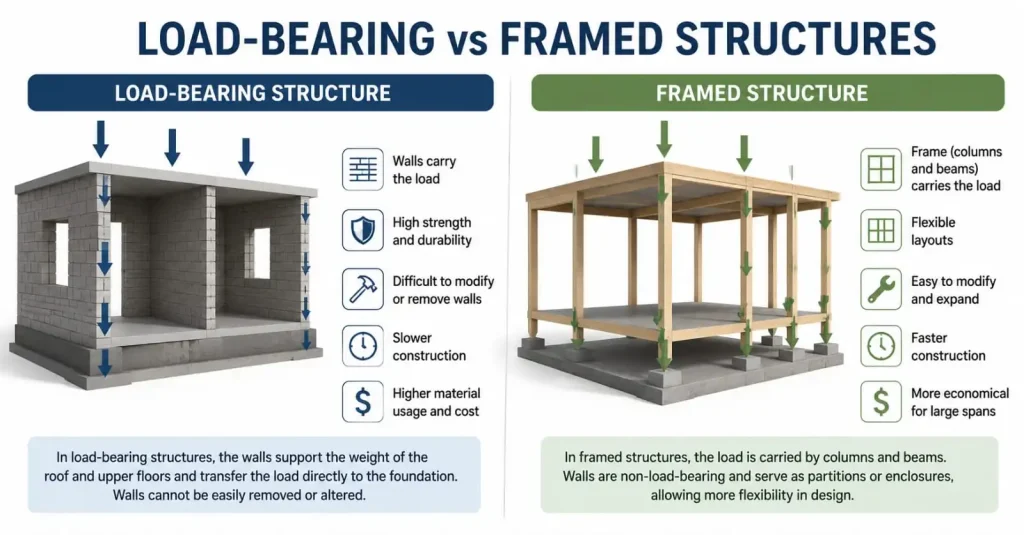
In a load-bearing setup, your walls are the real heroes. Every brick wall is like a giant column—it takes the load from slabs, floors, and roof, and passes it down to the foundation. No fancy RCC skeleton here—the walls are the skeleton.
Quick realities of load-bearing homes:
- Walls of brick, stone, or block carry all the loads.
- Common for one or two floors, especially in small towns and rural areas.
- Needs thick walls (9” for single story, 12” for double story, per BIS norms).
- Cheaper material-wise, but slow—brickwork takes time.
I’ve walked through old townhouses in Jaipur and Lucknow—absolutely charming, with thick brick walls that keep interiors cool. But ask those owners about modifying layouts, and they’ll laugh—because every wall is structural, moving even one means big trouble.
What Is a Framed Structure?
Framed structures flip the script. Here, the load doesn’t sit on walls—it runs through a skeleton of RCC (columns + beams) or sometimes steel. The walls are just infill—non-structural.
Hallmarks of framed structures:
- Columns and beams form the core load path.
- Walls can be brick, AAC blocks, or even lightweight boards—just partitions.
- Perfect for high-rises, apartments, multi-story villas.
- Governed by IS 456 (concrete design) and IS 1893 (seismic safety).
Step into any Mumbai apartment and you’ll see this in action. You can knock out a bedroom wall to create a bigger hall because that wall isn’t carrying the building. In seismic zones, this flexibility isn’t just about design—it’s about survival.
Load-Bearing vs Framed Structures: A Side-by-Side Look
| Feature | Load-Bearing | Framed Structure |
| Height | Safely up to 2 floors | 3 floors to skyscrapers |
| Speed | Slow (lots of masonry) | Faster with formwork/prefab |
| Cost | Cheaper initially | Higher upfront but efficient later |
| Layout | Fixed, rigid | Flexible, walls can shift |
| Earthquake Safety | Weak in seismic zones | Much better with ductile detailing |
| Renovations | Painful (walls are structural) | Easier (infills can be removed) |
When Does Load-Bearing Construction Make Sense?
- Tight budgets: It’s the cheapest route for a small house.
- Small height: Ground floor or two floors max.
- Rural plots: Local masons are comfortable with this method.
- Good masonry supply: Needs consistent, strong brick/block quality.
But remember: if your area is Zone IV or V (Delhi, Northeast, Himachal), a load-bearing house is like rolling dice with your safety.
When Is a Framed Structure the Smarter Option?
- Going vertical: Planning 3 floors today or maybe 5 tomorrow? RCC frames are the way.
- Open layouts: Want a double-height hall or flexible partitions? Only frames allow that.
- Earthquake-prone zones: RCC frames with ductile detailing absorb seismic shocks way better.
- Speed builds: Precast or prefab frames save months.
Cost Comparison in 2025
For a 1000 sq ft home (approx figures):
- Load-bearing: ₹1,200–₹1,400/sq ft
- RCC Framed: ₹1,400–₹1,600/sq ft
- Steel frame (prefab): ₹1,800–₹2,000/sq ft
Load-bearing seems cheaper, but framed wins if you factor in seismic safety, expansion, and renovation ease.
Design Flexibility and Future Expansion
Load-bearing is like signing a rigid contract—you can’t back out. Knock down one wall and the whole house sulks.
Framed is forgiving—you can add a floor, shift walls, or open up spaces. Future-proofing your foundation for extra stories is easier with frames.
Regional Realities
- North India / Himalayas (Zone IV–V): Stick to framed + seismic detailing (IS 13920). Load-bearing is unsafe here.
- Coastal South (Zone III): Framed with AAC infills works best; moisture control is key.
- Central India (Zone II): Load-bearing is okay up to 2 floors, but soil testing still mandatory.
- Metro cities (Delhi, Bengaluru, Mumbai): Speed + regulations = framed or prefab, no questions asked.
Practical Tips Before You Decide
- Talk to an engineer, not just your mason. Structural choice isn’t guesswork.
- Plan early. Switching from load-bearing to framed mid-project is a nightmare.
- Check local skills. In small towns, RCC work may suffer without trained masons.
- Think future. Even if you’re building just ground + 1 now, foundations for RCC should allow for vertical growth.
- Check codes. Your municipality may not even allow load-bearing above two floors.
FAQs
1. What exactly is the difference between a load-bearing wall house and an RCC framed structure in simple terms?
In a load-bearing house, the brick or block walls carry all the load. If you remove one, the house weakens or even collapses. In a framed structure, the load goes through RCC columns and beams, while the walls are just partitions. This gives framed structures flexibility, especially in multi-story and seismic zones.
2. Can I change my existing load-bearing home into a framed structure later?
Not really. To “convert” you’d have to demolish and rebuild, because load-bearing foundations aren’t designed for RCC frames. What you can do is retrofit for strength (like adding concrete jackets or steel ties), but that still won’t give you the flexibility of a frame.
3. Which option is cheaper if I want to build a simple two-floor house in a small town?
Load-bearing will be cheaper upfront—by ₹200–₹300 per sq ft. But remember: if you ever plan to add a third floor, remodel rooms, or you live in a seismic zone, RCC framed is safer and more future-proof.
4. Why do experts say framed structures perform better in earthquake-prone areas?
Because RCC frames are ductile—they bend and sway without collapsing. Load-bearing masonry is brittle—once cracks form, walls can fail suddenly. BIS codes (IS 1893, IS 13920) mandate RCC frames with ductile detailing in Zones III, IV, and V for this reason.
5. Is framed construction always faster than load-bearing?
Generally yes. Load-bearing needs endless masonry, while framed uses formwork or even precast elements. On large projects, framed can be 20–30% quicker. On small homes, speed difference is less, but RCC still gives you cleaner timelines.
6. In a framed house, which walls can I safely remove during renovation?
You can remove infill walls (brick or AAC) but never touch columns or beams. Always get a structural engineer’s approval—sometimes even infill walls provide lateral support.
7. Do framed structures need more skilled labor compared to load-bearing?
Yes. RCC frames require trained carpenters for shuttering, masons who know proper concrete pouring, and site engineers for detailing. Load-bearing relies more on traditional masonry skills. Labor quality directly affects safety.
8. What kind of maintenance does a framed building need compared to a load-bearing one?
Framed structures might show cracks near joints or infill walls—usually minor and repairable. Load-bearing homes need regular repointing of mortar, and cracks can signal bigger issues since walls are structural.
9. Which type of construction gives better insulation and thermal comfort?
Neither by default—it depends on the infill or wall type. For framed, AAC blocks give great insulation. For load-bearing, hollow clay or cavity walls help. The structural system itself doesn’t decide comfort—the material does.
10. Can I still use brick walls in a framed structure?
Yes, absolutely. Many framed buildings still use brick infills. But modern trends prefer AAC blocks because they’re lighter, reduce seismic loads, and insulate better.