Gaj to Square Feet Conversion: Easy Formula & Calculator for Home Construction

If you’ve ever stood at a construction site or a property office in India, you’ve probably heard this line: “Plot kitne gaj ka hai?”
And then, five minutes later, someone else asks the same thing in square feet.
This back-and-forth between gaj to sq ft is so common that it’s almost part of the building process. Yet, it still confuses homeowners, first-time buyers, and even some seasoned folks when numbers start flying around.
People nod confidently, then quietly pull out a calculator later.
Let’s clear this up once and for all, without jargon, without overcomplicating things, and using examples that actually make sense on a real site.
What is a gaj?
In most parts of North India, gaj is just another name for a square yard.
Simple as that.
So when someone says “1 gaj feet,” what they really mean is the area of one square yard, expressed in square feet.
And here’s the key relationship you need to remember:
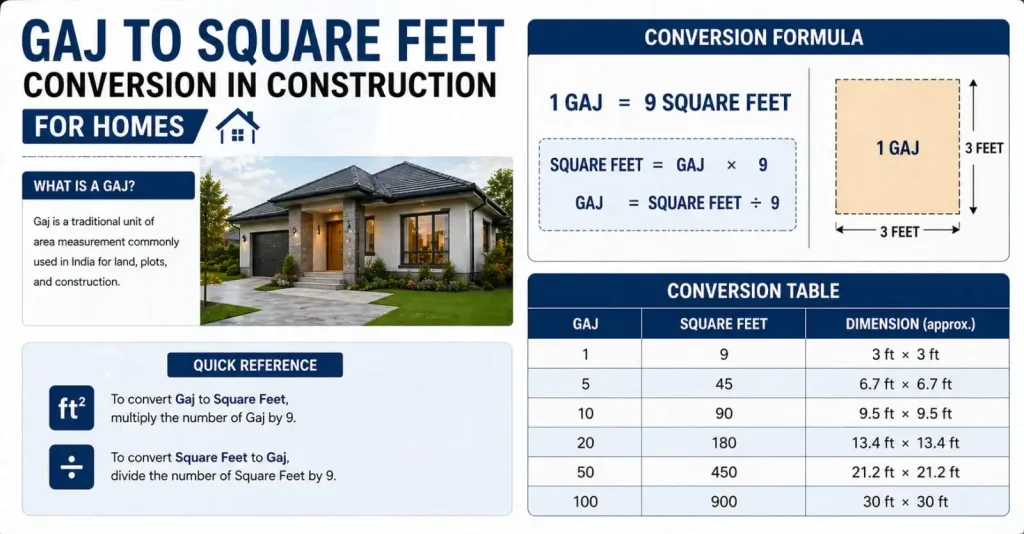
1 gaj = 9 square feet
That’s it.
No hidden math.
No complicated formula.
This single line is the backbone of every gaj to sq ft conversion you’ll ever do.
Why this conversion matters on a construction site
On paper, plots are often quoted in gaj.
But when you start building, almost everything else—floor plans, cement calculations, tiles, paint coverage—works in square feet.
If you don’t convert correctly:
You might underestimate material.
Or worse, over-order and waste money.
Contractors and homeowners may talk different “measurement languages.”
That’s when confusion creeps in.
Understanding square feet to gaj and back helps everyone stay on the same page.
The easiest formula (no calculator stress)
Let’s keep this practical.
Gaj to square feet:
Multiply by 9
Square feet to gaj:
Divide by 9
That’s all.
So if your plot size is in gaj and you want square feet, just multiply.
If it’s in square feet and someone asks in gaj, divide.
This works every single time.
A real-world example everyone asks about
This is probably the most Googled question in small towns and growing cities:
100 gaj in square feet
Let’s do it together.
100 × 9 = 900 square feet
So, 100 gaj in square feet = 900 sq ft
Now picture it.
A typical 2BHK ground-floor layout with sensible room sizes, a small setback, and decent ventilation—that’s roughly what 900 square feet looks like.
Once you visualise it, numbers stop feeling abstract.
Thinking in rooms, not numbers
Here’s a trick that is often shared with homeowners.
Instead of obsessing over formulas, think like this:
A small bedroom: 100–120 sq ft
Living room: 150–180 sq ft
Kitchen: 70–100 sq ft
When you convert gaj to sq ft, suddenly the space becomes relatable.
You stop seeing “90 gaj” or “120 gaj” as just numbers and start seeing rooms, walls, and movement.
That’s when planning gets smarter.
Common mistakes people make
One big one is mixing linear feet with square feet.
Someone says “1 gaj feet” and assumes it’s a length.
It’s not.
Gaj is an area, just like square feet.
Another mistake?
Using 10 instead of 9 for quick math.
That may feel harmless, but over a full house, it can throw off your estimates badly—especially for cement, flooring, or waterproofing.
Stick to the correct gaj to sq ft factor. Always 9.
Why dealers and engineers insist on square feet
Most construction materials—cement, tiles, putty, paint—are calculated per square foot.
So even if your plot is discussed in gaj during purchase, all serious execution shifts to square feet.
That’s also why knowing square feet to gaj helps during land negotiations, while gaj to sq ft helps during construction.
Both matter. Just at different stages.
A quick mental shortcut (for site conversations)
If you want a rough idea without pulling out your phone:
10 gaj ≈ 90 sq ft
50 gaj ≈ 450 sq ft
100 gaj ≈ 900 sq ft
This mental math keeps you confident during discussions with contractors or brokers.
And yes, it still respects the proper gaj to sq ft conversion.
Strong Homes Start with Simple Clarity
At the end of the day, construction is already stressful enough. Measurements shouldn’t add to it. Once you lock this into your head—1 gaj = 9 square feet—things start falling into place. Conversations with brokers get clearer. Discussions with engineers make more sense. Even material planning feels less intimidating. And when your basics are right, everything else—from choosing reliable materials like JK Cement to planning each stage of construction—becomes smoother and more confident. Because good construction doesn’t start with cement bags on site. It starts with getting the fundamentals right.
FAQs
1. Is gaj the same everywhere in India?
Mostly yes. In North India, gaj is commonly used and equals one square yard. Always confirm locally, but the gaj to sq ft value of 9 is standard.
2. How do I convert square feet to gaj quickly?
Just divide by 9. That’s the simplest square feet to gaj method.
3. How much is 1 gaj feet exactly?
1 gaj feet = 9 square feet. No rounding needed.
4. Why are plots sold in gaj but houses planned in square feet?
Gaj is a traditional land unit. Square feet work better for design, materials, and costing.
5. Is 100 gaj enough space for a small family home?
Yep, 100 gaj is like having 900 square feet. That should work fine for a small house if it’s planned out well.
7. Are online gaj to sq ft converters accurate?
You can, but honestly, multiplying by 9 is faster and more reliable on-site.
7. Does wrong conversion affect construction cost a lot?
Absolutely. Even a small miscalculation can cause significant wastage of materials and cost a lot of money.