What Is a Dome in Construction? Meaning, Structure, Types, and Modern Uses

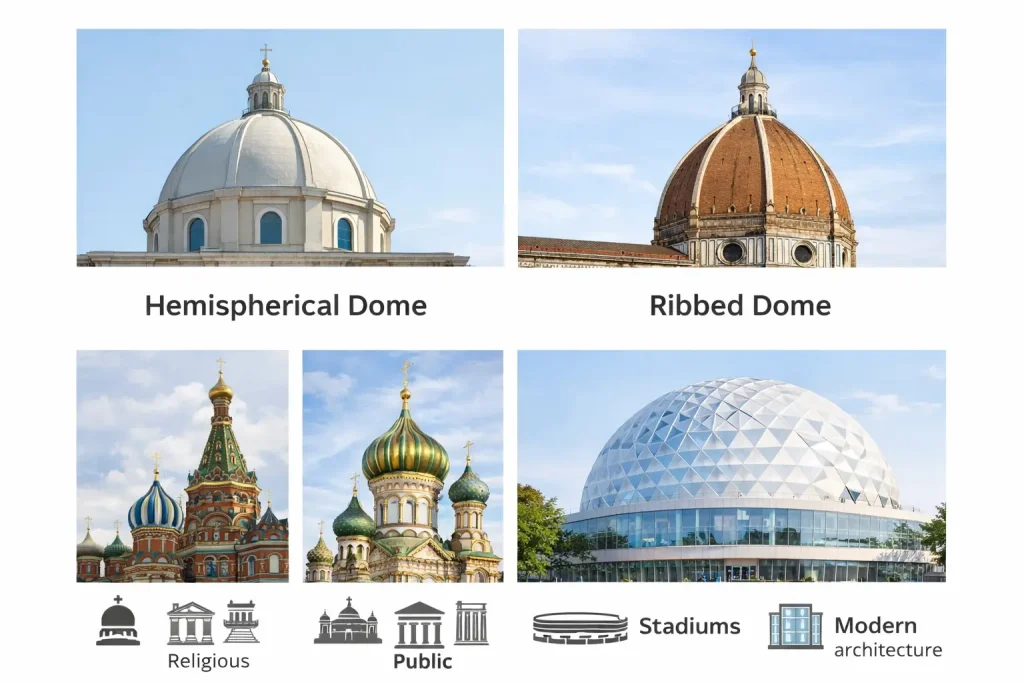
Domes are among the oldest structural forms still actively used in modern construction. From historic monuments and religious architecture to stadiums, industrial storage, and temporary site enclosures, domes continue to be relevant because they work with structural physics rather than against it.
For architects, engineers, and construction planners, understanding the meaning of a dome, how it behaves structurally, and how modern variants like air domes are used is not just academic. It directly affects safety, durability, execution timelines, and long-term performance.
What Is a Dome in Construction?
A dome is a curved roof or structural shell, typically shaped like a portion of a sphere, that spans a space primarily through compression rather than bending. Unlike flat slabs or trussed roofs, domes distribute loads smoothly across their surface and transfer forces outward to their supports.
In simple terms, a dome stays stable because its shape allows gravity loads to flow naturally along curved paths, which materials like masonry and concrete resist very efficiently.
How Does a Dome Structure Work?
Structurally, a dome behaves like a series of arches arranged in a circular form:
- Loads travel along the curve (meridional forces), mostly in compression
- Circumferential or hoop forces develop around the dome, especially near the base
- If the base is not adequately restrained, outward thrust must be resisted using ring beams or buttressing systems
Because domes minimise bending stress, they often require less material than flat roofs covering the same span. In reinforced concrete domes, cement quality, reinforcement detailing, and curing discipline become critical due to the thin shell sections involved.
Main Types of Domes Used in Construction
1. Masonry and Traditional Domes
These include corbelled (beehive) domes and true masonry domes built using brick or stone. They are common in heritage structures, temples, and mosques. While extremely durable, they are labour-intensive and require skilled workmanship.
2. Reinforced Concrete (RCC) Domes
RCC domes are widely used in modern construction for auditoriums, water tanks, planetariums, temples, and public buildings. Reinforcement helps manage tension near the base and around openings. Consistent cement strength and proper curing are essential for long-term performance.
3. Steel, Geodesic, and Space Frame Domes
Steel domes use ribs, lattices, or space frames to create large, lightweight spans. Geodesic domes, formed from interconnected triangles, are material-efficient and structurally stable, making them popular for exhibition spaces, eco-resorts, and greenhouses.
4. Air Domes (Air-Supported Structures)
An air dome is supported by controlled internal air pressure rather than rigid framing. A fabric or membrane shell is anchored at the base and kept in shape using continuous air supply.
Typical characteristics:
- Large column-free spans
- Rapid installation and dismantling
- Integrated HVAC and pressure-control systems
- Suitability for temporary or semi-permanent use
In construction projects, air domes are increasingly used as weather-protection enclosures, sports facilities, and industrial shelters.
Where Are Domes Used Today?
Domes solve practical challenges across many applications:
- Religious and cultural buildings
- Stadiums and indoor sports facilities
- Auditoriums and assembly halls
- Water tanks and reservoirs
- Industrial bulk storage (cement, grain, fertiliser)
- Temporary construction shelters for all-weather execution
Domes are preferred when large, unobstructed interiors, aerodynamic performance, and material efficiency are required.
Why Cement Quality Matters in Dome Construction
Domes rely heavily on compressive strength and uniform load transfer. Inconsistent cement quality can lead to:
- Micro-cracking in thin shell sections
- Uneven stress distribution
- Reduced durability over time
For RCC domes, cement must deliver predictable strength, workability, and long-term durability. This is why large dome projects specify strict performance criteria and controlled curing regimes.
Domes and Modern Construction Technology
Modern dome projects increasingly integrate technology to manage performance and risk:
- Sensors to monitor temperature, humidity, and internal pressure
- IoT systems to track curing conditions in RCC domes
- Structural monitoring for long-span or air-supported domes
These tools allow engineers to detect deviations early and maintain consistent performance throughout the structure’s life cycle.
Planning Considerations for Dome Structures
Before finalising a dome design, teams must evaluate:
- Load paths, wind uplift, and seismic behaviour
- Support systems to resist outward thrust
- Material specifications and quality control
- Thermal insulation and waterproofing
- Maintenance access and inspection planning
- Local approvals, especially for air-supported or temporary domes
With proper planning and execution, domes are no longer exotic structures. They are practical, efficient solutions for modern Indian construction projects.
Domes represent a rare combination of ancient engineering wisdom and modern construction technology. Whether built in masonry, reinforced concrete, steel, or air-supported membranes, their success depends on disciplined design, material quality, and execution. When planned correctly, a dome is not just a roof—it is a long-term structural asset.
FAQs: Dome Construction, Structure, and Air Domes
1. What is a dome in construction?
A dome is a curved roof or shell structure that spans space mainly through compression. Its shape allows loads to flow evenly to supports without relying on multiple internal columns.
2. Why are domes structurally efficient compared to flat roofs?
Domes reduce bending stresses by transferring loads along curved paths. This makes them more material-efficient and often stronger than flat slabs over large spans.
3. What materials are commonly used to build domes?
Domes can be constructed using masonry, reinforced concrete, steel, space frames, timber, or membrane fabrics, depending on span, function, and design intent.
4. What is an air dome in construction?
An air dome is a structure supported by controlled internal air pressure. A fabric membrane is anchored at the base and maintained by blowers, creating a large column-free enclosed space.
5. Where are air domes typically used?
Air domes are used for sports facilities, temporary warehouses, construction site enclosures, and seasonal structures where rapid installation and flexibility are required.
6. Are domes suitable for Indian climatic conditions?
Yes. Domes perform well in wind and seismic conditions due to their aerodynamic shape, but they must be designed carefully for temperature, rainfall, and local codes.
7. Why is cement quality critical in RCC dome construction?
RCC domes use thin shell sections, leaving little margin for variability. Consistent cement strength and proper curing are essential to prevent cracking and long-term durability issues.
8. Do domes require special foundations or supports?
Most domes require ring beams or stiff supports to resist outward thrust. Foundation design depends on span, loading, and soil conditions.
9. Can domes be used in residential or small projects?
Yes. Geodesic and monolithic domes are used in eco-homes, resorts, community halls, and architectural features where energy efficiency and durability are priorities.
10. How does modern technology improve dome performance?
Sensors, IoT systems, and monitoring tools help track temperature, pressure, curing, and structural movement, improving safety and long-term performance.