Borewell: Meaning, Cost, Pump Types & Complete Installation Guide

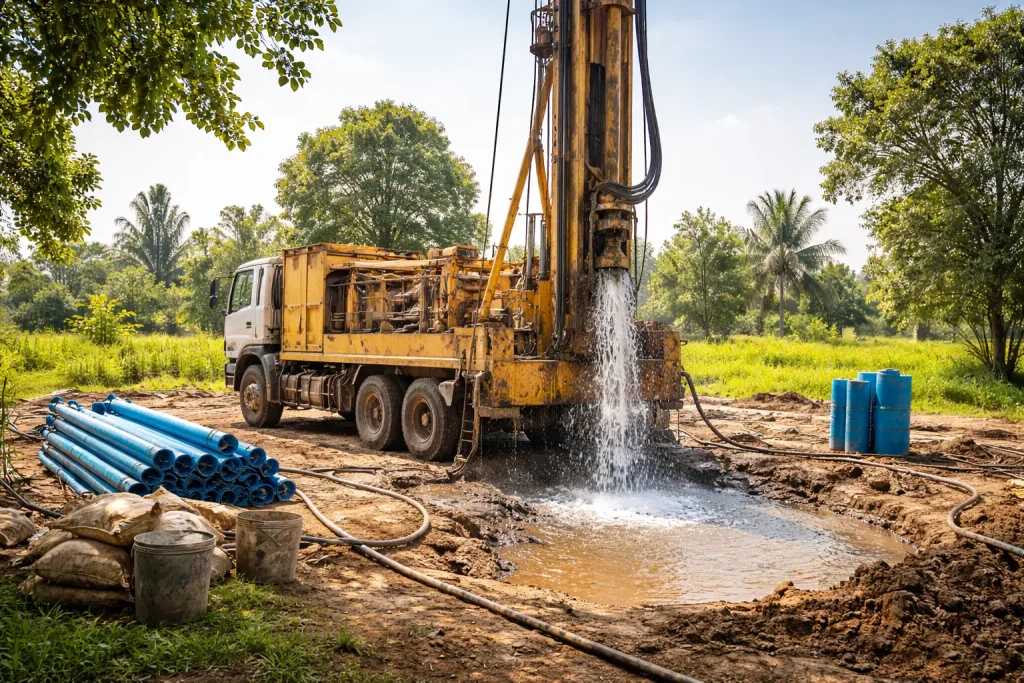
Water independence in India is not a luxury. It is risk management.
Most borewells are drilled when:
- Municipal supply becomes unreliable
- Tanker bills start crossing ₹8,000–₹15,000 per month
- A new home is under construction
- Agriculture or rental units need steady supply
But here’s the reality nobody explains properly:
A borewell is not “drill deeper and get water.” It is geology + hydraulics + discipline.
Drill blindly and you risk spending ₹3–4 lakh for a dry hole. Plan properly and the same borewell can serve 15–20 years. Let’s break this down clearly.
Quick Answer
A borewell is a deep, machine-drilled narrow shaft constructed to extract groundwater from underground aquifers using a submersible pump system.
For Indian residential homes:
- Typical depth: 150–600 feet (region dependent)
- Most common pump: Submersible
- Practical total cost: ₹1.5 lakh to ₹5 lakh
Water availability depends on aquifer recharge — not just drilling depth.
Borewell Meaning (In Practical Terms)
A borewell is a vertical drilled hole, usually 4.5 to 8 inches in diameter, that reaches underground water-bearing rock layers.
Unlike traditional open wells:
- It occupies very little land
- It accesses deeper fracture zones
- It requires mechanical pumping
Important: A borewell does not create water. It accesses groundwater stored in rock fractures. If recharge fails, yield drops — regardless of depth.
How Borewell Drilling Actually Works
Here’s what happens on a properly managed site:
- Hydrogeological survey identifies possible fracture zones
- DTH (Down-The-Hole) hammer drills through soil and rock
- Casing pipes inserted in loose soil sections
- Slotted screen pipe placed near aquifer zone
- Flushing done to clear debris
- Yield test performed
- Submersible pump installed
Drilling alone is not success. Yield stability determines long-term value.
Borewell Depth in India (Indicative Ranges)
Depth varies significantly by geology:
- Alluvial plains: 100–300 ft
- Semi-urban granite regions: 300–600 ft
- Hard rock belts: 500–1,000+ ft
Deeper does not automatically mean more water. In hard rock regions, water is found in fractures — not uniformly across depth.
Borewell Cost in India (2026 Realistic Range)
Drilling Cost Per Foot:
- ₹120 – ₹350 per foot (soil vs hard rock)
Additional Components:
- PVC casing: ₹20,000 – ₹60,000
- Submersible pump: ₹18,000 – ₹70,000
- Electrical panel & wiring: ₹15,000 – ₹40,000
- Hydro survey: ₹5,000 – ₹15,000
Practical Total: For 300–600 ft residential borewell: ₹1.5 lakh to ₹5 lakh overall. Budgeting only for drilling is the most common mistake.
Types of Borewell Pumps
1️⃣ Submersible Pump (Most Common)
Installed below water level inside bore.
Why it works:
- Efficient at depth
- Quiet operation
- Better cooling
- Long service life
For most homes: 0.5–1.5 HP is sufficient. This is the standard choice in India.
2️⃣ Jet Pump
Surface-mounted. Suitable only for shallow depths (below ~80 ft). Rarely used for deep borewells.
3️⃣ Solar Borewell Pump
Used mostly in rural/agricultural setups. Higher upfront investment. Lower running cost. Good where power supply is unstable.
Pump Selection Logic (Critical Section)
Pump size must be based on:
- Static water level
- Dynamic water level (drawdown)
- Required discharge rate
- Pipe head height
Oversized pump → Rapid aquifer depletion + motor burnout.
Undersized pump → Low pressure + insufficient supply.
Correct pump sizing increases borewell life dramatically.
What Actually Goes Wrong on Indian Sites
Most failures are planning failures. Common mistakes:
- Drilling without hydro survey
- Incomplete casing in unstable soil
- No yield testing
- Adding oversized pump “for extra pressure”
- No dry-run protection
- Continuous pumping without recharge
Water flow looks strong initially. Six months later — especially in summer:
- Sand discharge
- Motor overheating
- Reduced water yield
This problem rarely shows in the first month. It shows in May.
Borewell Yield Testing (Often Ignored)
Proper yield testing involves:
- Continuous pumping for 6–24 hours
- Measuring stabilized discharge rate
- Observing drawdown levels
Without yield testing, pump selection is guesswork. And guesswork shortens lifespan.
Government Regulations (Important)
Many states now require:
- Groundwater authority registration
- NOC in notified areas
- Restrictions in over-exploited zones
Ignoring compliance can result in penalties. Always check state groundwater guidelines before drilling.
Borewell Lifespan
Typical lifespan: 10–20 years. Depends on:
- Aquifer recharge
- Pump discipline
- Casing integrity
- Rainwater harvesting
A recharge pit significantly improves sustainability. Recharge is not optional anymore in urban India.
Maintenance Essentials
- Install dry-run protection panel
- Use voltage stabilizer
- Avoid continuous 3–4 hour pumping cycles
- Conduct periodic water testing
- Flush borewell if sand accumulation observed
Motor replacement is expensive. Protection systems are cheaper.
If This Were My Own House
I would:
- Conduct proper hydro survey
- Drill only to confirmed water fracture zone
- Use full-depth casing where needed
- Install 1–1.5 HP submersible with dry-run protection
- Perform 24-hour yield test
- Construct rainwater recharge pit
Because borewell reliability is about discipline — not depth.
FAQs
What is borewell meaning in simple words?
A borewell is a deep drilled hole used to extract groundwater through a motor pump system.
How much does a borewell cost in India in 2026?
Typically ₹1.5 lakh to ₹5 lakh depending on depth and equipment.
How deep should a borewell be?
Depth depends on local geology. Residential borewells are usually 150–600 feet.
Which pump is best for borewell?
Submersible pumps are best for most residential systems.
Can a borewell run dry?
Yes. Over-extraction or poor recharge reduces groundwater levels.
Is borewell water safe for drinking?
Only after water testing and appropriate filtration.
Does deeper borewell mean more water?
No. Water availability depends on aquifer strength and fracture zones.
How long does a borewell last?
10–20 years depending on maintenance and recharge.
What HP pump is ideal for home use?
Usually 0.5–1.5 HP for standard residential demand.
Is hydro survey necessary?
Highly recommended. It reduces dry bore risk significantly.
Final Thought
A borewell is not a drilling decision. It is a groundwater responsibility.
Drill with data. Pump with discipline. Recharge with intention.
That’s how a borewell survives beyond one monsoon — and beyond one generation.