BIM Full Form: Meaning, Uses & Importance in Construction

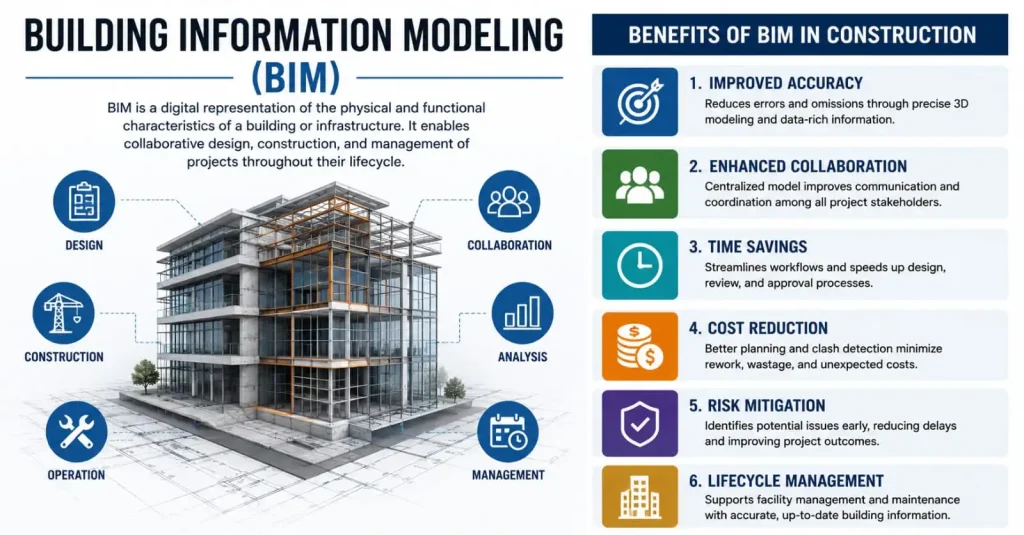
Today, construction is no longer just about bricks, cement, steel, and manpower. It is becoming digital. That’s where BIM comes in. The BIM full form is Building Information Modeling. But BIM is much more than software.
Think of it like a digital brain for a construction project. A place where architects, structural engineers, MEP consultants, contractors, and even facility managers work together using one shared model instead of disconnected drawings.
And in real-world construction, this matters a lot. Because one small mismatch between plumbing and structural work can delay a project by weeks. BIM helps everyone involved in construction see the same picture before work starts on-site.
Read on to find out more about building information modelling (BIM).
What is BIM?
In simple words, BIM is a digital process used to plan, design, construct, and manage buildings more efficiently. Now don’t confuse BIM with just 3D drawings. A normal 3D model only shows how a building looks. A BIM model carries information like the following:
- Wall thickness
- Material specifications
- Electrical layouts
- Plumbing details
- Quantity estimates
- Cost calculations
- Construction timelines
Everything is connected. So if an architect changes a wall location in the BIM model, the related drawings, quantities, and schedules can automatically update. That’s the real power of BIM.
A good analogy?
Imagine ordering food through an app. You can see the restaurant, menu, delivery time, payment details, and live tracking in one place. BIM works somewhat similarly for construction projects. Instead of multiple disconnected files and teams, BIM creates one shared system where everyone collaborates.
Today, BIM is widely used in:
- Residential towers
- Hospitals
- Airports
- Metro projects
- Commercial buildings
- Industrial plants
Large infrastructure projects especially depend heavily on BIM because coordination becomes impossible manually once projects become complex.
How does BIM Works in Construction Projects?
To understand what BIM is, it helps to imagine a project before construction begins. Instead of waiting for problems to appear on-site, BIM helps teams identify issues digitally first.
Here’s how it usually works.
Step 1: Creating the Digital Model
Architects and engineers create a 3D BIM model of the building. This includes:
- Structural systems
- Plumbing layouts
- Electrical systems
- HVAC networks
- Interior elements
Everything exists inside one intelligent model.
Step 2: Coordination
Different consultants combine their work into a shared BIM environment. This helps detect clashes. For example: An AC duct passing through a beam. Or a plumbing pipe colliding with electrical conduits.
These mistakes can be fixed digitally before actual construction starts.
Step 3: Quantity and Cost Planning
The BIM model can automatically generate quantities for:
- Concrete
- Steel
- Tiles
- Paint
- Cement
This improves budgeting and reduces wastage.
Step 4: Construction Sequencing
Project managers use BIM to simulate construction timelines. They can visualize:
- Which floor gets completed first
- Material movement
- Equipment placement
- Labour scheduling
This is extremely useful in crowded urban projects where site space is limited.
What Are the Key Components of BIM?
The reason BIM is so powerful is because it combines multiple layers of information together. Key components are given below:
- 3D Modelling: This is the visual representation of the building. It helps teams understand space, design, and structure clearly.
- 4D BIM: This adds time scheduling to the model. Construction teams can track project timelines visually.
- 5D BIM: This includes cost estimation. Changes in design automatically reflect in project costs.
- 6D BIM: Focused on sustainability and energy efficiency. Useful for green buildings and lifecycle management.
- 7D BIM: This supports facility management after project completion. Maintenance teams can use BIM data long after construction ends.
That’s why BIM is not just useful during construction. It continues adding value throughout a building’s life.
What Are the Top Uses of BIM in Construction?
The practical uses of BIM are growing every year. Given below are the top uses of BIM in construction:
- Design Visualization
BIM helps clients understand projects before construction starts. This reduces confusion and design changes later.
- Clash Detection
Probably one of the biggest advantages of BIM. It catches conflicts between systems before they become expensive site issues.
- Quantity Estimation
Material calculations become more accurate. This helps reduce over-ordering and wastage.
- Project Scheduling
Construction activities can be sequenced better. Very useful in large infrastructure projects.
- Site Coordination
Multiple contractors can collaborate more effectively using shared BIM models.
- Facility Management
Even after handover, BIM helps maintenance teams track systems and repairs.
What is the Importance of BIM in Modern Construction?
Construction today moves fast. Clients expect tighter timelines. Labour costs are increasing. Material prices fluctuate constantly. And mistakes are expensive. That’s exactly why BIM has become important. The biggest advantage of BIM is predictability.
Before a single brick is laid, teams already understand:
- Design conflicts
- Material requirements
- Construction sequencing
- Budget impact
This improves decision-making significantly. BIM is also becoming important because buildings themselves are becoming more complicated. Modern buildings include:
- Smart systems
- Energy-efficient designs
- Advanced MEP networks
- Sustainability requirements
Managing all this manually becomes nearly impossible. In many ways, BIM is doing for construction what GPS did for navigation. Earlier people relied on experience and rough estimation. Now decisions are data-driven. And the industry is moving in that direction quickly.
What Are the Benefits of BIM in Construction?
The benefits of BIM go far beyond fancy visuals.
- Better Collaboration: Everyone works on a shared platform. This reduces communication gaps.
- Reduced Errors: Clash detection helps identify issues before construction starts.
- Cost Savings: Less rework means lower project costs.
- Faster Project Delivery: Better planning improves efficiency.
- Improved Quality: Teams can maintain consistency across drawings and execution.
- Reduced Material Wastage: More accurate quantity estimation supports sustainable construction practices.
- Enhanced Safety Planning: Construction sequencing helps identify potential site risks early.
What Are the Challenges of BIM in Construction?
Of course, BIM is not perfect. Like every technology shift, it comes with challenges too.
- High Initial Cost: BIM software and training can be expensive initially. Smaller contractors often hesitate because of upfront investment.
- Learning Curve: Many professionals are still more comfortable with traditional drafting methods. Shifting to BIM requires time and training.
- Software Compatibility Issues: Different teams sometimes use different BIM platforms, creating coordination challenges.
- Resistance to Change: This is probably the biggest hurdle. Construction is a traditional industry. And honestly, many companies still prefer “the old way.”
- Data Management: Large BIM models require proper handling, storage, and updates. Without disciplined workflows, things can get messy.
Conclusion
The BIM full form may sound technical but its purpose is actually very practical. Make construction smarter. More coordinated. Less wasteful. That’s really what BIM is trying to achieve. When people ask what BIM is, the best answer is this: It’s a smarter way to build.
Not just digitally. But collaboratively. Because construction has always been a team effort. And BIM simply helps everyone work from the same page before real work begins on-site.
In an industry where one small mistake can cost weeks of delays and lakhs of rupees, that level of clarity matters more than ever.
FAQs
1. What is the BIM full form in construction?
The BIM full form is Building Information Modeling. It is a digital process used for planning, designing, constructing, and managing buildings efficiently.
2. What is BIM used for?
BIM is used for:
- 3D building design
- Project coordination
- Clash detection
- Quantity estimation
- Construction scheduling
- Facility management
3. Is BIM only for large projects?
No. While BIM is commonly used in large infrastructure projects, smaller residential and commercial projects can also benefit from better coordination and planning.
4. What is the difference between CAD and BIM?
CAD mainly focuses on drafting drawings.
BIM goes beyond drawings by adding intelligent project information like materials, costs, timelines, and system coordination.
5. Why is BIM important in modern construction?
BIM improves collaboration, reduces errors, saves costs, and helps projects run more smoothly from design to execution.
6. Which industries use BIM?
BIM is widely used in:
- Architecture
- Civil engineering
- Infrastructure
- Real estate
- Facility management
- Industrial construction
7. Does BIM help reduce construction costs?
Yes. BIM reduces rework, improves material estimation, and detects design clashes early, which helps lower overall project costs.