What Is Portland Cement? Definition, Composition & Uses

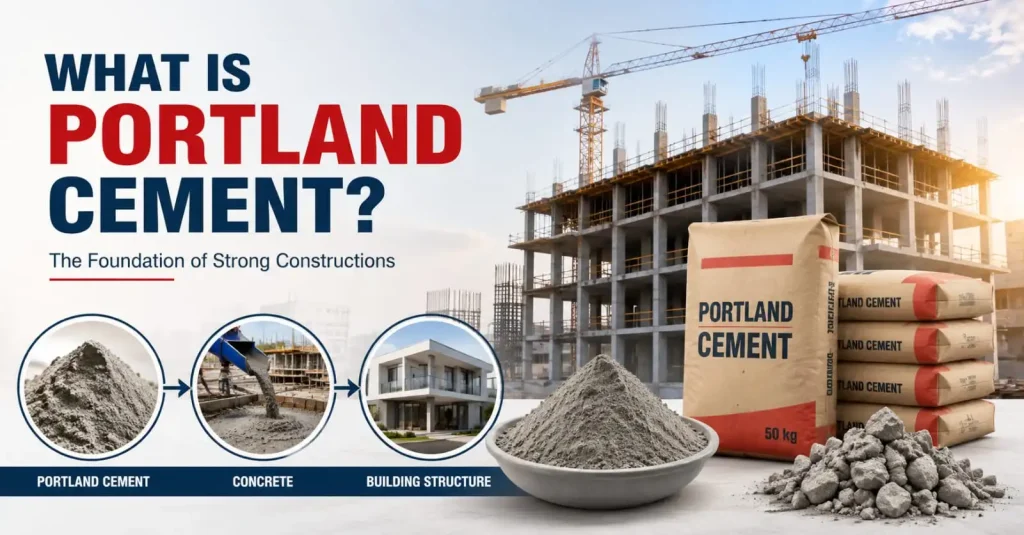
We notice visible things first at a construction site. The workers are doing brickwork. The engineers tie steel reinforcement into a column. They cast a slab. But do you know that one material that holds the entire structure together? It is Portland cement. It is one of the important building materials that binds everything. So, what exactly is Portland cement? What is it made of? And how is it different from ordinary cement? Read on in this blog post to find out!
What Is Portland Cement?
Portland cement is a hydraulic powder that becomes hard when mixed with water. The main ingredient in this type of cement is clinker. The manufacturers heat raw materials in a certain proportion to form clinker. The next step is to grind clinker into a fine powder. The workers often add gypsum to control the setting time.
Portland cement reacts when it comes into contact with water. Hence, this process is known as hydration. The result is further bound with other ingredients that help structures develop strength. This is why cement is necessary in concrete. It turns loose ingredients into a solid mass.
Most people confuse cement with concrete. Concrete is made when other building materials like fine and coarse aggregates are mixed with cement and water.
Note: Portland cement derives its name from a Portland stone of a historical building in England. It is now considered a family of hydraulic cement.
Quick Answer
Portland cement is a type of cement that forms through cement clinker and gypsum. It gets hard when it reacts with water. Hence, workers use it as a binding material in concrete and mortar. There are different types of Portland cement. Some of them are as follows:
- Ordinary Portland Cement
- Portland Pozzolana Cement
- Portland Slag Cement
The engineers recommend using Portland cement for both residential and commercial construction.
What Is the Composition of Portland Cement?
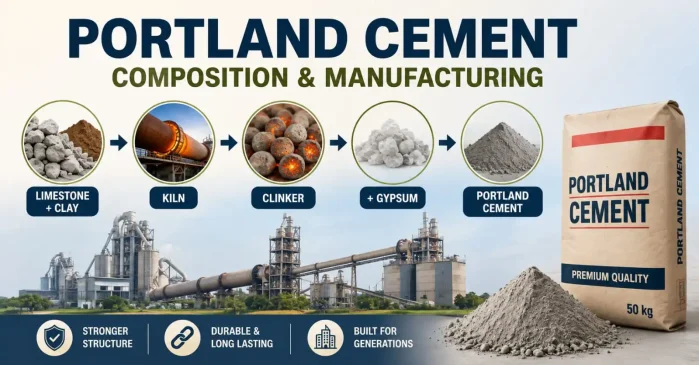

The composition of Portland cement begins with raw materials. Limestone is an important source of calcium. However, clay and other materials contribute various nutrients to the structures. The manufacturer processes and heats these materials in a kiln to form clinker. Further, they grind the clinker with gypsum to produce cement.
The table below highlights the common raw materials used for the composition of Portland cement:
| Raw Material | Role in Portland Cement |
| Limestone | It is a major source of calcium for the structures. |
| Clay and other materials | These materials not only provide alumina and iron but also offer silica. |
| Clinker | It is a primary component for the composition of cement. |
| Gypsum | It regulates the setting time of the cement. |
| Fly ash | It is mostly used in the composition of Portland Pozzolana Cement (PPC). |
| Granulated blast-furnace slag | The primary use of this raw material is in Portland Slag Cement (PSC). |
Portland cement clinker contains the following at a chemical level:
- Calcium silicates
- Calcium aluminates
- Calcium aluminoferrite
Most importantly, alite (C₃S) and belite (C₂S) are two components that produce strength. These compounds react and form hydration products when mixed with water. This is why it is advisable to cure it properly after application.
What Are the Different Types of Portland Cement?
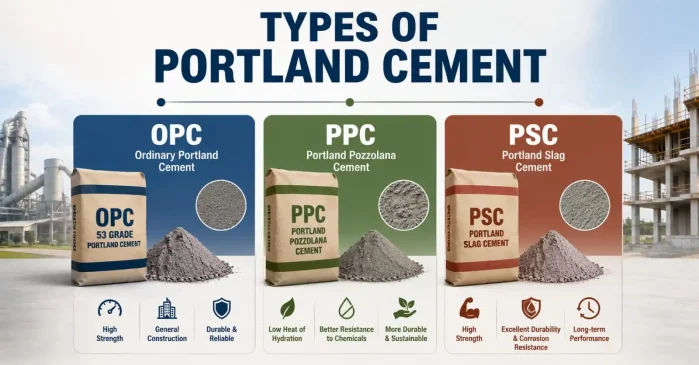
Given below are different types of Portland cement in construction:
- Ordinary Portland Cement (OPC)
It is one of the most common types of cement in construction. It is available in OPC 43-grade and OPC 53-grade. Hence, the experts recommend it as per the application. The grade refers to the characteristic compressive strength of the cement.
This type of cement has pozzolanic materials like fly ash. Hence, it is popular for its durability and long-term performance. The best part? It manages different weather conditions to protect structures from corrosion.
- Portland Slag Cement (PSC)
The engineers recommend this type of Portland cement for sustainable construction. It not only reduces carbon dioxide emissions but also protects against environmental exposure. It consists of granulated blast furnace slag as a supplementary building material.
What Are the Uses of Portland Cement?
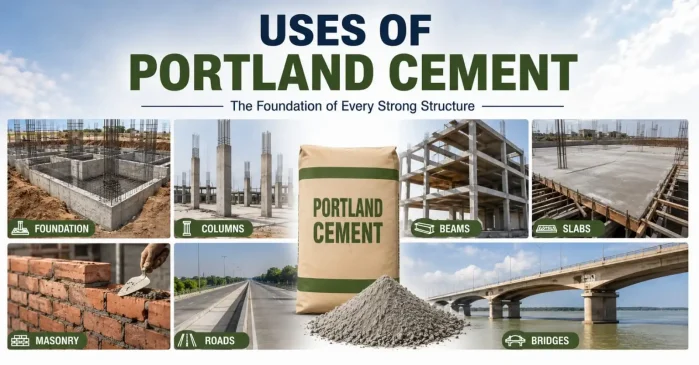
The following are the common uses of Portland cement:
- Concrete Construction
Portland cement is a binding material in concrete. Hence, it is used for the construction of the following:
- Foundations
- Columns
- Beams
- Slabs
- Other structural elements
Concrete is made when the workers mix the cement with water and other aggregates.
- Masonry and Mortar
The engineers also use Portland cement in mortar for masonry work. The cement binds sand and water that is used to lay masonry units and other applications.
- Roads and Infrastructure
Portland cement concrete is also used for the construction of infrastructure projects like roads and bridges.
- Residential Construction
The most common application of Portland cement is residential construction. The workers use it for the following reasons:
- Foundations
- RCC elements
- Floors
- Walls
Tip: Engineers recommend choosing good-quality Portland cement for construction. It ensures that your structures are durable and maintain long-term performance.
The Final Words
Portland cement is a hydraulic binding material that reacts with water and becomes hard. It is necessary to choose the right cement for construction. Hence, it is advisable to understand the application and required strength. What’s more? It is necessary to select good-quality cement that not only ensures consistency but also maintains durability.
FAQs
1. What is Portland cement in simple words?
Portland cement is a powder that reacts with water and hardens to form a strong binding material. It is commonly used to bind sand and aggregates in concrete and to make mortar for construction applications.
2. What is Portland cement made of?
Portland cement is mainly made from clinker and gypsum. Clinker is produced by heating raw materials such as limestone and other minerals. Blended Portland cements may also contain materials such as fly ash or granulated blast-furnace slag.
3. Is Portland cement the same as OPC?
Portland cement and OPC are not exactly the same. Ordinary Portland Cement (OPC) is a specific type of Portland cement. Other Portland-based cement types include Portland Pozzolana Cement (PPC) and Portland Slag Cement (PSC).
4. What is the difference between OPC 43 and OPC 53 grade?
OPC 43 and OPC 53 are different grades of Ordinary Portland Cement. The numbers refer to their characteristic compressive strength classification at 28 days under applicable standard testing conditions. The appropriate grade depends on the construction application and project requirements.
5. Is PPC a type of Portland cement?
Yes, PPC is a type of Portland-based blended cement. Portland Pozzolana Cement (PPC) combines Portland cement clinker with pozzolanic material, such as fly ash. It is commonly considered for construction applications where durability and long-term performance are important.
6. Which is better: OPC, PPC or PSC?
There is no single “best” cement for every project. The choice between OPC, PPC and PSC depends on the application, structural requirements, exposure conditions, project specifications and applicable standards. Always select the cement type recommended for the specific construction work.