What Is OPC Cement? Meaning, Types and Benefit

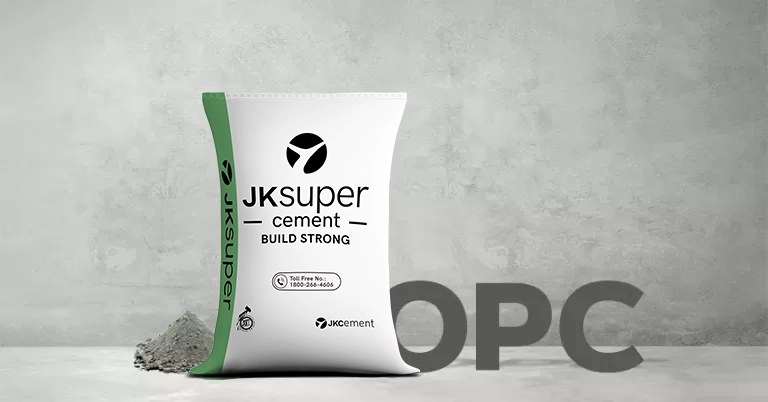
Portland cement is a widely used cement across construction projects. Different construction projects may require different types of Portland cement. The three main categories of Portland cement are Ordinary Portland Cement (OPC), Portland Pozzolana Cement (PPC) and Portland Slag Cement (PSC). OPC is a hydraulic cement that is made up of Portland cement clinker and gypsum. OPC is used in almost all general construction.
What is OPC in Cement?
Short for Ordinary Portland Cement, OPC is a type of Portland cement that is mixed with water and aggregates to form concrete, mortar or plaster. Other constituents like pozzolana and slag are added to OPC to form blended cements.
Types of Ordinary Portland Cement
Based on the compressive strength that it OPC provides, OPC is divided into three grades:
-
OPC 33 Grade
Ordinary Portland Cement with a compressive strength of 33N/mm2 at 28 days is OPC 33. While OPC 33 is suitable for all general construction, it is particularly used for masonry and plastering.
-
OPC 43 Grade
OPC 43 is cement with a compressive strength of 43N/mm2 at 28 days. Along with general construction, OPC 43 Grade cement is suitable for high strength concrete work. Cement that is used for railway sleepers is designated as 43-S grade.
-
OPC 53 Grade
Ordinary Portland Cement 53 Grade has a strength of 53N/mm2 at 28 days. OPC 53 is mostly used for precast concrete, prestressed concrete, long span structures like bridges, tall buildings, etc. OPC 53 specially used for railway sleepers are referred to as 53-S grade.
OPC vs PPC vs PSC Cement – Comparison & Usage
| Parameter | OPC (Ordinary Portland Cement) | PPC (Portland Pozzolana Cement) | PSC (Portland Slag Cement) |
| Early strength | High | Moderate | Low |
| Heat of hydration | High | Low | Very low |
| Workability | Moderate | Good | Good |
| Crack resistance | Lower | Better | Very good |
| Durability | Moderate | High | Very high |
| Chemical / sulphate resistance | Moderate | Good | Excellent |
| Curing requirement | Strict | Moderate | Moderate |
| Setting speed | Fast | Slower | Slower |
| Where to use | RCC slabs, beams, columns, precast work, fast-track construction | Residential houses, plastering, masonry, mass concreting | Marine structures, foundations, sewage plants, coastal & aggressive environments |
How is Ordinary Portland Cement Made?
The following is the manufacturing process for Ordinary Portland Cement:
- Source Raw Materials
Raw materials like limestone and clay are obtained from blasting rock quarries with explosives. The raw material is then transported to grinding units.
- Grind Limestone and Clay
Various types of grinders grind the limestone and clay into finer particles to achieve a homogenous blend.
- Heat The Mixture
The homogenous blend of raw materials is heated in kiln at high temperatures. The manufacturer may add additional ingredients per the type of cement. The heated mixture forms clinker.
- Grind Clinker
Clinker is intimately ground with gypsum to form Ordinary Portland Cement.




Properties of Ordinary Portland Cement4
The following are the physical properties of OPC:
- Fineness: It indicates the particle size of cement which impacts the surface area and, in turn, the heat of hydration.
- Soundness: Soundness of cement is the volume change when its set and hardened.
- Setting Time: Setting time is the taken by the cement and water paste to turn from its plastic state to its hardened stage.
- Initial Setting Time: The initial time is the time when cement turns into paste when mixed with water and begins losing its plasticity.
- Final Setting Time: The time when cement loses its plasticity completely after it has been mixed water is the final setting time.
- Compressive Strength: Compressive strength refers to the capacity of concrete to withstand load without cracking or deflecting.
| Sr. No | Characteristic | OPC 33 | OPC 43 | OPC 43-S | OPC 53 | OPC 53-S |
| 1 | Fineness | 225 m2/kg | 225 m2/kg | 370 m2/kg | 225 m2/kg | 370 m2/kg |
| 2 | Soundness | |||||
| 2.a | Le Chatelier method, max | 10 mm | 10 mm | 5 mm | 10 mm | 5 mm |
| 2.b | Autoclave test method, max | 0.8% | 0.8% | 0.8% | 0.8% | 0.8% |
| 3 | Setting Time | |||||
| 3.a | Initial, minimum | 30 mins | 30 mins | 60 mins | 30 mins | 60 mins |
| 3.b | Final, maximum | 600 mins | 600 mins | 600 mins | 600 mins | 600 mins |
| 4 | Compressive Strength N/mm2 | |||||
| 4a | 3 Days | 16 | 23 | 23 | 27 | 27 |
| 4b | 7 Days | 22 | 33 | 37.5 | 37 | 37.5 |
| 4.c.i | 28 Days, minimum | 33 | 43 | 43 | 53 | 53 |
| 4.c.ii | 28 Days, maximum | 48 | 58 | – | – | – |
Chemical Composition Of OPC
- Lime: Calcium Oxide derived from limestone or chalk makes up a greater portion of the cement’s composition. Both, limestone and chalk are calcium carbonate materials.
- Silica: Silica is sourced from sand or clay and is the second highest chemical found in cement. During the cement’s manufacturing process, silica reacts with calcium to form di-calcium and tri-calcium silicates.
- Iron Oxide: Iron oxide sourced from iron ores is favourable for producing high early strength cements.
- Alumina: Aluminum oxide is sourced from clay and shale and helps accelerate the hydration reactions.
- Gypsum: Gypsum is added to cement to help control the setting time.
Advantages of Ordinary Portland Cement
Here’s why OPC is a popular cement choice:
- OPC and its various grades can be used for almost all types of construction.
- Its low alkali content provides improved protection from alkali-aggregate reactions.
- It has superior resistance to sulphate attacks making it ideal for marine constructions.
- It offers high early strength which helps speed up construction.
Explore a range of JK Super Cement – OPC for all your construction needs.
FAQs
What is cement?
Cement is a binding agent which when mixed with water helps bind aggregates like sand, gravel or crushed rock. Cement is a finely ground powder made up of calcareous and argillaceous materials.
What is the shelf life of Ordinary Portland Cement?
The shelf life of OPC is typically printed on its packaging. Generally, Ordinary Portland cement may have a shelf-life of three to six months. If cement is stored for extended periods, ensure you test the cement before use. Also, place the cement in a dry place to prevent it from dampness.
Is OPC cement good for house construction?
Yes. OPC 43 grade is commonly used for RCC slabs, beams, and columns in residential buildings.
OPC vs PPC – which is better?
OPC gives faster early strength. PPC offers better durability and crack resistance. Choice depends on application.
Can OPC cement be used for plastering?
OPC 33 or OPC 43 can be used, but PPC is generally preferred due to better workability.
Why is OPC 53 not recommended for masonry?
Its high early strength and heat of hydration can lead to shrinkage cracks if curing is inadequate.
Which OPC grade is best for slabs?
OPC 43 is commonly preferred. OPC 53 is used where higher strength is required.