What Is RMC? Meaning, Full Form, Uses & Benefits Explained (2026 Construction Guide)

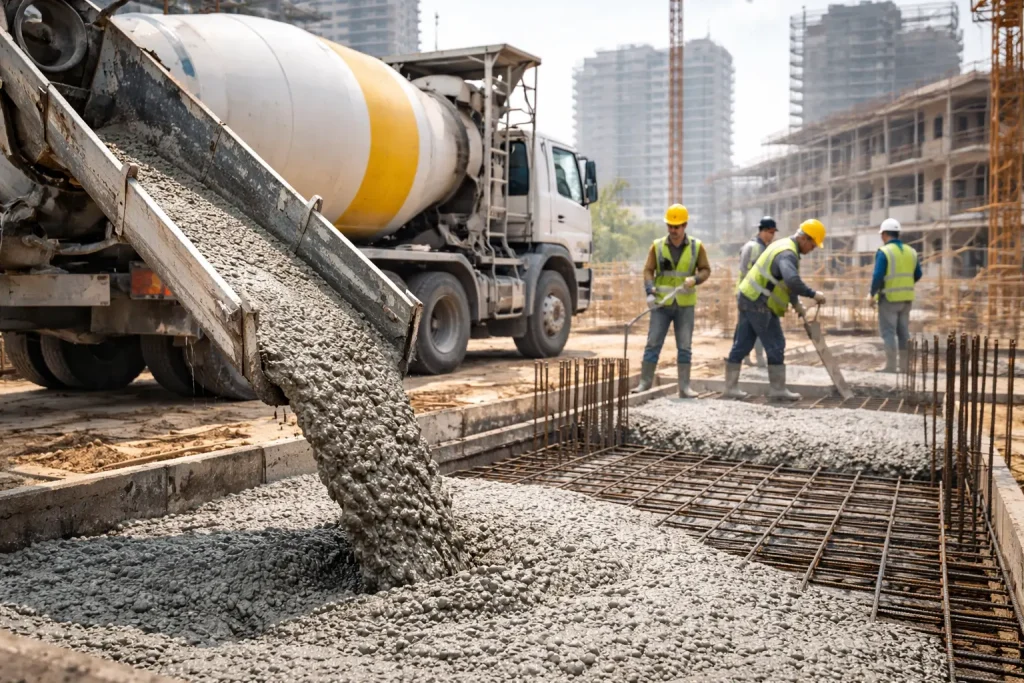
Ready-mix concrete (RMC) is often misunderstood as just a convenience.
In reality, it is a quality control system delivered to your site.
Most structural issues in Indian construction don’t come from bad cement. They come from inconsistency:
- water added “thoda sa aur flow ke liye”
- ratios changing mid-mix
- rushed pouring
- no testing
- curing stopped early
Concrete doesn’t forgive these mistakes.
Because strength in concrete is not visual—it is mathematical.
RMC reduces that uncertainty. But it does not eliminate responsibility on site.
RMC Full Form and What It Actually Means
RMC stands for Ready-Mix Concrete.
Instead of mixing cement, sand, and aggregates manually, the entire mix is produced in a controlled batching plant and delivered to site in transit mixers.
But the real meaning goes deeper.
RMC is not just “ready” concrete—it is pre-engineered concrete.
Every component is:
- weighed digitally
- adjusted for moisture
- mixed under controlled conditions
- tracked for quality
So instead of relying on labour judgement, you rely on a system.
What Changes When You Use RMC
On paper, both site-mix and RMC can achieve the same strength.
On site, they rarely do.
With manual mixing, quality depends on people:
- how accurately materials are measured
- how much water is added
- how consistent the batching is
With RMC, quality depends on the process.
That shift—from human judgement to controlled batching—is the real advantage.
How RMC Is Produced (Real Process, Not Theory)
At the batching plant, everything is controlled.
Materials are measured by weight, not by volume. Water is adjusted based on aggregate moisture. Admixtures are added depending on required workability and setting time.
The concrete is then mixed and loaded into transit mixers.
These drums rotate continuously—not just for transport, but to prevent the mix from setting prematurely.
From plant to site, there is a working window—typically 2 to 3 hours.
Once the concrete reaches site:
- slump is checked
- it is poured (by chute or pump)
- compaction begins
After that, quality is no longer controlled by the plant—it depends entirely on site execution.
RMC Grades for Residential Construction
Concrete grades are defined by their 28-day compressive strength.
But choosing the right grade is not about picking the highest number.
It’s about using the right strength for the right element.
For typical Indian homes:
- M20 → base concrete, PCC
- M25 → slabs and beams (most common)
- M30 → columns and foundations
For G+1 or G+2 houses:
- M25 works well for slabs
- M30 provides better safety margins for columns
Going beyond this without design only increases cost—not performance.
Slump: Where Most Mistakes Begin
Slump measures workability, not strength.
And this is where most site errors happen.
For residential slabs:
- 100–150 mm slump is typical for pumped concrete
- lower values work for manual placement
But what usually happens?
Concrete arrives slightly stiff.
Someone says: “paani daal do.”
That one decision can reduce strength significantly.
Because adding water changes the water–cement ratio—the single most important factor in concrete performance.
Correct approach:
Workability should be adjusted using admixtures, not water.
What Actually Determines Concrete Strength
Even with RMC, strength is not guaranteed.
It depends on four things working together:
- Water–cement ratio → controlled at plant
- Material quality → cement and aggregates
- Compaction → proper vibration
- Curing → moisture retention over time
RMC handles the first two very well.
But the last two—compaction and curing—are entirely site-controlled.
And this is where most failures originate.
Curing: The Step That Decides Everything
Curing is where concrete gains strength.
Not during mixing. Not during pouring.
During curing.
Concrete needs moisture for hydration. If it dries early, strength stops developing.
Good practice:
- start curing within 12–24 hours
- continue for at least 7–14 days
If curing is neglected, your M25 slab may behave closer to M15.
No mix design can fix that later.
RMC vs Site-Mixed Concrete (Reality Check)
Instead of a textbook comparison, here’s the real difference:
Site mix depends on:
- labour discipline
- approximate measurements
- visual judgement
RMC depends on:
- calibrated batching
- controlled ratios
- repeatable process
That’s why RMC gives:
- consistent strength
- faster execution
- lower wastage
Not because it is “stronger”—but because it is more reliable.
RMC Price in India (2026)
Prices vary by city and logistics, but broadly:
- M20 → ₹4,500 – ₹5,500 per m³
- M25 → ₹5,200 – ₹6,200 per m³
- M30 → ₹5,800 – ₹6,800 per m³
Pumping adds ₹800–₹1,200 per m³.
For a typical 100 m³ slab:
👉 ₹5.5 – ₹7 lakh (approx.)
RMC may appear slightly costlier than site mix.
But when you consider:
- reduced rework
- faster completion
- lower risk
…it usually becomes more economical overall.
When RMC Is Not Ideal
RMC is not the right solution in every case.
Avoid it when:
- site is very remote (long travel times)
- quantity is very small
- minor repair work is involved
But for slabs, beams, and columns—it remains the preferred option.
Ordering RMC Correctly (Where Many People Go Wrong)
Most mistakes happen at the ordering stage.
You should always specify:
- grade (M25, M30)
- slump requirement
- quantity
- pump requirement
- pour timing
And on site:
- check slump
- take cube samples
- start curing immediately
RMC is an engineered product. Treat it like one.
If This Was My Own House
I would keep it simple and disciplined:
- M25 for slabs
- M30 for columns
- slump around 120 mm
- cube testing every 15–20 m³
- proper vibration
- curing for minimum 14 days
Because structural strength is invisible.
Until something goes wrong.
FAQs
What is the full form of RMC?
RMC stands for Ready-Mix Concrete, which is produced in a batching plant and delivered ready for use at site. It ensures consistent mix proportions and controlled quality.
Is RMC better than site-mixed concrete?
Yes, in most cases. RMC provides consistent batching and controlled water content, while site mixing depends heavily on labour and manual judgement.
Which RMC grade is best for house construction?
M25 is commonly used for slabs and beams, while M30 is preferred for columns and structural elements in residential buildings.
What slump should be used for slab concrete?
For residential slabs, a slump of around 100–150 mm is commonly used, especially when pumping is involved.
Can water be added to RMC at site?
No. Adding water reduces strength by increasing the water–cement ratio. Workability should be adjusted using admixtures instead.
Does RMC require curing?
Yes. Curing is essential to achieve strength. Concrete should be kept moist for at least 7–14 days.
How long does RMC take to gain strength?
Concrete gains most of its strength in 7 days but reaches its design strength at 28 days under proper curing.
Is cube testing necessary for RMC?
Yes, cube testing verifies compressive strength and ensures the concrete meets design requirements.
Is RMC more expensive than site mix?
Slightly per cubic meter, but overall more cost-effective due to reduced wastage and better quality control.
Can slabs still fail with RMC?
Yes, if site practices like vibration and curing are poor. RMC improves consistency but does not replace proper execution.
Final Thought
Concrete is not forgiving. You can repaint walls.
You can change finishes.
You cannot easily fix a slab.
RMC reduces mixing errors.
But:
- grade selection defines strength
- slump defines placement
- curing defines performance
If curing is careless, even good RMC fails.
If curing is disciplined, even standard concrete lasts decades.
That’s the difference between construction—and engineering