Concrete Cube Test: IS Code, Procedure and Acceptance Criteria

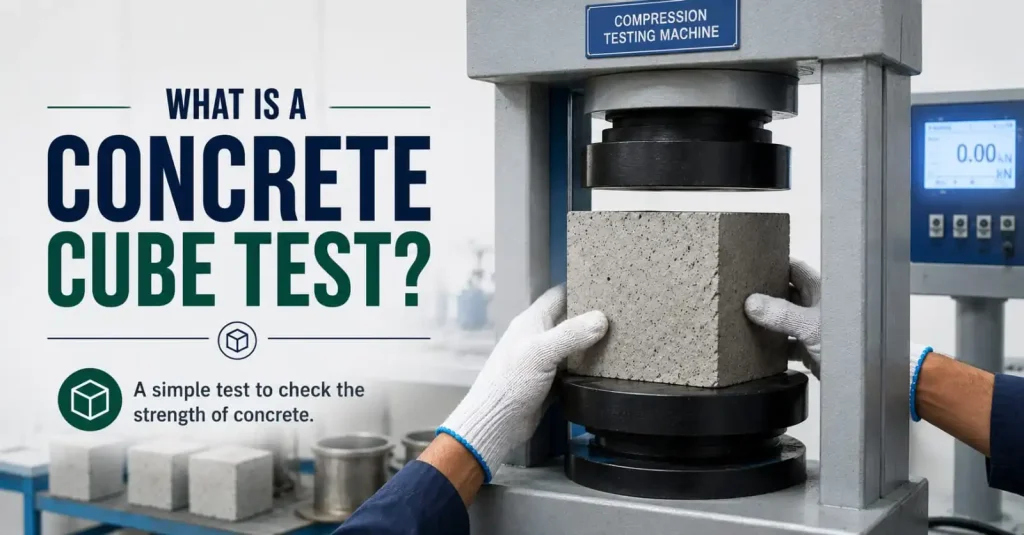
Building a home starts even before construction. We compromise our everyday lifestyle to build a strong and durable home. Isn’t it? But imagine if you found that the concrete was weak after the months of construction. And it would burn a hole in your pocket if you thought of repairing it. It feels like a rollercoaster of emotions. This is where the concrete cube test is necessary. It is one of the most important quality checks in construction. Read on to find out the process and acceptance criteria of the concrete cube test in detail.
What Is a Concrete Cube Test?
The concrete cube test helps you determine the compressive strength of hard concrete. It is a laboratory test through which engineers verify whether concrete will safely support the loads. But when does the engineer perform this test? They often perform this test after 7 days or 28 days. The standard benchmark is a 28-day test because concrete gains most of its strength during this period.
Why Is the Concrete Cube Test Important?
Concrete is one of the strongest building materials. But it is only strong when the supplier store and workers mix it properly. Given below are several site conditions that might influence the quality of concrete:
- Incorrect water-cement ratio
- Poor batching
- Concrete is not compacted properly
- Transportation is delayed
- Skipped the curing process
- Used low-quality materials
Testing helps you identify these issues. Hence, it prevents cracks and structural failures. That’s it? Here are some more benefits of a concrete cube test in construction:
- It ensures that concrete meets the necessary design strength.
- The engineers detect poor-quality concrete at an early stage.
- It maintains the project needs in line with compliance.
- The structural safety and durability improve.
Note: The engineers test hundreds of cubes for large commercial projects.
What Is the IS Code for the Concrete Cube Test?
Given below is the concrete cube test IS code in India:
- IS 516 (Part 1/Sec 1): 2021 – Methods of Tests for Strength of Concrete
- IS 456:2000 – Plain and Reinforced Concrete – Code of Practice
These standards define every stage of the testing process. Some of these steps are as follows:
- Sampling of fresh concrete
- Cube mould dimensions
- Compaction methods
- Curing conditions
- Compression testing procedure
- Calculation of compressive strength
Note: Make sure that you cure standard cubes in clean water at 27 ± 2°C before testing.
The concrete cube test IS code specifies that you should apply the load uniformly during testing. These standards will ensure that results from different laboratories are consistent and reliable.
What Is the Step-by-Step Process for Concrete Cube Testing?
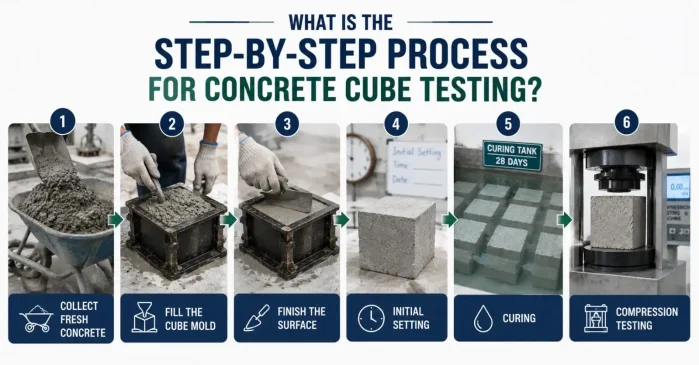

Given below is the concrete cube testing process in construction:
- Collect Fresh Concrete
The first step in the process of concrete cube testing is to collect fresh concrete. The workers collect the fresh concrete from the mixer or transit mixer immediately after batching. Remember, the sample must represent the actual concrete that applies to the structure.
- Fill the Cube Mold
The next step is to pour the concrete into clean steel cube molds in three equal layers. Moreover, compact each layer using either a tamping rod or a vibrating table. The result? This will remove trapped air and ensure uniform density.
- Finish the Surface
The site workers use a trowel to level the top surface. It ensures that the cube has smooth and even faces. Besides this, it also distributes the testing load evenly.
- Initial Setting
It’s time to keep the molds at rest. Look for a vibration-free environment to let the molds rest for 24 hours.
- Curing
At this stage, immerse the cubes in clean water until the testing date. It is essential to do proper curing because concrete gains strength through hydration. Poor curing may result in lower test values.
- Compression Testing
Remove the cube from the water after 7 or 28 days and place it inside the compression testing machine. The machine applies a load until the cube fails.
Note: The formula to calculate the compressive strength is (Compressive Strength = Failure Load / Loaded Area)
What Are the Acceptance Criteria For Concrete Cube Tests?
According to IS 456:2000, the acceptance criteria depend on the following evaluations:
- The average strength of a group of test results should be equal to or greater than the characteristic compressive strength.
- Individual test results should align with the concrete cube test IS code permissible limits. For example, the characteristic compressive strength of M25 grade must be 25 MPa (25 N/mm²) after 28 days.
The concrete is acceptable if multiple cube test results achieve or exceed this value consistently. However, the engineers advise the following if results fall below the specific limit:
- Core test
- Non-destructive test
- Structural assessment
- Test loads in special cases
Note: The contractors determine the durability and safety of the structures through these additional tests.
The Final Words
The concrete cube test directly impacts the safety and durability of every building. Hence, a proper concrete cube test procedure confirms that the concrete is strong enough to handle the loads. But make sure you hire an expert who knows the concrete cube test IS code for reliable results across projects.
FAQs
1. What is the purpose of a concrete cube test?
A concrete cube test determines the compressive strength of hardened concrete. It helps verify whether the concrete meets the specified design strength, quality standards, and safety requirements before it is approved for structural use.
2. Which IS code is used for the concrete cube test?
The concrete cube test is conducted as per IS 516 (Part 1/Sec 1): 2021, while IS 456:2000 provides the acceptance criteria for compressive strength. These Indian Standards ensure uniform testing procedures and quality control in construction.
3. Why are concrete cubes tested after 7 and 28 days?
Concrete gains strength over time. The 7-day cube test indicates early strength development, whereas the 28-day test measures the standard compressive strength used to determine whether the concrete meets design and IS code requirements.
4. What is the standard size of a concrete cube?
In India, the standard concrete cube size is 150 mm × 150 mm × 150 mm. This size is specified in IS standards and is widely used for compressive strength testing in laboratories and construction projects.
5. What happens if a concrete cube fails the test?
If a concrete cube fails to achieve the required compressive strength, engineers may perform additional tests such as core testing or non-destructive testing (NDT). Based on the findings, they decide whether repairs, strengthening, or replacement is required.
6. How many concrete cubes should be tested?
The required number of concrete cubes depends on the volume of concrete produced and IS code sampling requirements. Typically, multiple cubes are cast from each sample to test compressive strength at different curing ages.
7. Can poor curing affect the concrete cube test?
Yes. Improper curing can significantly reduce the compressive strength of concrete cubes. Maintaining adequate moisture and the recommended curing period ensures accurate test results and helps concrete achieve its intended design strength.